
How long does it take to sell a house in Sicily?
Longer than most foreign owners expect. The best national figure comes from the Banca d'Italia's quarterly survey of estate agents. In the round carried out between June and July 2026, about 1,500 agencies reported an average of around five months between a property going on the market and the sale being agreed. The survey for the end of 2025 put it at about five and a half months. Those are averages for all of Italy, and include city flats that sell quickly.
In Sicily the market is active but uneven. The Agenzia delle Entrate counted 53,590 homes sold on the island in 2025, up 7% on the year before, at an average of about €95,800 per home. That activity is concentrated in Palermo, Catania and the coastal towns. A village house inland, or a country house with land and unclear paperwork, can sit on the market for a year or more. That is not a published statistic; it is what you see when you watch the same listings appear month after month on the portals.
The stages, and roughly how long each takes
| Stage | What happens | Typical time |
|---|---|---|
| Preparation | Gather documents, check the cadastral and planning position, get an APE, fix problems | A few weeks to several months |
| On the market | Agent or private listing, viewings, negotiation | Five months is the national average; often more in rural Sicily |
| Offer accepted | Buyer signs a proposta with a small deposit; you accept in writing | Days |
| Compromesso | Preliminary contract, larger deposit, completion date fixed | Usually two to six weeks after the offer |
| Rogito | Final deed before the notary, balance paid, keys handed over | Commonly two to four months after the compromesso, longer if the buyer needs a mortgage |
The commonest serious delay is not a lack of buyers but a sale that collapses at the notary's desk because the house does not match its papers. That is why most of what follows is about preparation.
How to price a house in Sicily: OMI values and why asking prices drift
Asking prices on the big portals are what owners hope for, not what buyers pay. To price realistically you need two other numbers.
OMI values
The Osservatorio del Mercato Immobiliare (OMI), run by the Agenzia delle Entrate, publishes a minimum and maximum value per square metre for each zone of each comune, by property type and condition, every six months. The latest release covers the first half of 2026. The quotazioni are free to search on the Agenzia's website and on a map. They are a range, not a valuation: the Agenzia says plainly that they do not replace a professional appraisal of a specific house. But if your asking price is far above the top of the OMI range for your zone, a buyer's agent, a buyer's bank and the buyer's geometra will all notice.
What houses actually sold for
The Agenzia also runs a service that shows the prices declared in deeds for sales in the last five years, searchable by area on a map. You need an Italian digital identity (SPID or CIE) to use it, so many foreign owners ask their geometra or agent to look. It is the closest thing Italy has to a public record of sold prices, and it is far more useful than asking prices.
Why asking prices drift
- The discount is built in. In the mid 2026 Banca d'Italia survey the average gap between asking price and agreed price was about 7% nationally, around 5% in the North East and about 9% in the South and islands. Sicilian buyers expect to negotiate.
- Stale listings. A house that has been on sale for two years at the same price teaches every local agent that the price is wrong. Some owners relist with a new agent at the same figure, which fools nobody who checks the portals.
- Renovation cost is priced in by buyers, not sellers. An owner remembers what the house is worth finished. A buyer subtracts what it will cost to finish it, and adds a margin for the surprises.
- The buyer's bank. If your buyer needs a mortgage, the bank's valuer will value the house independently. Banks lend against their own figure, not your price, so an optimistic price can lose a buyer late in the process. My guide to mortgages in Italy explains how that valuation works.
For a feel for where Sicilian prices sit today, see my piece on whether property in Sicily is still cheap.
Do you need an estate agent to sell in Italy? Agents and commissions
You do not have to use one. Private sales are legal and common between Italians who know each other. For a foreign owner who lives abroad, though, a good local agent does a lot of the work you cannot do from a distance: viewings, keys, chasing documents, and keeping a nervous buyer on side.
What agents charge
In Sicily, as in the rest of Italy, the agent is normally paid by both sides. Expect 3 to 4% of the sale price from you as seller, and the same again from the buyer. The exact figure varies by agent and is negotiable, and some agents set a minimum fee on cheap houses. Agree in writing whether the percentage is gross or net, and when it is due. Under article 1755 of the Italian Civil Code the agent is entitled to commission from each party once the deal is concluded as a result of their work. Italian courts generally treat a binding preliminary contract as concluding the deal, and an accepted written offer can already be one, so the commission is usually due at that point, not at the final deed. Read that clause before you sign anything.
The mandate
- Exclusive or open. An exclusive mandate gives one agent the sole right to sell for a fixed period, often three to six months. In return, a good agent should put real effort into marketing. An open mandate lets you list with several agents, which in small Sicilian towns often means the same house at three different prices.
- Length and renewal. Check the end date and whether it renews automatically.
- Your own buyer. If a friend or a buyer you found yourself might buy, say so in writing before you sign an exclusive mandate.
- Registration. Estate agents in Italy must pass a qualifying exam and be registered with the Chamber of Commerce, in the business register (REA). Ask for the registration details and check them.
I have written about how estate agents work in Sicily from the buyer's side. The same habits apply when you are selling, just with your interests reversed.
What documents do you need to sell a house in Italy?
The notary who draws up the final deed has to check that you own the house, that it is the house described in the records, and that it was built or altered with the right permits. The national council of notaries publishes a checklist of what the seller should bring. Here is what matters most for a foreign owner in Sicily.
| Document | What it is | Where to get it |
|---|---|---|
| Atto di provenienza | The deed by which you acquired the house: your purchase deed, a gift deed, or inheritance papers | Your copy, or a copy from the notary who drew it up or the notarial archive |
| Visura catastale | The cadastral record: owner, category, rendita, location | Agenzia delle Entrate catasto service; a geometra can pull it in minutes |
| Planimetria catastale | The cadastral floor plan filed for the house | As above; it must match the house as it is today |
| Building permits | The licence, concessione or permesso di costruire, later permits, and any condono papers | The comune’s technical office (ufficio tecnico); your geometra can request the file |
| Certificate of habitability | Agibilità or abitabilità, where one was issued | The comune |
| APE | Energy performance certificate, valid for ten years | A qualified technician; needed before you advertise |
| ID and tax code | Passport and Italian codice fiscale for every owner | You; a codice fiscale comes from the Agenzia delle Entrate or a consulate |
| Marital status | Certificate or extract showing your marital status and, if married, your property regime | Your home country register, apostilled and translated if foreign |
| Mortgage papers | If the house is mortgaged, the redemption figure and, later, proof of repayment | Your lender |
| Condominium statement | For a flat, a statement from the administrator that charges are paid | The condominium administrator |
Two of these trip up foreign owners more than any others. The first is the marital status certificate: Italian notaries need to know whether a spouse has rights over the house, and a British marriage certificate on its own does not say that. The second is the APE. Italian law requires the energy class to be shown in any advert, so you need the certificate before you list, not at the deed. It is not expensive, and a sale without one causes trouble for everyone.
If any of these words are new, my Italian property glossary explains them.
Fixing paperwork problems before you list
This is the chapter that decides whether your sale goes through. Two kinds of conformity matter.
Conformità catastale
Since 2010 the seller has to declare in the deed that the cadastral data and floor plan match the house as it actually is. If the plan shows a wall that is not there, or misses a bathroom you added, the declaration cannot be made truthfully, and a deed made without it can be void. The fix is usually simple: a geometra surveys the house and files an updated plan (a variazione catastale, using the DOCFA procedure). It costs a few hundred euros and takes weeks, not months.
Conformità urbanistica
This is the harder one. The deed must mention the permits under which the house was built and altered. If work was done without a permit, or differently from the permit, the house has a planning irregularity (an abuso edilizio). Some irregularities can be regularised after the event with a sanatoria, paying a fine. Some fall within tolerances. Some cannot be fixed at all and have to be removed.
- Condono files. Many Sicilian houses had unauthorised work covered by one of the national amnesties (condoni) of 1985, 1994 or 2003. If the condono was granted, bring the paperwork. If the application was made but never decided, a sale can often still go ahead, provided the deed states the application details and the amnesty payment (the oblazione) has been paid in full. Your notary will want the receipts.
- Salva Casa in Sicily. The 2024 national Salva Casa decree widened the tolerances for small discrepancies and made some regularisations easier. The Regione Siciliana adopted it with its own law, L.R. 27/2024, in November 2024. A geometra who knows the local technical office can tell you whether your problem falls within it.
- Old houses. If construction began before 1 September 1967, the deed can rely on a sworn declaration of that fact instead of quoting a building licence. Before that date a licence was needed only in built-up areas, or where the comune's own building rules required one, so many old country houses never had one. The declaration does not cover later work: every extension or alteration since then needs its own permit.
The person to start with is a geometra. Ask for a conformity check (a verifica di conformità) comparing the house with the cadastral plan and the comune's permit file. For what it is worth, my own geometra cost €2,500. If the house has been altered over the years, also read my guide to building permits in Sicily.
A buyer's geometra will do this check anyway. If they find the problem first, it becomes a reason to cut the price, or to walk away.
The offer and the compromesso: the deposit from the seller’s side
The proposta
In Sicily most sales start with a written purchase offer (proposta d'acquisto), usually on the agent's form, with a small deposit held by the agent. The offer is binding on the buyer for a stated period. Once you sign your acceptance and the buyer knows you have accepted, it can already be a binding preliminary contract. Do not sign an acceptance just to keep a buyer interested. Read the conditions first: price, dates, what is included, and any condition such as the buyer getting a mortgage.
The compromesso
The compromesso (contratto preliminare) is the main contract. It fixes the price, the completion date, what is included, and the deposit. Most deposits in Italy are paid as a caparra confirmatoria, and the rule in article 1385 of the Civil Code is the thing every seller should understand:
- If the buyer pulls out without a valid reason, you can withdraw from the contract and keep the deposit.
- If you pull out, the buyer can withdraw and claim double the deposit back from you.
- Either side can instead go to court to force completion or claim damages, but that is slow and costly.
So once you sign a compromesso, you are committed. Accepting a better offer later can cost you the deposit twice over. The amount is negotiated; 10 to 20% of the price is a common range.
What to agree, as seller
- A realistic completion date. If the buyer needs a mortgage, two months is tight. A missed date is a common source of disputes.
- Mortgage conditions. If you accept a condition that the sale depends on the buyer getting a loan, set a deadline for it, so your house is not off the market for months while a bank thinks.
- Contents and land. List what stays: furniture, solar panels, water tanks, outbuildings, and exactly which parcels of land.
- Registration. The preliminary contract must be registered with the Agenzia delle Entrate. A buyer may also ask for it to be drawn up by a notary and recorded in the property register (trascrizione), which protects them if you later sell to someone else. That is reasonable; agree it.
My guide to how to buy a house in Sicily walks through the same contracts from the buyer's point of view, which is worth reading to understand what your buyer will be asking for.
The rogito: what happens on completion day
The final deed (the rogito, or atto di compravendita) is signed before an Italian notary. By custom the buyer chooses the notary and pays the notary's fees, but the notary acts for neither side: their job is to make sure the deed is valid and the property register is correct.
- Before the day. Send the notary every document in the list above as early as possible. The notary checks the property register for mortgages and other charges against the house.
- An existing mortgage. If the house is mortgaged, the loan is normally paid off from the sale money on the day, and your bank's mortgage is then cancelled. Talk to your bank and the notary weeks in advance, because the bank must confirm the exact redemption figure.
- Payment. The balance is paid by bank transfer or banker's draft, and the deed records how every payment, including the deposit, was made. Keep the bank records.
- Declarations. You confirm under your own responsibility the permits, the cadastral conformity and the energy certificate. This is why the preparation matters: if a declaration is false, it is your problem.
- Language. If you do not speak Italian well enough, the notary will require an interpreter or a translation.
- Keys and utilities. Keys usually change hands at the signing. Arrange meter readings and the transfer or closure of electricity, water and waste accounts, and cancel your home insurance from the day after completion, not before.
Selling can create tax to pay in Italy, in the country where you live, or in both, so ask a notary or a commercialista before you agree a price.
My guide to Italian notaries explains the rest of what they do.
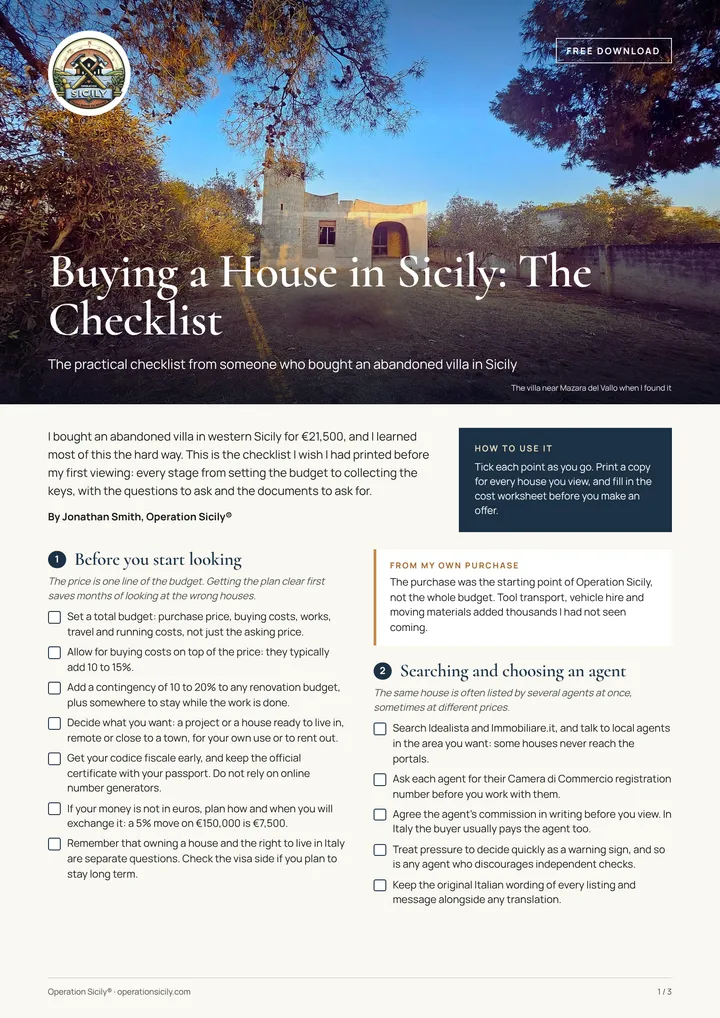
Free download
Buying a house in Sicily? Take my checklist.
Every step from budget to keys, the questions to ask at a viewing and the documents to ask for, as a PDF you can print.
Here is your checklist. Download the checklist (PDF)
How to sell a house in Italy from abroad: power of attorney (procura)
You do not have to be in Sicily to sell. You can give someone a power of attorney (procura) to sign for you: a friend, a relative, a lawyer, or anyone you trust. It should be a special power (procura speciale) for this sale, naming the house, and ideally the minimum price and the main terms, rather than a general power over everything you own.
Making a procura outside Italy
- Ask the Italian notary for the wording first. They will usually send a draft in Italian, or in both languages.
- Sign it before a notary in your own country. In the UK that means a notary public, not a solicitor witnessing a signature.
- Get an apostille. Under the Hague Convention, which both the UK and Italy belong to, the apostille confirms the foreign notary's signature. In the UK it comes from the Foreign, Commonwealth and Development Office.
- Translate it. If the procura is not already in Italian, it needs a certified translation.
- Send the original to Italy. It is deposited with the Italian notary, who checks it before the sale.
Italian consulates offer notarial services, but check before you book: the consulate in London, for example, provides these acts to Italian citizens. Most foreign owners use a local notary public at home.
Allow several weeks for the whole chain. The commonest delay is a procura that does not match what the Italian notary needs, so do step one properly. If you can travel, signing in person at the rogito avoids the procura altogether, and some sellers do both: give a procura for the compromesso, then fly out for the deed.
Selling a renovated house vs an unrenovated one
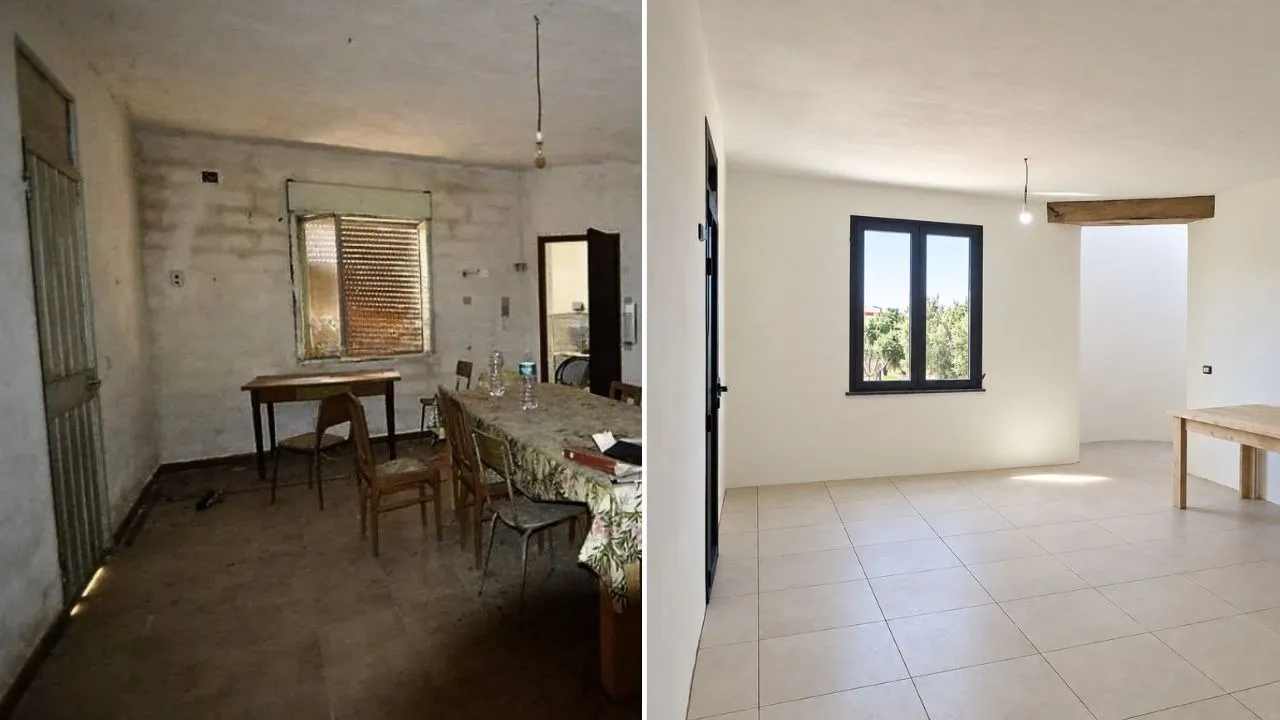
Should you renovate before you sell? Usually not, if the aim is profit, and the reason is the buyer pool.
Gate-away, a property portal aimed at foreign buyers, reported for the first half of 2026 that about 65% of foreign enquiries for Sicily were for houses that were renovated or ready to live in, and that about two thirds were for homes under €250,000. So a finished, legal house with tidy papers is easier to sell to that market. But that does not mean renovating to sell pays. Renovation in Sicily routinely costs more and takes longer than planned, and a buyer rarely pays you back the full cost of finishes they did not choose.
If the house is unrenovated
- Sell it as a project, with honest numbers. Buyers of ruins and village houses are mostly cash buyers, because banks rarely lend on them. They compare your price with the cost of the work. My renovation cost breakdown is the kind of maths they will do.
- Clear the papers, not the rubble. Updating the cadastral plan, collecting the permit file and getting the APE usually add more value per euro than cosmetic work.
- Utilities and access. Say clearly what the house has: mains water or a well, mains power or none, road access. These are the questions every buyer of a country house in Sicily asks.
If the house is renovated
- Keep the paperwork for the renovation. The permits, the final completion notices, the updated cadastral plan and any certificates for systems. A renovated house without that file is worth less than one with it.
- Off-grid systems. Solar panels, batteries, water tanks and wells are selling points for some buyers and worries for others. Have the installation documents ready, and decide before the compromesso whether they stay with the house.
- Holiday let history. If you have let the house, a record of bookings helps some buyers, but they will want to check the registration and rules themselves. My piece on holiday lets in Sicily covers what they will look at.
Who buys houses in Sicily?
Mostly Italians, many of them local. Only about a third of the homes bought by individuals in Sicily in 2025 were bought with a mortgage, against about 46% nationally, so cash buyers are common. Local buyers know the market, know the OMI values, and will not pay a foreigner's premium. They often want a flat in town rather than a farmhouse.
Foreign buyers are a smaller group, but they matter for the kind of house that Sicilians tend not to want: old stone houses, country properties, and homes with a view in tourist areas. Gate-away's figures for the first half of 2026 give a picture of where foreign interest goes and who it comes from:
| Foreign interest in Sicily, first half of 2026 | Share |
|---|---|
| Siracusa province | 29.13% of Sicilian enquiries |
| Palermo province | 19.50% |
| Trapani province | 17.78% |
| Messina province | 15.14% |
| Buyers from the USA | 28.21% |
| Buyers from the UK | 11.35% |
| Buyers from Germany | 7.45% |
What that means for a seller: a house in or near Siracusa or Noto is in the area foreign buyers look at most. A house in the west, around Trapani or Castellammare del Golfo, has a real but smaller foreign market. Inland, the buyers are mostly local, and the price has to work for them. An agent who sells to foreigners, with listings in English and good photographs, is worth more on the coast than in the interior.
Foreign buyers also tend to visit in spring and autumn. If you are selling a house aimed at them, have it listed, photographed and ready by then. Many will be following a buying checklist like mine, so expect them to ask early for the documents listed above.
Frequently asked questions
How long does it take to sell a house in Sicily?
Italian estate agents surveyed by the Banca d’Italia in mid 2026 reported about five months on average from listing to an agreed sale across Italy. Then allow another two to four months from the preliminary contract to the final deed. Town flats in Palermo or Catania can be quicker; rural and inland houses, or houses with paperwork problems, often take much longer.
How much do estate agents charge to sell a house in Italy?
Commission in Sicily is usually 3 to 4% of the sale price from the seller, with a similar fee charged to the buyer, and the figure varies by agent. It is negotiable, some agents have a minimum fee for cheap houses, and you should agree in writing whether the figure is gross or net and exactly when it is due, which is often when the offer is accepted rather than at the final deed.
Can a foreigner sell a house in Italy?
Yes. A foreign owner sells in the same way as an Italian: offer, preliminary contract with a deposit, then the final deed before a notary. You need an Italian codice fiscale, your passport, your purchase deed, the cadastral records and permits, an energy certificate, and a document showing your marital status and property regime. If you cannot travel, you can sign by power of attorney.
What documents do I need to sell my house in Italy?
The notary will want your deed of acquisition, the visura and planimetria catastale, the building permits and any condono papers, the certificate of habitability if one exists, a valid APE energy certificate, your ID and codice fiscale, proof of marital status, and, for a flat, a statement from the condominium administrator. Ask your notary for their own checklist early.
What happens if my house does not match the cadastral plan?
You cannot truthfully declare cadastral conformity in the deed, and the sale can stall or be void. The usual fix is for a geometra to survey the house and file an updated floor plan with the Agenzia delle Entrate. It normally costs a few hundred euros and takes a few weeks. Do it before you list, not after a buyer finds the problem.
Can I sell a house in Italy with a condono still pending?
Often yes. If the amnesty application was made but never decided, the deed can usually go ahead provided it states the application details and the amnesty payment, the oblazione, has been paid in full. Your notary will want the receipts and the application number. Some cases are more complicated, so have a geometra check the file with the comune first.
What happens to the deposit if the buyer pulls out?
If the deposit was paid as a caparra confirmatoria and the buyer withdraws without a valid reason, you can end the contract and keep it. If you are the one who withdraws, the buyer can claim double the deposit from you. That is why you should only sign a compromesso when you are sure, and with dates you can meet.
Can I sell my Italian house without going to Italy?
Yes. Give someone a special power of attorney, a procura speciale, to sign for you. Ask the Italian notary for the wording, sign it before a notary public at home, get an apostille, have it translated into Italian if needed, and send the original to the notary in Italy. Allow several weeks for this.
Should I renovate my house in Sicily before selling it?
Usually not for profit. Most foreign buyers prefer a house that is ready to live in, but renovation in Sicily often costs more than planned, and buyers rarely pay back the full cost of finishes they did not choose. Spending money on clean paperwork, an updated cadastral plan and an energy certificate is usually better value than cosmetic work.
Do I need an energy certificate to sell a house in Sicily?
Yes. You need an APE, the energy performance certificate, before you advertise, because the energy class must appear in the listing, and it is attached to or mentioned in the deed. It is valid for ten years if the house is not altered. A qualified technician issues it after inspecting the house.
Sources and small print
- Banca d'Italia: Sondaggio congiunturale sul mercato delle abitazioni, Q2 2026 (time to sell, discount on asking price by area) and the Q4 2025 survey tables
- Agenzia delle Entrate: OMI quotazioni immobiliari and declared sale prices service
- Agenzia delle Entrate: Rapporto Immobiliare 2026, residential (sales and average price in Sicily, mortgage share)
- Consiglio Nazionale del Notariato: real estate checklist (seller's documents)
- NotaioFacile: documents and conformity and the APE at the deed
- Notariato: selling with a pending condono
- Regione Siciliana: Salva Casa adopted in Sicily
- Civil Code art. 1755: agent's commission and Chamber of Commerce: requirements and registration for estate agents
- NotaioFacile: houses built before 1967
- Civil Code art. 1385: caparra confirmatoria and Notariato: registering the preliminary contract
- Notaio Busani: deposits and advance payments and idealista: length and renewal of agency mandates
- A notary on powers of attorney made abroad and Italian Consulate General in London: special powers of attorney
- Gate-away.com: foreign buyers in Italy, first half of 2026
Time to sell and discount figures are averages from a survey of estate agents, not a forecast for any one house. This page is general information; your notary and geometra will advise on your property.
Credits
Photo: Aislinn O'Kelly, Unsplash Licence, via Unsplash.
Photo: Stefano Huang, Unsplash Licence, via Unsplash.
Photo: Operation Sicily®, all rights reserved, via operationsicily.com.
 The weekly YouTube series