Can a US citizen buy property in Italy?
Americans can buy houses, apartments and land in Italy, and you do not need to be resident or hold a visa to buy. For buyers from outside the EU, Italian law looks at reciprocity, whether Italians can buy in your country, and the notary confirms the position for your nationality and your purchase before the deed. Reciprocity is not checked if you hold an EU passport, or live in Italy with a residence permit for work, self-employment, running a business, family, study or humanitarian reasons (the elective residence permit is not on that list).
Buying a house does not, on its own, let you live in Italy or stay beyond 90 days in any 180. If you plan to move, read Moving to Sicily from the US alongside this guide.
How buying a house in Italy differs from the US
The biggest difference is the notary (notaio), a public official who runs the legal side of every sale and is neutral between buyer and seller. Here is how the words you know map onto the Italian system:
| At home | In Italy | What it means |
|---|---|---|
| Realtor (buyer and seller agents) | Agente immobiliare | Usually one agent for the sale, and both buyer and seller pay them, typically 3% to 4% of the price each. |
| Offer | Proposta d'acquisto | A written offer, often with a small cheque, that becomes binding once the seller signs it. |
| Earnest money | Caparra confirmatoria | The deposit at the preliminary contract. Walk away and you lose it; if the seller walks away they pay you double. |
| Purchase agreement | Compromesso (contratto preliminare) | The binding preliminary contract, registered with the tax office. |
| Home inspection | Checks by a geometra | A surveyor checks the house matches the plans, permits and land registry. There is no standard inspection report. |
| Title search and title insurance | The notary’s checks | The notary checks ownership and debts on the property. Title insurance is rarely used. |
| Escrow | Deposito prezzo (on request) | There is no escrow company, but you can ask the notary to hold the money in their dedicated account until the sale is registered. |
| Closing | Rogito (atto di compravendita) | The deed, signed in front of the notary. You get the keys the same day. |
| Property taxes | IMU and TARI | IMU is the yearly property tax on second homes; TARI is the rubbish collection charge. |
| HOA fees | Spese condominiali | Shared costs in an apartment building, set by the condominio. |
Our Italian property glossary explains every other term you will meet, from visura catastale to agibilità.
The steps to buy a house in Italy
- Get your codice fiscale, the Italian tax code. You need it to make an offer, and the Italian consulate covering where you live can issue it.
- Find the house. Listings are on Italian property portals and with local agents; many rural houses are sold privately, by word of mouth.
- Before you offer, have a geometra check that the house matches its plans, permits and land registry entry, and ask for the visura catastale.
- Make a written offer (proposta d'acquisto). Once the seller signs it, it is binding.
- Sign the preliminary contract (compromesso) and pay the deposit, usually 10% to 20% of the price. It is registered with the tax office.
- Sign the deed (rogito) in front of the notary, pay the balance and the taxes, and take the keys. The notary registers the sale.
From offer to keys usually takes two to three months, longer if papers need putting right. Our buying timeline planner works out the dates for you, and the guide to what Italian notaries do explains the deed day.
Closing costs in Italy: what you pay on top of the price
For an older house bought from a private seller as a second home, buying costs usually add 10% to 20% to the price. When a private person buys a home from a private seller, the main tax is worked out on the cadastral value (the prezzo-valore rule, which you ask for in the deed and the notary arranges), an official value from the land registry that for older houses is often well below the price. A new or rebuilt home bought from a builder pays IVA on the price instead, so ask the notary which applies.
| Cost | Usual amount |
|---|---|
| Registration tax (imposta di registro) | 9% of the cadastral value for a second home, or 2% for your main home (at least €1,000 either way) |
| Cadastral and mortgage taxes | €50 each |
| Notary | €1,500 to €3,500 |
| Estate agent | 3% to 4% of the price, plus 22% IVA on the fee |
| Geometra checks | €500 to €2,000 |
| Translation or interpreter at the deed | If you do not understand legal Italian; ask the notary |
A worked example in USD
On a €50,000 (about US$55,300) house with a cadastral value of €25,000, bought through an agent as a second home: registration tax €2,250, cadastral and mortgage taxes €100, notary €1,500 to €3,500, agent €1,830 to €2,440 including IVA, and geometra €500 to €2,000. That is €6,180 to €10,290 (about US$6,830 to US$11,400) on top of the price.
The 2% main home rate (prima casa) needs you to become resident in the town within 18 months of buying, which suits people moving here on a visa, and also that you own no other home in that town and have not already used the relief on another home in Italy (unless you sell that one within two years). The house must not be in the luxury categories (A/1, A/8 or A/9); the notary checks all of this. Each year after that, a second home pays IMU, the local property tax, usually 0.86% to 1.06% a year (each comune sets its own rate) of the IMU value, which is the rendita catastale × 1.05 × 160, plus TARI for rubbish collection; for a modest rural house that is often a few hundred euros.
Paying for it: cash, mortgages and moving money
Italian mortgages for non-residents exist but are hard to get, with large deposits and a lot of paperwork, so most Americans buying the cheaper houses in Sicily pay cash. Every payment has to be traceable, by bank transfer or banker's draft, and the deed records how the price was paid.
Moving a large sum from the US through a specialist transfer service rather than your bank usually saves a noticeable amount on the exchange rate. Some services let you fix the rate in advance, so a move in the exchange rate between the preliminary contract and the deed does not change your budget.
Buying from abroad: power of attorney
You do not have to be in Italy to sign. You can give a trusted person a power of attorney (procura) to sign the deed for you. It can be made in front of an Italian consulate, or a notary in the US with an apostille and an Italian translation. Ask the Italian notary for the exact wording they need before you have it made.
If you do attend, and you do not understand legal Italian, the notary will need an interpreter at the signing, and the deed can be bilingual.
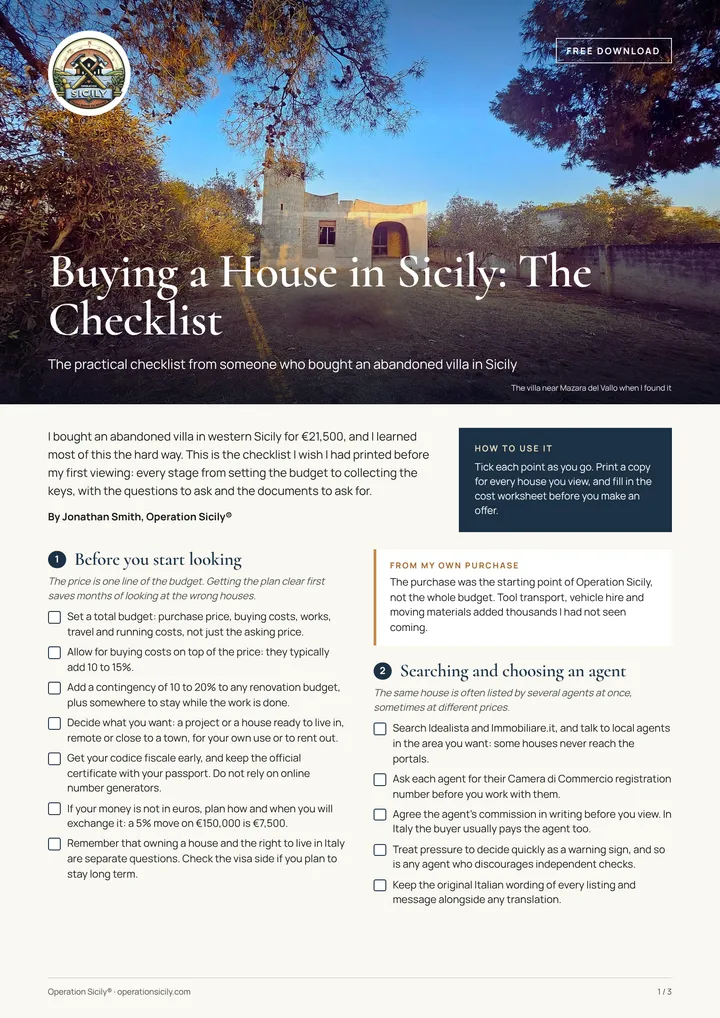
Free download
Buying a house in Sicily? Take my checklist.
Every step from budget to keys, the questions to ask at a viewing and the documents to ask for, as a PDF you can print.
Here is your checklist. Download the checklist (PDF)
The checks that matter before you sign
Most problems with old Sicilian houses are paperwork, not price. Before the preliminary contract, make sure someone working for you checks:
- that the building and its extensions match the approved plans and the land registry (conformità urbanistica e catastale), or that any differences can be put right;
- whether there is an outstanding building amnesty (condono) or a ruin with no registered value;
- access rights over neighbours' land, and whether neighbouring farmers have a right of first refusal on agricultural land (prelazione);
- what the house really has for water, power and drainage;
- debts, mortgages or claims registered against the property.
Our guide to the biggest red flags when buying in Sicily goes through each one.
Cheap houses and €1 homes: what they really cost
Sicily's average asking price is about €1,192 per square metre, and rural houses needing work can be found for €15,000 to €50,000 (about US$16,600 to US$55,300). I bought my abandoned villa near Mazara del Vallo for €21,500. The price is the easy part: a light renovation typically costs €25,000 to €45,000, and a full structural renovation €60,000 to €120,000 or more.
The €1 homes come with obligations: a renovation plan, a deadline, and a refundable deposit, often €2,000 to €5,000. Our guide to the truth about Sicily's €1 homes and the free €1 homes map show what each town asks.
To compare prices town by town, Sicily town by town gives the official average price per square metre for every one of the island's 391 towns, and our list of the cheapest towns in Sicily starts with the lowest.
Frequently asked questions
Can Americans buy property in Italy?
Yes. US citizens can buy houses and apartments in Italy, and you do not need to live here or hold a visa to buy. The notary confirms the legal position for each buyer before the deed.
What closing costs do Americans pay when buying in Italy?
For a typical older house bought from a private seller as a second home, expect roughly 10% to 20% on top of the price: registration tax of 9% of the cadastral value (2% if it becomes your main home), €50 each in cadastral and mortgage taxes, the notary at about €1,500 to €3,500, the agent at 3% to 4% plus IVA, and a geometra for the checks.
Does an American buyer need a lawyer in Italy?
It is not compulsory, because the notary handles the deed, checks and registration. Many foreign buyers still use an independent lawyer or geometra working only for them, especially for older rural houses, since the notary is neutral rather than on your side.
Can I get a mortgage in Italy as an American?
It is possible but hard for non-residents, with big deposits and lots of paperwork. Most Americans buying cheaper houses in Sicily pay cash, or borrow at home against property they already own.
Does buying a house in Italy give an American residency?
No. Owning a home does not give you a visa or extra days. You still need a visa to live here, though owning a home meets the housing requirement for most visas.
Do I have to be in Italy to sign?
No. You can give someone power of attorney (a procura) to sign for you, made in front of an Italian consulate or a local notary with an apostille.
Sources and small print
Tax rates and fixed taxes come from the Agenzia delle Entrate, the Italian tax office, and the rules on foreign buyers from the Italian Ministry of Foreign Affairs. Costs and prices are the figures in our own buying and renovation guides.
This guide is general information, not legal or financial advice. Every purchase is different, so confirm the costs and your position with the notary and your own advisers before you sign anything. Converted amounts use a recent European Central Bank reference rate and are approximate.
 The weekly YouTube series