
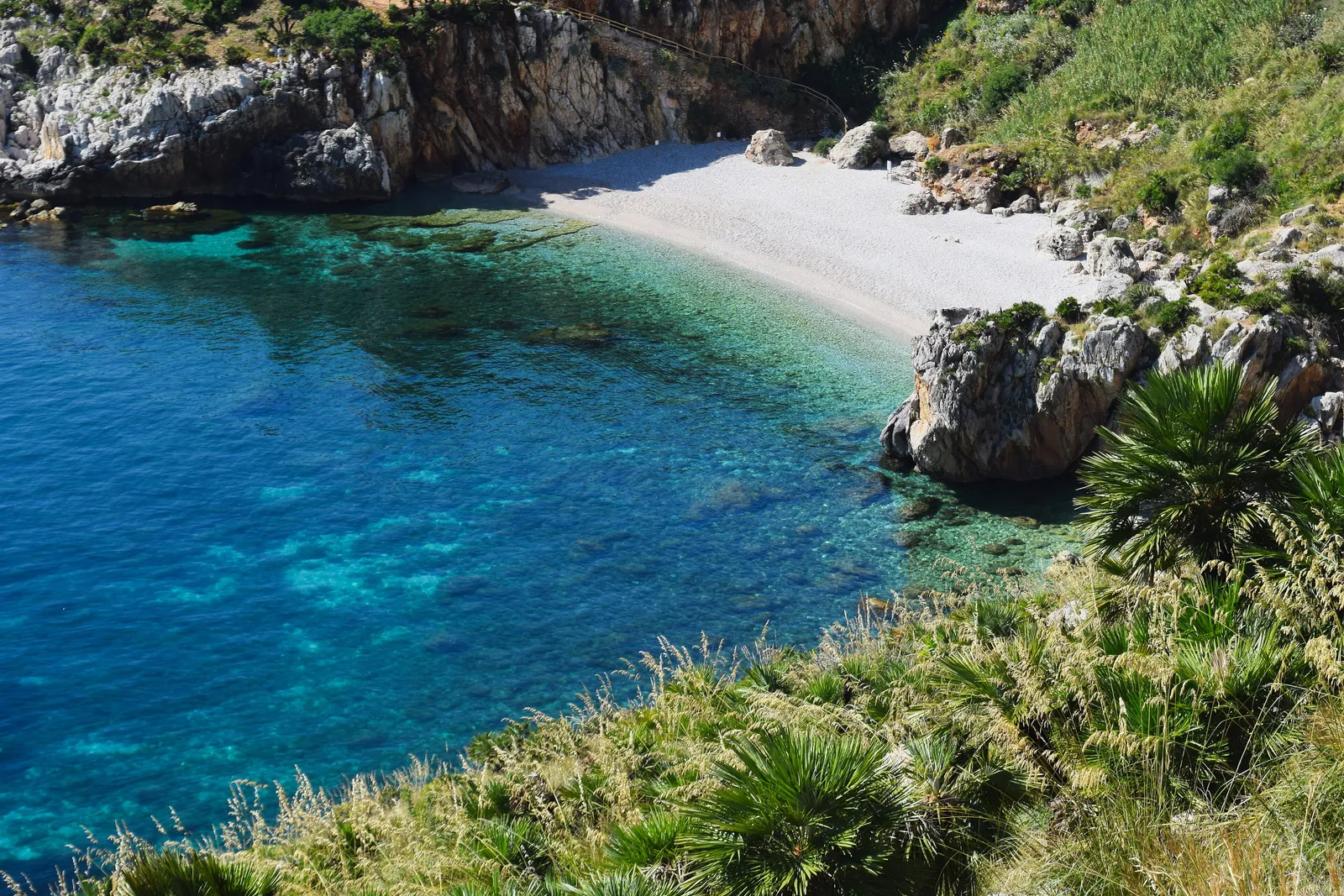
What is the Zingaro Nature Reserve?
Western Sicily is home, and the Zingaro is where I send visitors who want to see what this coast looked like before the roads. It covers about 1,650 hectares (some 4,080 acres) of mountain and coast on the Gulf of Castellammare, rising to Monte Speziale at 913 m (2,995 ft), with about 7 km of shoreline and no road along it.
That is no accident. A coastal road was begun here in 1976, and on 18 May 1980 about 3,000 people marched along the route in protest. The regional parliament created the reserve the following year, by regional law 98 of 6 May 1981, and it became the first nature reserve in Sicily. It lies within the comuni of Castellammare del Golfo and San Vito Lo Capo and is run by the Regione Siciliana's rural development department. No road was ever built along this stretch.
Inside are the prehistoric Grotta dell'Uzzo, a cave lived in since the Palaeolithic, the ruins of the Uzzo watchtower and a handful of small museums. Most people come for the coves.
Zingaro entrances: Scopello or San Vito Lo Capo?
There are two entrances, one at each end, and no road between them along the coast. By road they are about 55 km (34 miles) and roughly 80 minutes apart, so pick one and walk in and out from it.
- The south entrance, near Scopello. From the A29 motorway take the Castellammare del Golfo exit, then the SS187 towards Trapani and the signs for Scopello, through Guidaloca and past the Tonnara di Scopello to the car park at the gate. From central Palermo it is about 78 km (48 miles), roughly 80 minutes. The first cove, Cala Capreria, is about 1.4 km (0.9 miles) in.
- The north entrance, near San Vito Lo Capo. Follow the signs from San Vito towards Calampiso and the reserve; the gate is about 12 km from San Vito, and about 49 km (30 miles), roughly 75 minutes, from Trapani. The first cove, Tonnarella dell'Uzzo, is only about 700 m (0.4 miles) from the gate.
If you are staying in Castellammare del Golfo or Scopello, or coming from Palermo, use the south gate. If you are staying in San Vito Lo Capo or Trapani, use the north gate, which also has the shortest walk to a cove.
Zingaro tickets and opening hours
- About €5 ($5.50) for adults and €3 reduced (for students, among others). Children under 8 go free, as do disabled visitors and their companions.
- No cash. The reserve takes electronic payment only, so bring a card or a phone that pays.
- Keep your ticket with you; you may be asked for it inside.
- Opening hours change with the season. The reserve has given 8am to 4pm on its home page and 7am to 7pm on its map, so check its site before you set off, and make sure you are out before the gates close.
Guided walks can be booked through the reserve. Bivouacking is normally allowed only by permit from mid-October to mid-May, and the reserve says it is currently suspended.
Zingaro hiking trails
The reserve marks three trails between the two entrances:
| Trail | Length | Difficulty | What it is |
|---|---|---|---|
| Coastal trail | About 7 km (4.3 miles) | Easy | Along the coast past the coves and museums; about two hours end to end |
| Mid-coast trail | About 7.5 km (4.7 miles) | Medium | A middle line, higher up the slopes than the coast |
| High trail | About 13 km (8 miles) | Difficult | The long route through the hills, the reserve’s hardest |
"Easy" is relative. The coastal trail is well marked but stony, with short climbs, steep steps down to each cove and very little shade, and every cove you walk down to is a climb back up. Most visitors walk in to one or two coves, swim and walk back out, which is a full and very good day. Walking the whole coastal trail and back is about 14 km (9 miles), and the high trail is a serious hike. For other walks around the island, see my guide to hiking in Sicily.
The beaches of the Zingaro, from south to north
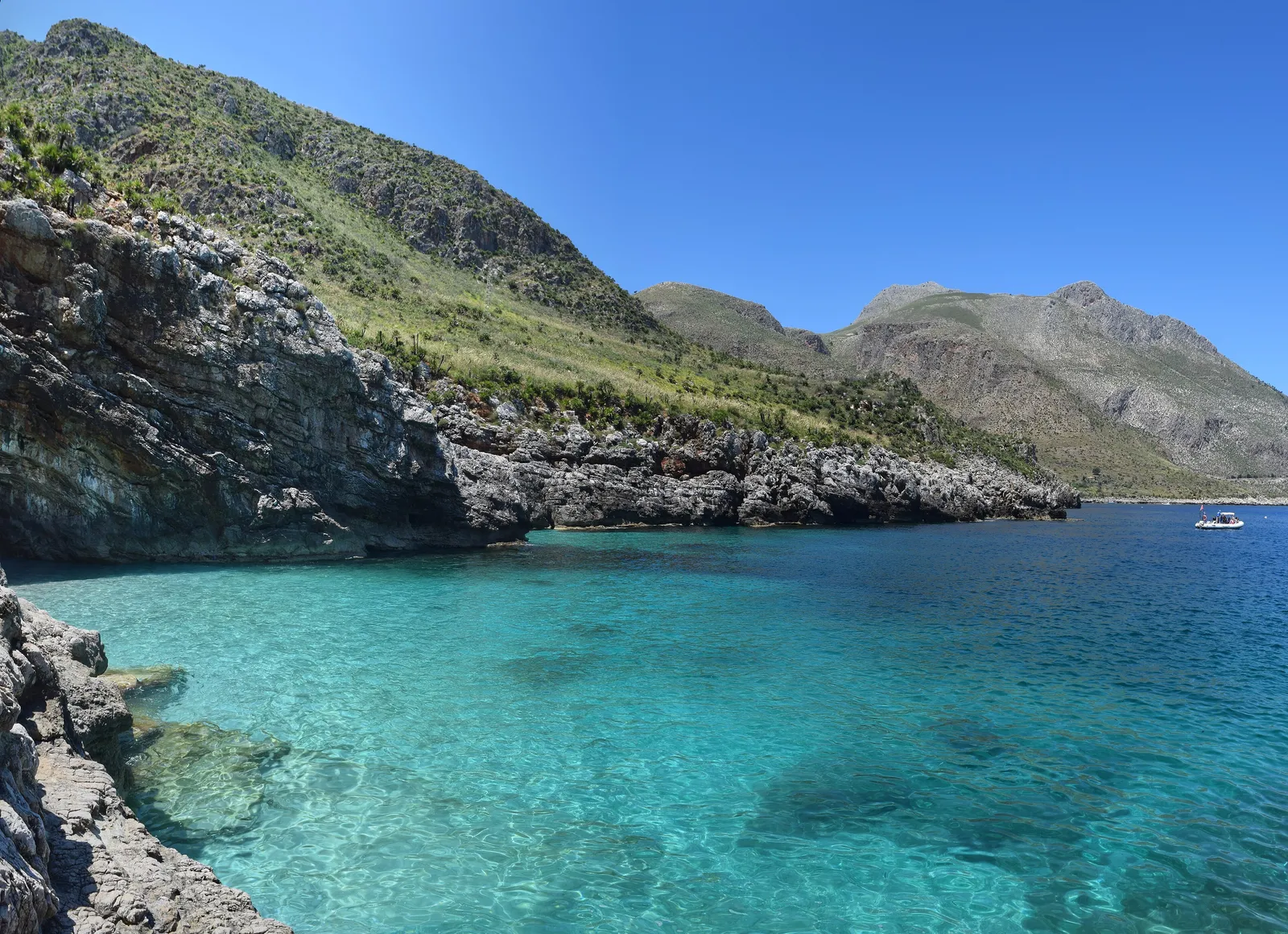
Every beach in the reserve is pebbles or rock, not sand, with water so clear you can see the bottom several metres down. Umbrellas, sunbeds and inflatables are not allowed, so bring a towel and a mat. Each cove has its own page with the detail:
- Cala Capreria, two small pebble beaches about 1.4 km from the south gate.
- Cala del Varo, reachable only from the sea.
- Cala Disa.
- Cala Berretta, in the middle, 3.5 to 4 km from either gate, about an hour each way.
- Cala Marinella, about 3.5 km from the north gate, the hardest to reach, mostly rock.
- Cala dell'Uzzo, under the ruined Uzzo tower, about 2 km and half an hour from the north gate.
- Tonnarella dell'Uzzo, the largest cove, about 700 m from the north gate and the busiest.
Just outside the south gate, Cala Mazzo di Sciacca has a car park above it, no ticket and summer sunbeds, and Guidaloca, on the road in, is a sandy bay. At the other end, San Vito Lo Capo beach is the long white sand the town is famous for.
Zingaro rules and what to bring
The reserve is strict, and the rules are enforced:
- No dogs, not even on a leash.
- No fires, no camping, no vehicles and no leaving the marked trails.
- Do not pick plants or take anything away, stones and shells included.
- Motorboats may not land, and fishing gear is banned, even though it is not a marine reserve.
- Wear trekking shoes or sturdy trainers. Flip-flops are not suitable, and the reserve says so.
Bring more water than you think: the water points marked on the reserve's map are not drinkable. Bring food, sun cream, a hat and a mask for snorkelling. There are toilets marked on the map, but no shops or cafés inside the reserve. In July and August, start at opening time and be off the trail before the worst of the afternoon heat; spring and autumn are far kinder for walking.
Museums inside the reserve
The small museums along the coastal trail are a reason to stop in the shade:
- The Museo Naturalistico, the natural history museum, near the south gate.
- The Museo delle Attività Marinare, above Tonnarella dell'Uzzo, on tuna fishing and the sea trades of this coast.
- The Museo della Civiltà Contadina, on farm life and the grain cycle, near Cala dell'Uzzo.
- The museums of weaving (Intreccio) and of manna, the ash tree sap once harvested in these hills, both marked on the reserve's map.
Getting to the Zingaro without a car
It can be done, but plan it. Castellammare del Golfo has a train station with services to Trapani and Palermo, and Russo coaches run from Palermo and its airport to Castellammare, Scopello and San Vito Lo Capo; the timetables are on Autoservizi Russo's site, and my Palermo airport guide has the details. From Scopello or San Vito you still need a taxi or a long walk to the gate, so check the last coach back before you set off.
With a car it is far simpler, and the rest of this corner of the island is built for driving; see my guide to renting a car in Sicily. For the wider area, my things to do in Trapani guide covers the rest of the province.
Frequently asked questions
How much does it cost to enter the Zingaro Nature Reserve?
About €5 for adults and €3 reduced, with children under 8 free. The reserve takes electronic payment only, not cash.
Which entrance to the Zingaro is better?
The south entrance near Scopello is closer to Palermo and Castellammare del Golfo. The north entrance near San Vito Lo Capo is closer to Trapani and San Vito, and its first cove, Tonnarella dell’Uzzo, is only about 700 m from the gate.
How long is the hike through the Zingaro?
The coastal trail is about 7 km one way and takes around two hours end to end. Since the two entrances are about 80 minutes apart by road, most people walk in to a cove or two and back out the same way.
Can you swim in the Zingaro Nature Reserve?
Yes. Swimming from the coves is the main reason most people go. The beaches are pebbles and rock, so water shoes help, and umbrellas and sunbeds are not allowed.
What is the best beach in the Zingaro?
For the shortest walk, Tonnarella dell’Uzzo, about 700 m from the north gate. For fewer people, Cala Berretta in the middle or Cala Marinella, the hardest to reach. From the south gate, Cala Capreria is the first cove, about 1.4 km in.
Can you bring dogs to the Zingaro?
No. Dogs are not allowed in the reserve, even on a leash.
What should I bring to the Zingaro?
Plenty of drinking water, since the water points inside are not drinkable, food, sun protection, proper walking shoes, a towel and a card to pay for the ticket. There are no shops or cafés in the reserve.
Can you get to the Zingaro without a car?
Yes, with planning. Trains run to Castellammare del Golfo, and Russo coaches run from Palermo to Castellammare, Scopello and San Vito Lo Capo. From there you need a taxi or a long walk to the gate.
Sources and small print
- Riserva Naturale Orientata dello Zingaro, the reserve's official site and map: entrances, tickets, trails, rules, museums and history
- Parks.it database of Italian protected areas, the reserve's founding law, comuni and managing body
- ISPRA, the text of Sicilian regional law 98 of 6 May 1981 on parks and reserves
- Autoservizi Russo, coaches from Palermo and its airport to Castellammare del Golfo, Scopello and San Vito Lo Capo
Driving times are measured on the road network and rounded. Hours and prices change, so check the reserve's site before you go.
Credits
Photo: The Cosmonaut, CC BY-SA 4.0, via Wikimedia Commons.
Photo: The Cosmonaut, CC BY-SA 4.0, via Wikimedia Commons.
 The weekly YouTube series