
In this episode
- A scraper suggested by the plasterers to flatten the stone without losing its character
- Shells embedded in the stone of the feature wall
- Cracks stitched with flat steel bar primed against rust
- Olive trees pruned for the first time in over 20 years
- Hydrated lime wash to protect the fruit trees from pests, disease and sun
Cleaning back the stone wall
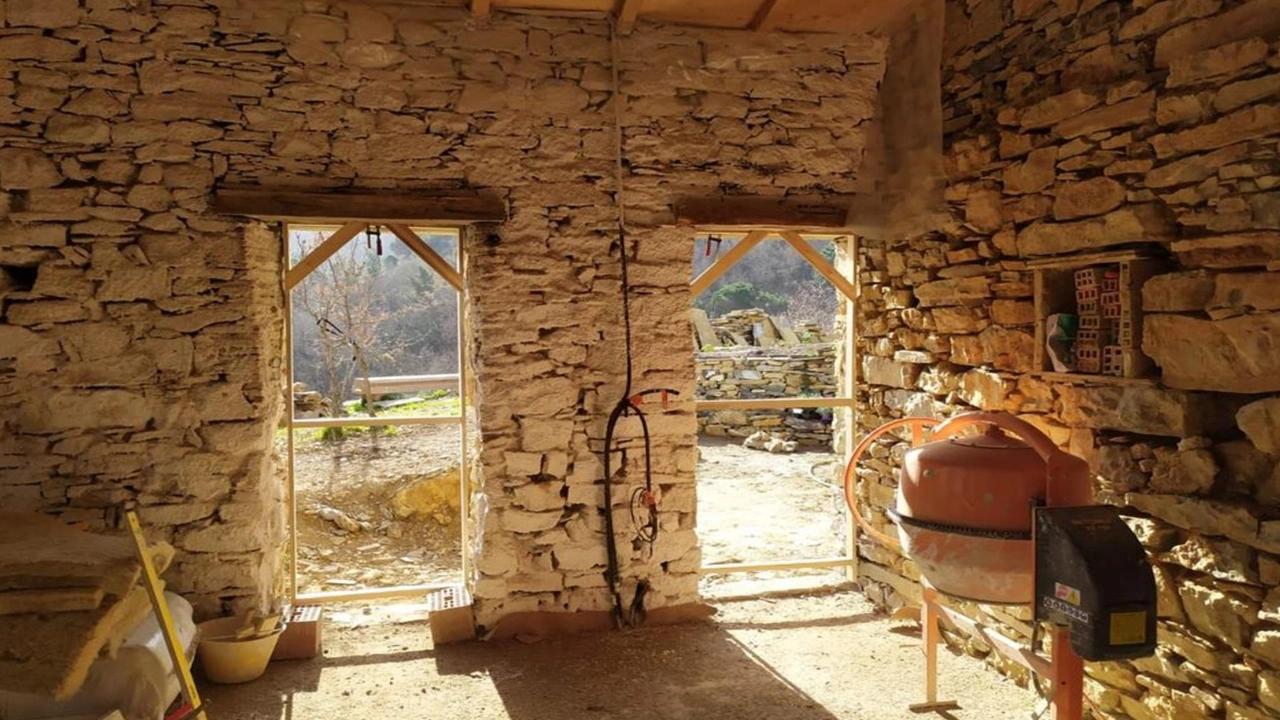
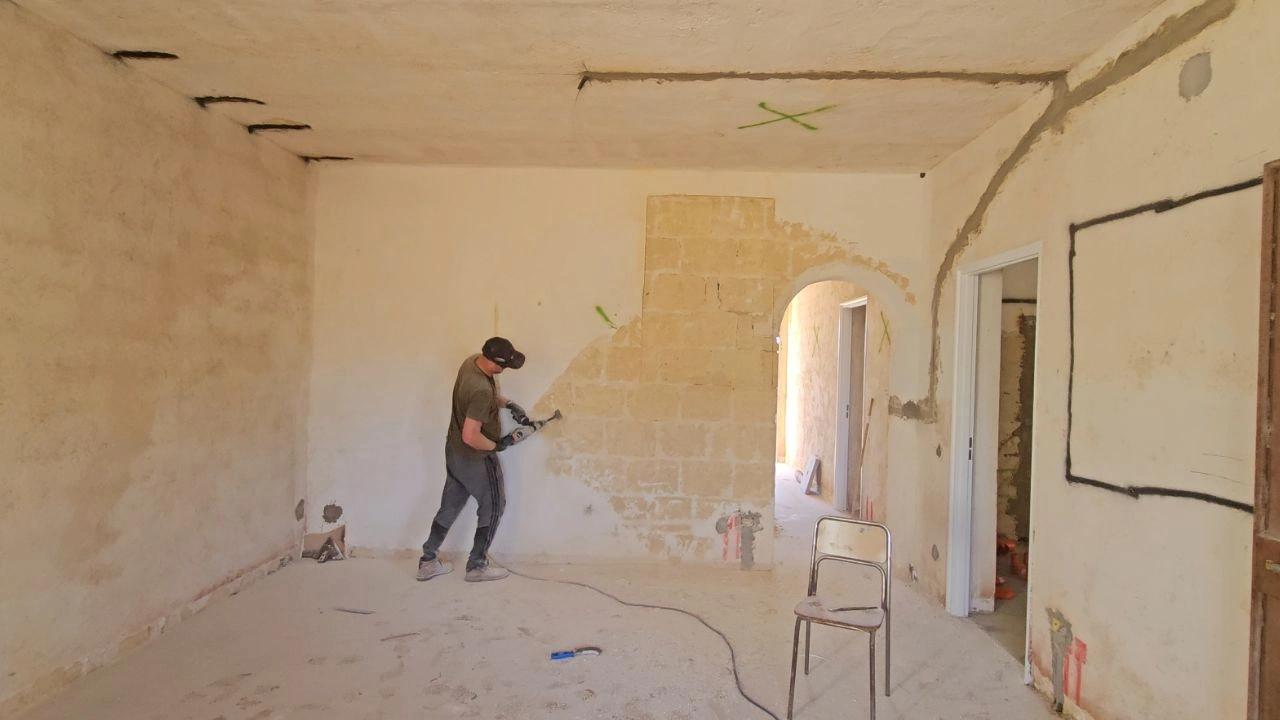
This week I start repointing the exposed stone wall in the lounge and lime wash the fruit trees. The plaster is on everywhere else, as you saw in episode 70, so now the stone wall I uncovered in episode 52 gets its turn. I use a variety of tools to remove the remaining bits of plaster, damaged mortar and old cement based joints and clean up the blockwork: the SDS with a chisel bit, hand chisels, a wire scraper and a multi-blade hand scraper.
The plasterers suggested the crazy looking scraper, to go over the wall and take off any high spots. The wall has loads of character, and I want to keep it that way. It even has shells embedded in the stone. The scraper does a great job of flattening the surface while still keeping all that character. I chip back the excess plaster along the edge of the plastered wall by the arch, then sweep down the wall and the floor and take the debris out to the garden.
Mixing mortar and filling the chases
I mix up a batch of mortar with the paddle mixer. The chases and back boxes I cut along the base of the wall in episode 70 are vacuumed out and misted with the pump sprayer, then filled with mortar and smoothed flush with trowels. My article on traditional lime mortar and Sicilian stonework covers mixes for walls like this.
Stitching the cracks with steel
Over the years, natural movement has caused cracks in the wall, so I am reinforcing the joints near the archway with flat steel bar to strengthen it and prevent any future cracking:
- Check the grooves cut across the cracked joints.
- Cut the flat steel bar to length with the angle grinder.
- Spray the bar with primer to stop the steel rusting.
- Vacuum the debris out of the joints and mist them with water.
- Pack structural repair mortar into the slot.
- Tap the steel bar into the mortar and point over it with a pointing trowel.
The primer matters. Rusting steel is what cracked the old lintels in episode 59. The rest of the wall is repointed in lime mortar in episode 74.
Repotting mango and avocado trees
On the veranda, I repot new mango and avocado trees. I drill drainage holes in large tubs, blend compost into the soil with a shovel and move each tree into its new tub with fresh soil around it. In the garden, I dig holes with a post hole digger and plant a young fruit tree, firming the soil down with my feet and raking it round the base. Then the veranda floor is washed down and swept clear of soil and water.
Pruning the olive trees
I trimmed these olive trees last night by head torch. It is long overdue, as they have not been pruned in over 20 years. They are big trees but have not been producing many olives. From what I have learned, olives grow on new growth, so I am cutting them back to encourage it.
- Open up the centre so light can reach the whole canopy. A bird should be able to fly through the middle.
- Keep it fairly light this year, because going too hard could mean no olives for two to three years.
- Go harder next year to shape them properly.
It might not look like much, but I have taken a fair bit off. Hopefully it is enough to get a harvest this year. The cut branches are hauled to the brush pile by the side wall. My guide to harvesting olive oil in Sicily follows those olives to the bottle, and what makes Sicilian olive oil different explains the varieties.
Lime washing the fruit trees
I open a 25kg bag of hydrated lime, calce idrata, add it to water in a bucket and mix it with a paddle on the drill. Then I scrape the dead bark, lichen and moss off the trunks of the fruit trees and the fig with a wire brush, and paint the trunks and main branches with the lime wash, carrying on by head torch into the night.
I am lime washing the trees to create a protective barrier against pests, disease and sun damage while they recover from the intense Sicilian summer, after the heatwave in episode 45. Later, every young tree gets a final coat. The garden is strimmed late at night too.
A shelter for Fang
What I do next is a little bit ridiculous, but there is good reason for it. Thanks to Lisa, Fang has a really nice indoor bed, as you saw in episode 70, but he does not have an outdoor one, and every time I leave at night, he has to go outside. Ever since I bought the house, there has been an abandoned car down the road with a window left open, and a lot of the stray cats sleep in there at night, especially when it rains or there are thunderstorms. This past week, that car was removed.
In the mornings, I have been finding Fang asleep in a bucket of soil on the veranda. The floor does get a bit wet, but the sides stay dry, so it has given him some shelter. I just felt bad for him. So, for the sake of a few quid, I cut timber with a handsaw, build a bracket shelf, level it and screw it to the veranda wall, then mount a modified pet carrier on it with a soft pillow inside. Fang settles straight in. You first met him in episode 57.
Frequently asked questions
How do you repair cracks in a stone wall?
I reinforced the cracked joints with flat steel bar, primed against rust, set into structural repair mortar and pointed over, to strengthen the wall.
How hard should you prune old olive trees?
Mine had not been pruned in over 20 years. I kept the first prune fairly light, as going too hard could mean no olives for two to three years.
Why lime wash fruit tree trunks?
I lime washed my fruit trees with hydrated lime to create a protective barrier against pests, disease and sun damage while they recovered.
Why open up the centre of an olive tree?
Opening the centre lets light reach the whole canopy. The rule I learned is that a bird should be able to fly through the middle.
More episodes on the same job: Stone walls and lime · The garden and fruit trees

 The weekly YouTube series