
In this episode
- The old bath connected to the rainwater runoff as an overflow tank
- Corner posts marked with every block course, mortar bed and the fall
- A 10mm per metre fall, 60mm in total, so rainwater runs off the terrace
- The pear tree moved out of a mop bucket into a proper pot
- The rubbish pile from inside the house finally taken to the recycling centre
No mortgage, no shortcuts
This week is about setting out a garden terrace with the right falls for rainwater, so water runs off it instead of pooling. I bought this villa to build my own future: no mortgage, no shortcuts, just raw renovation. It is a long term plan for freedom and sustainability. My friend Lewis is still here helping.
The old bath becomes a rainwater overflow tank
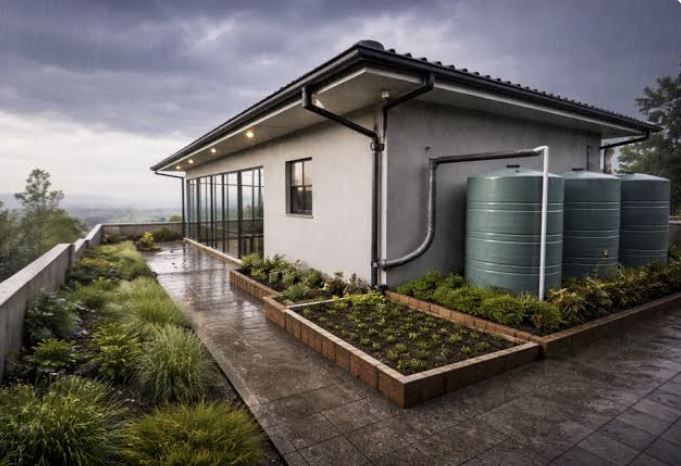
The metal bath I finally cut free in episode 30 has a new job. It is now an overflow tank, connected to the main rainwater runoff from the roof, so when the first tank is full the water carries on into the bath instead of being lost. The joints are sealed with two tubes of silicone and a jubilee clip, which Lewis and I agree is overkill, so we add a bit more overkill to be sure.
It is still a temporary setup, built on the system I started with a single tank in episode 25 and sealed in episode 27. Every extra litre stored now is a litre I do not have to carry from the public tap. My guide to rainwater harvesting in Sicily covers tanks, roofs and filters in more detail.
Corner posts and string lines for the terrace walls
In the back garden I make temporary wooden posts to mark out the corners of the rear terrace. These will really help when I start laying the stone blocks for the terrace walls. The plan is to build each layer of blocks up from these posts, using a string line to keep everything level and in line. Every time I complete a course, I just move the string line up to the next height.
Each post is marked with the block height and the mortar bed I will be working to, transferred across with the laser level I used for the footings in episode 26. It sounds straightforward, but there is a fair bit of prep involved to make sure everything is square and the heights are right on every post. Doing it now should, at least in theory, let me crack on with the blocks without constantly checking levels.
Why the terrace needs a fall
The terrace will not be dead level. It will have a fall of 10 millimetres for every metre, which works out at 60 millimetres, or 6 centimetres, across the whole terrace. The fall is there for rainwater runoff, because the last thing I want is water pooling on the terrace.
Building that fall into the posts from the start means every course of blocks already allows for it, rather than trying to fix it in the surface at the end. The terrace also has to rise to its finished height for the underground water tank I explained in episode 30. After Lewis strims back the weeds, we square the whole layout with the 3-4-5 method, which I explain properly in episode 32, and the walls themselves go up in episode 37.
The pear tree and priming the ceiling rebar
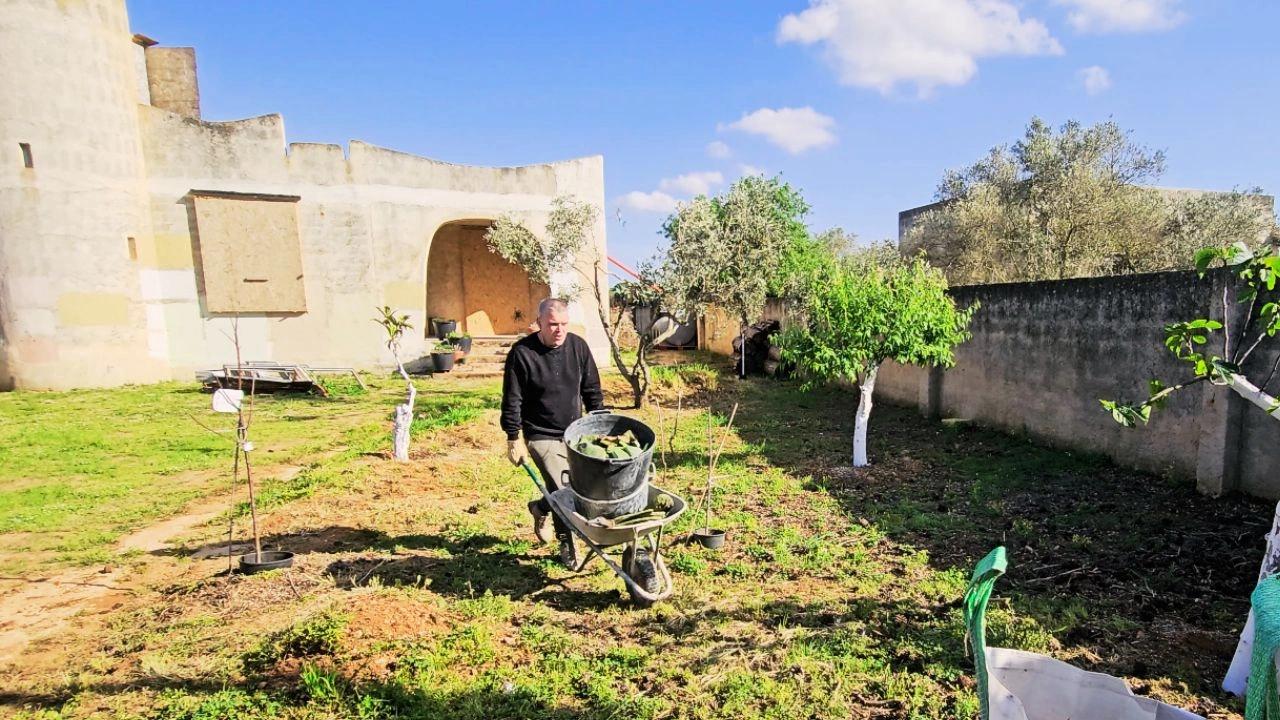
While the excavator was removing the large tree stump to the left of the gate, I had to quickly dig up this pear tree to stop it being damaged. I did not have a proper pot at the time, so it ended up in a mop bucket. I have been to the brico and picked up a more suitable, larger container, so today it is repotted properly. Hopefully it will be much happier. Later the fruit trees get a spray of copper fungicide.
Inside, last week Lewis exposed the rusted rebar in the ceilings and treated it with a rust converter. That has now had time to dry, so today he gives the bars a coat of paint that acts as a primer and helps protect the metal going forward, ready for plastering.
Finishing the front garden footings
I was not able to finish the front garden footings before, because a couple of large tree stumps were in the way. With the excavator having removed them, Lewis and I can get the rest done. First I cement wooden posts in place, then mark the correct height to match the footings already poured, before any concrete goes in.
After the trenches were first dug, we realised the garden is not completely level. One section was not deep enough, so when the excavator came back he took it down to the same depth as the rest. He also took out another stump I had been using as a fire pit. Now that I have a barbecue, and with the footings to finish, it was time for it to go.
Clearing the rubbish pile at last
I cannot tell you how relieved I was when Lewis offered to help clear the pile of rubbish. It had sat there ever since I dragged it out of the house in episode 3, a grim reminder of how bad things were inside. I kept putting it off because I knew what I would be dealing with: rat droppings, dust and filth. I found the local recycling centre, made an appointment and did a few trips to dispose of it properly.
The metal is not going to waste. It is going into the footings to bulk them out a little and add some structural support. I am also keeping the two metal bed frames, after someone suggested respraying them as trellises for grape vines, which I love. Then the cement mixer gets a clean as the sheep pass by, and I thank the very first channel members for their support. My article on what I wish I had known before buying has more on the clearing out.
Frequently asked questions
What fall should a garden terrace have for rainwater?
I set my rear terrace at 10 millimetres for every metre, which came to 60 millimetres across the whole terrace, so rainwater runs off rather than pooling.
How do you keep stone block courses level?
I put wooden posts at each corner, marked every block course and mortar bed on them, then ran a string line between the posts and moved it up one course at a time.
Can an old bath be used for rainwater storage?
Mine became an overflow tank connected to the roof runoff, sealed with silicone and a jubilee clip, so water carries on into it once the main tank is full.
How do you treat rusty rebar with a rust converter?
At the villa the rusty bars were treated with a rust converter, left to dry, then painted with a coat that acts as a primer to protect the metal.
More episodes on the same job: Water and plumbing · The garden terrace
 The weekly YouTube series