
In this episode
- An old 500 litre roof tank sealed, fitted with a tap and raised on blocks
- A 100 m² flat roof that gives about 2,500 litres from an inch of rain
- The tank 95% full after a single storm
- An olive, two apples, a caviar lime and two avocados potted in 40 litre tubs
- Handmade Sicilian ravioli from a local pasta shop
Off grid, with no mains water
This week I build a DIY rainwater collection system for the off grid villa from the old tank I moved in episode 24. I bought this abandoned villa in Sicily for €20,000, with no water, no electricity and a desert for a garden, and I have given myself 15 months and a €50,000 budget to bring it back to life. Without mains water, every drop counts.
The weather has taken a turn, so before starting I stop at a nursery for more fruit trees, then call into the Brico for a file to sharpen the mulcher blade and, finally, a barbecue. I have been putting it off, but if the rain keeps up I will need it for cups of tea, and it will be nice to do a bit of cooking too.
Potting six fruit trees in tubs
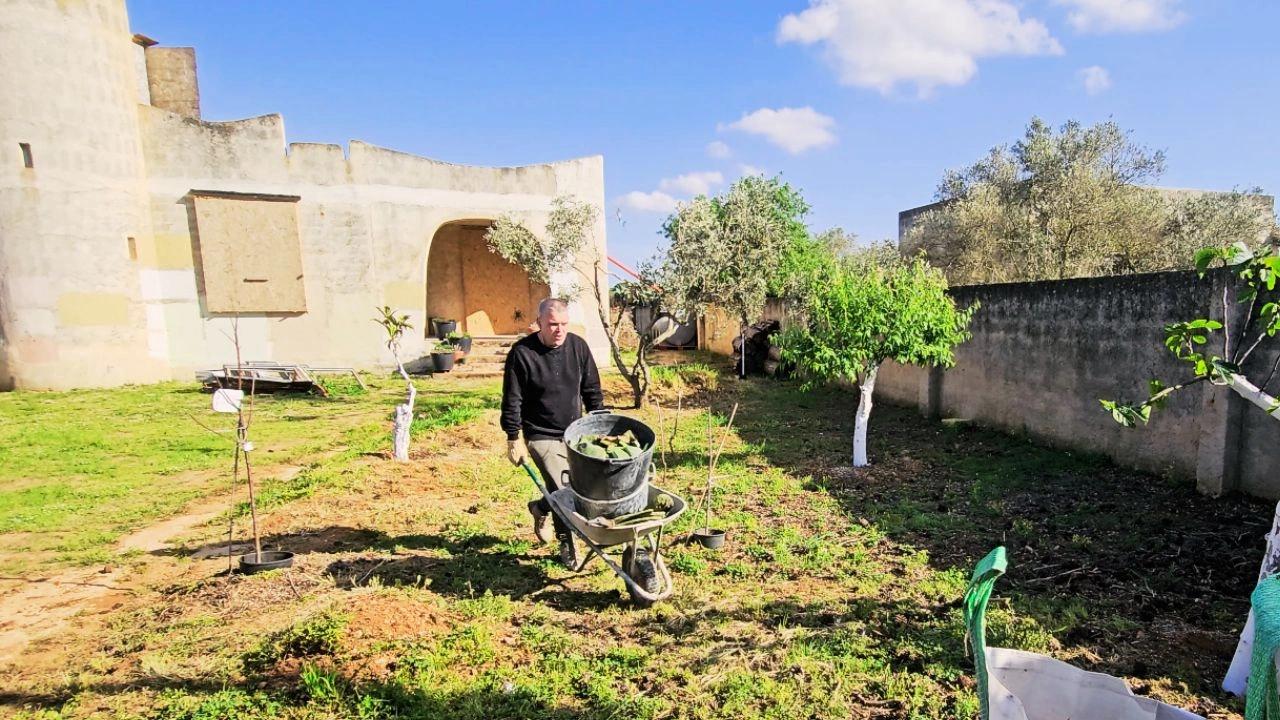
From the nursery I bring back an olive tree, two varieties of apple, a caviar lime and two avocado trees. I have not decided where they will be planted yet, so for now they go into 40 litre tubs where they can start growing.
On the covered veranda, with the barbecue lit for warmth, I tip soil onto the tiles and mix equal parts compost and garden soil. Drainage holes are drilled in the tubs and a layer of gravel goes in the bottom, then each tree is potted, firmed in and watered, and the muddy floor swept clean. Meanwhile my friend Lewis sits with the rented mulcher, trying to sharpen its blade with the new file. My article on growing your own food in Sicily follows how trees like these have done since.
Restoring the old water tank
As lightning flashes over the garden, we carry the old tank onto the porch. It holds 500 litres. Its redundant holes and old fittings are sealed with expanding foam, silicone and jubilee clips. Then I fit a core bit to the drill, cut a clean hole in the side and fit a brass threaded fitting with a red handled quarter turn tap, tightened with two pairs of pliers so it is watertight. Inside the house I also seal some old pipe holes in the ceiling with foam to keep the water out.
Against the side wall, under the roof downpipe, we build a raised base from concrete blocks and level it. Then the tank is lifted on.
Connecting the downpipe
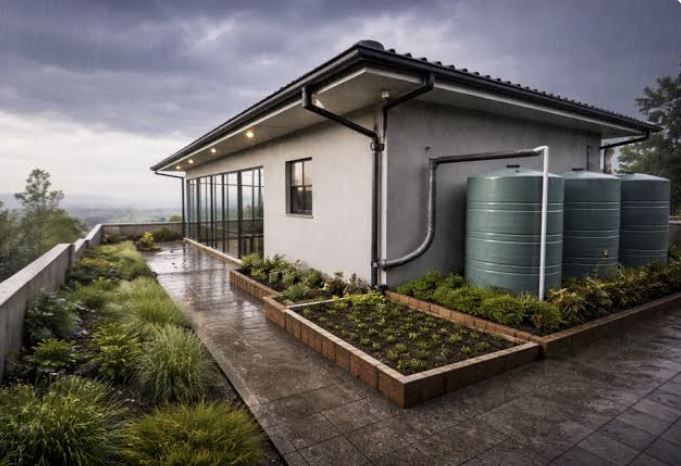
The flat roof has a good gradient, and rainwater drains off both sides through dedicated pipes. With a total roof area of about 100 square metres, one inch of rain produces around 2,500 litres of water, roughly 1,250 litres a side. On this side I swap the old downpipe for a temporary orange soil pipe that feeds straight into the top of the tank, held in place with timber battens and cable ties. It does not rain often here, but when it does it pours, so I should be able to collect a serious amount in no time.
You can run the same sum for any roof with the rainwater harvesting calculator, and my guide to rainwater harvesting in Sicily covers tanks, filters and pumps in detail.
Testing the system: the tank fills fast
The storm does the testing for me. Rainwater pours down the new pipe into the tank, the tap runs cleanly with no leaks, and by the next morning the tank is 95% full from a single storm. A board goes down in front of the tap to keep my boots out of the mud.
Eventually I would like a more permanent solution. Water butts are not the prettiest things to have around, so I ask in the comments for ideas for a system that is not an eyesore, or better still, one that could be a feature. The permanent answer is the underground rainwater tank I start digging in episode 76.
Ending the day with fresh Sicilian pasta
To finish, I visit a traditional fresh pasta shop in Mazara del Vallo, where everything is made by hand, and come away with a tray of ravioli for dinner. My Sicily food guide has more on the local pasta shapes.
Why every drop counts
Until now, all the water for cleaning, mixing and drinking has come in containers from the public tap. Even a 500 litre tank changes that, cutting down the trips to the public tap. It is a small, temporary system, but it is the first step towards a villa that collects and stores its own water. My article on off grid water versus mains water explains the longer term thinking.
Frequently asked questions
How much rainwater can a flat roof collect?
My flat roof is about 100 square metres. One inch of rain on it produces roughly 2,500 litres, around 1,250 litres from each side.
How do you add a tap to an old water tank?
I cut a hole in the side with a core drill bit, fitted a brass threaded fitting and a quarter turn tap, and tightened it with two pairs of pliers so it was watertight.
How quickly does a rainwater tank fill in Sicily?
It does not rain often, but it pours when it does. My 500 litre tank was 95% full the morning after a single storm.
What soil mix do you use for fruit trees in tubs?
Equal parts compost and garden soil, in 40 litre tubs with drainage holes drilled in the bottom and a layer of gravel underneath.
More episodes on the same job: Water and plumbing

 The weekly YouTube series