
In this episode
- The hole for the underground rainwater tank dug by a local friend
- Two independent water sources: the roof and the existing well
- Two 450 litre pressure tanks and multi-stage filtration planned
- Rubble compacted in layers with a hired whacker plate
- A wild swarm shaken from an olive tree into an empty hive
Digging the hole for the tank
This week I start digging the underground rainwater tank, and it is a huge job. I have called my local friend with the excavator to dig out the massive hole for the tank, which I will be building myself. Nothing goes to waste here, though. The rubble from the dig will backfill the rear terrace, so one job helps solve another. I marked out the tank in episode 75.
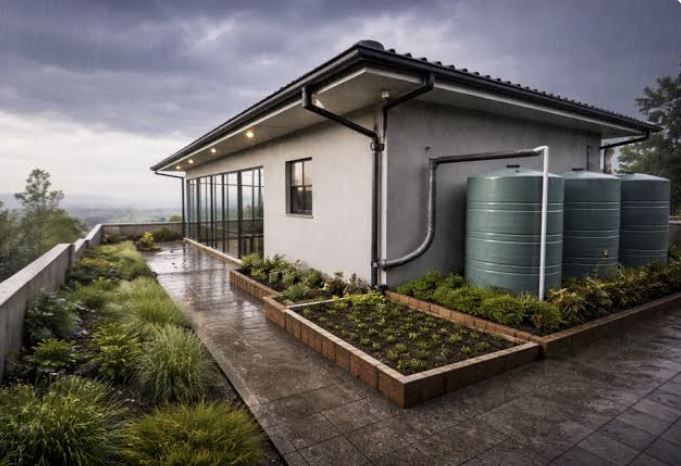
Once it is finished, the tank will collect rainwater from both sides of the flat roof and work alongside the existing well, giving the villa two completely independent water sources. From there, the water will feed into two 450 litre pressure tanks inside the terrace outbuilding, which I still need to build, before passing through a multi-stage filtration system and into the house.
We will not be using it as drinking water, but with the level of filtration planned, in theory it should be clean enough. This is a massive step towards making the villa properly off grid, which has always been my long term goal. My rainwater harvesting guide and the rainwater harvesting calculator show how a system like this is planned.
Backfilling and compacting the terrace
The stone rubble goes straight onto the rear terrace, moved by the excavator and by wheelbarrow. I hired a whacker plate from a DIY chain, because I still have not managed to find a local tool hire shop. The job now is to get all the rubble compacted properly so it becomes a solid base.
- Work across the entire area bit by bit.
- Compact it in layers, so the rubble locks together properly.
- Once it is solid, level it.
- Lay steel mesh across the whole area.
- Pour a concrete slab over the top.
It does not look like the most exciting job on camera, but this is exactly the kind of work everything else depends on. The slab will eventually be the floor of the outbuilding and give me a strong, level surface for the floor tiles. It is hard, noisy work, there is dust everywhere, and after a while my arms feel like they are going to vibrate off. But it is really satisfying seeing this area slowly come together. The terrace levels were set with timber battens last week, and the concrete is pumped in episode 82.
Marking out the outbuilding
I mark out the outbuilding now, because its area needs preparing slightly differently from the rest of the terrace. The whole terrace will eventually be one continuous concrete slab, poured in one go, but where the outbuilding walls will sit, I want the concrete thicker and stronger. By marking the walls out at this stage, I know exactly where to leave the backfill slightly lower, giving extra concrete depth in the areas that will carry the weight of the building. I first laid ducting for this outbuilding in episode 44.
A preview of the future terrace design shows how it should all come together. Then I level the backfill with the long straight edge, while the local sheep pass by the villa. My guide to building permits in Sicily covers the paperwork behind new structures like this.
Catching a wild bee swarm
It has been a busy day with the bees. This morning I saw a swarm in one of my olive trees. I was surprised, and I knew what it meant: an opportunity. Back in episode 74 I put up a swarm trap, hoping to catch one, and now one has come to me.
- Place an empty hive underneath the swarm.
- Shake the tree, so the swarm falls into the top of the hive.
- Close it up, and wait a couple of hours while the bees calm down and go inside.
- In the evening, with about 99% of the bees inside, move the hive onto the hive stand.
- Close the hive overnight so they cannot get out, and feed them some syrup.
- Put a bundle of branches in front of the entrance.
Tomorrow morning I will take off the front cover so they can come out. They will immediately be confronted with the branches, which makes them think it is a different location, so they reorientate, resetting their satnav. They fly out in circles until they pin down the location, and then they know exactly where to come back to. After a day or two I will remove the branches. My article on my first year of beekeeping follows both colonies.
Lavender, the roof and the fruit trees
Around the villa, I repot some French lavender, clean the flat roof ready for its waterproofing, and fertilise the fruit trees. The roof waterproofing products arrived in episode 75. The tank build itself is explained in episode 77, and my article on living off grid in Sicily shows where all this is heading.
Frequently asked questions
How does an underground rainwater tank work with a well?
My tank will collect rainwater from both sides of the flat roof and work alongside the existing well, giving the villa two independent water sources.
Can you reuse excavation rubble as backfill?
I used the stone rubble from digging my tank to backfill the rear terrace, compacting it in layers with a whacker plate until it was a solid base.
How do you catch a swarm of bees?
I put an empty hive under the swarm in my olive tree and shook the branch. The swarm fell in, and within a couple of hours the bees had gone inside.
Why put branches in front of a moved beehive?
The branches make the bees think they are somewhere new, so they reorientate, flying in circles to pin down the location so they know where to come back to.
More episodes on the same job: Water and plumbing · Beekeeping

 The weekly YouTube series