
In this episode
- Not a ready made tank: the hole itself becomes the tank
- Shells in the stone at the bottom of the hole
- A third septic chamber, between the Imhoff tank and the soakaway, uncovered and rebuilt
- The old rainwater tank cleaned of sediment and dead lizards
- New front steps marked out with 50cm treads
A hole that becomes the tank
This week I explain how I am building the underground rainwater tank. When I finished filming last week, in episode 76, there was a massive hole in the ground and a lot of unanswered questions, the biggest being what on earth to do with all the excess rubble. But as I am learning, there always seems to be someone local who knows someone who can help. A farmer has been collecting the rubble.
My friend in the excavator has been working nonstop and has done an amazing job. The hole is almost finished, and the rear terrace has changed completely. After months of being full of rubble and the perfect place to twist an ankle, stepping out here today feels amazing. I level and compact the sand on the terrace with a timber straight edge and the whacker plate.
How the tank will be built
The scale of this hole is ridiculous, and I do not think I have explained this properly before. I am not lowering a ready made tank into the ground. The hole itself becomes the tank:
- Clear all the rubble from the base of the hole.
- Lay steel mesh, build the formwork and bring in a concrete truck to pour the base.
- Build the retaining walls.
- Fully waterproof the inside.
- Build a reinforced concrete roof with an access hatch.
- Cover the whole thing back over with earth, completely hidden underground.
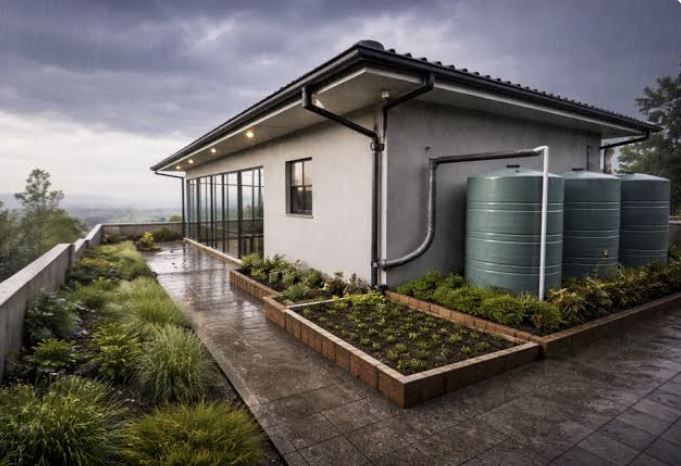
The tank is only one part of the system. I will also dig channels around both sides of the house, where pipework will collect rainwater from the flat roof and send it into the tank. More pipework will then run from the tank to the terrace outbuilding, where the water is pumped into pressure tanks and passed through a multi-stage filtration system before it enters the house. My rainwater harvesting guide covers each of these parts.
I put the ladder down into the pit with one of my boys to show its depth. Down there, we find shells in the stone, a sign this land may once have been an ancient seabed. Some of those shells end up set into the lounge wall in episode 89.
A hidden septic inspection chamber
With the constant back and forth of the digger and truck along this side of the house, the ground ended up a real mess. The soil was already wet, so it did not take long for it all to be churned up. But while clearing through it, I uncovered another part of the drainage system: a third manhole linked to the cesspit.
I had already found the first inspection chamber before the main tank, but this was the missing piece of the puzzle: a test chamber after the Imhoff tank and just before the soakaway. It is used to inspect and monitor the waste after it has passed through the Imhoff tank, before it disperses into the soakaway. The system passed its test in episode 57.
I mix mortar, lay red bricks on the old opening to raise it, level them, render the outside and set a new precast concrete frame and lid on top, so it sits level with the other chambers and all the lids match. By 7pm the mosquitoes are eating me alive, so the tidy up of the mortar waits until the morning. Then the soil is backfilled around the chamber and the round cover beside it is cleaned and sealed.
Sparrows in the bird box
On the wall, sparrows are going in and out of one of the bird boxes I put up in episode 59, pulling long green stems inside to build a nest. God loves a trier.
Cleaning out the old rainwater tank
I have been meaning to clean out this tank for a while. It had got pretty disgusting: the water smelt awful, there were dead lizards in it, and a thick layer of black sediment covered the bottom. I reuse the water on the fruit trees through a hose and pipe, then vacuum out the sediment, scrub the inside with a broom, spray it with cleaner, rinse it and seal the gaps in the timber braces with expanding foam.
This smaller tank will be used temporarily to collect water from this side of the house, and I will transfer it into the bigger tank on the other side, so I did not want to be moving dirty water across. The old bath beside it is cleaned out too.
Marking out the new front steps
At the front, I clear the pots away from the existing steps. I am not happy with how small the originals are, so next time my friend is here with the digger, he will dig the footings so I can rebuild them bigger and wider. With a tape, level, straight edge and spray paint, I mark out the plan:
- A top step running the full width of the opening.
- Two larger steps below it.
- Each lower step with a 50cm tread, extending both forwards and around the side of the step above, for a wider, more gradual entrance.
And here is an idea of how I am hoping the finished villa will look once it all comes together, in a rendered preview. I explained what this €20,000 ruin cost me in episode 9.
The swarm, pallets and the cats
I take the entrance cover off the swarm hive from last week, so the bees can get out and reorientate, because there is a bush in front of it. On the veranda, I stain some pallets dark brown with wood preservative, and the stray cats get their dinner. My guide to buying, renovating and living off grid and my article on setting up utilities cover the water and drainage side.
Frequently asked questions
How do you build an underground water tank?
In my case the hole becomes the tank: a poured concrete base on steel mesh, retaining walls, waterproofing, a reinforced concrete roof with a hatch, then earth over the top.
What is a septic test chamber for?
The one I uncovered sits after the Imhoff tank and before the soakaway. It is used to inspect and monitor the waste before it disperses into the ground.
Why are there shells in the ground in Sicily?
We found shells in the stone at the bottom of my tank hole, a sign that the land may once have been an ancient seabed.
How do you clean out a rainwater tank?
I used the old water on the fruit trees, vacuumed out the black sediment, scrubbed the inside with a broom, sprayed it with cleaner and rinsed it.
More episodes on the same job: Water and plumbing


 The weekly YouTube series