
In this episode
- The wall into the tower knocked through for a future spiral staircase
- The SDS hammer drill snaps in half mid-job
- Precast cesspit lids found by chance at a local concrete works
- A new mains electricity meter fitted at the roadside
- Old letters tell the story of a local teacher born in 1899
Slow, messy and full of surprises
This week I set out to knock through a stone wall into the tower. It should have been straightforward, but things did not go to plan and it left me with a dilemma. I am in the middle of restoring a long abandoned villa in rural Sicily. It is a huge project, slow, messy and full of surprises, but that is all part of the adventure. On the plus side, I stumble across a local concrete works with exactly what I have been looking for, and at the end I share the story inside the old letters we found in episode 31.
Opening up the tower
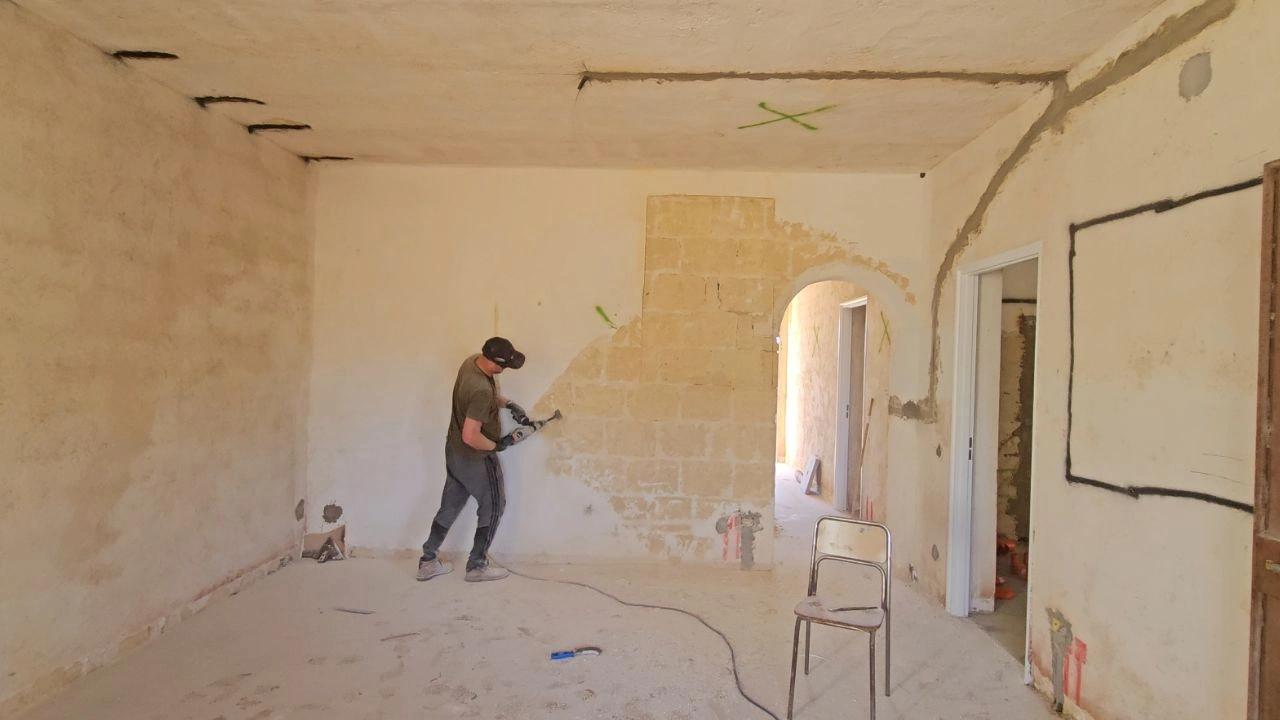
Today I am knocking out the wall and doorway that lead into the tower. Eventually a spiral staircase will go here, taking you all the way up to the roof terrace. The tower, with its little round room, is one of the biggest features of the property, and I do not see the point in hiding it behind a door. I want it to be something you notice as soon as you walk in, and I have a plan for a bespoke staircase that I think will look incredible.
To make it work structurally, I have ordered some reclaimed oak beams to support the ceiling above. They will add a solid, rustic touch and keep the character of the space. While I break through with the SDS hammer drill, the opening is held up with an acrow prop and hardwood planks, and the rubble is cleared as I go. It is one of those changes that really shapes the feel of the house. The beams are restored in episode 34 and lifted into place in episode 35.
The drill snaps, and a dilemma
Halfway through, the SDS hammer drill literally snaps in half. It has seen heavy use lately, but it is not that old and is still within its repair or replacement period, so it needs to go back to Leroy Merlin in Palermo. The round trip usually takes about three hours, and with a busy couple of weeks ahead I cannot spare a separate day for it. I will tie it in with dropping Lewis at Palermo airport.
That is the dilemma. I wanted to finish the knock through while Lewis was still here, so he could help lift the beams. They are solid oak and very heavy, and it looks like I may have to tackle that part on my own, which I am honestly dreading.
New covers for the cesspit chambers
While out with Lewis, we stumbled on a huge local concrete works, and by pure chance they had precast lids that fit the cesspit chambers perfectly. The old lids are crumbling and well past their best, so I was planning to replace them anyway. Back at the villa we lift off a giant old concrete lid, fit stainless steel mesh to the pipes to keep rodents out, and install the new cover on chamber 3.
I still have not worked out what is going on with the system after the drain test in episode 32, but there were some brilliant suggestions in the comments, and over the coming weeks I will try some of them. The full answer arrives in episode 57. Out front, the last footings are now ready for the pour.
The mains electricity meter at last
The big news this week is that the electric company fits a new meter at the roadside. After months of running everything off a noisy generator, it can finally go, at least once the cable from the trench dug in episode 30 is connected. It has been a long road since I first asked about getting connected in episode 20, and my guide to setting up utilities in rural Sicily explains the process.
That evening a bat flies into the villa. The next day the cats are fed, the new mango and pistachio trees are repotted, and we go out for pizza at a local Sicilian restaurant.
Old letters and a teacher's fight
When Lewis and I cleared the old rubbish pile, we found a bundle of yellowed papers. At first they looked like scrap, but they turned out to be a personal archive, a whole life sealed in time. One name appears again and again: Antonia de Gregorio, born in 1899 in Mazara del Vallo. She was a teacher and a public servant who taught generation after generation in tiny village schools, even before Italy's national school system was fully in place, and she also worked for a decade in the local post office.
Inside the bundle were service certificates, appeals to government offices, a spotless criminal record check and a retirement document from 1964. One letter describes a school in ruins, its walls crumbling, with lessons held in the sacristy of a local church. She spent years teaching in subsidised schools outside the state system with no pension or contract, and wrote appeal after appeal, in 1960, 1963 and 1964, to have those years recognised. Through fascism, war and rebuilding, she kept teaching.
There is no confirmed link between her and this villa. Another name in the papers belongs to a former owner of the property, who died in 1982. Maybe she lived nearby or knew the family. Either way, these papers did not belong in the bin. My article on Sicily's past gives the wider history she lived through.
Frequently asked questions
Why open up the wall into the tower?
The round tower room is one of the best features of the villa. Opening the wall lets you see it as soon as you walk in, and a spiral staircase will go up to the roof terrace.
How do you support a wall while knocking through?
I held the opening with an acrow prop and hardwood planks while breaking through, with reclaimed oak beams ordered to carry the ceiling permanently.
Where can you buy cesspit lids in Sicily?
I found precast lids that fit my chambers perfectly at a local concrete works, by chance while out with my friend. The old lids were crumbling.
How do you stop rats getting in through drain pipes?
When the new cesspit covers went on, I fitted stainless steel mesh over the pipes into the chambers to keep rodents out.
More episodes on the same job: Stone walls and lime
 The weekly YouTube series