
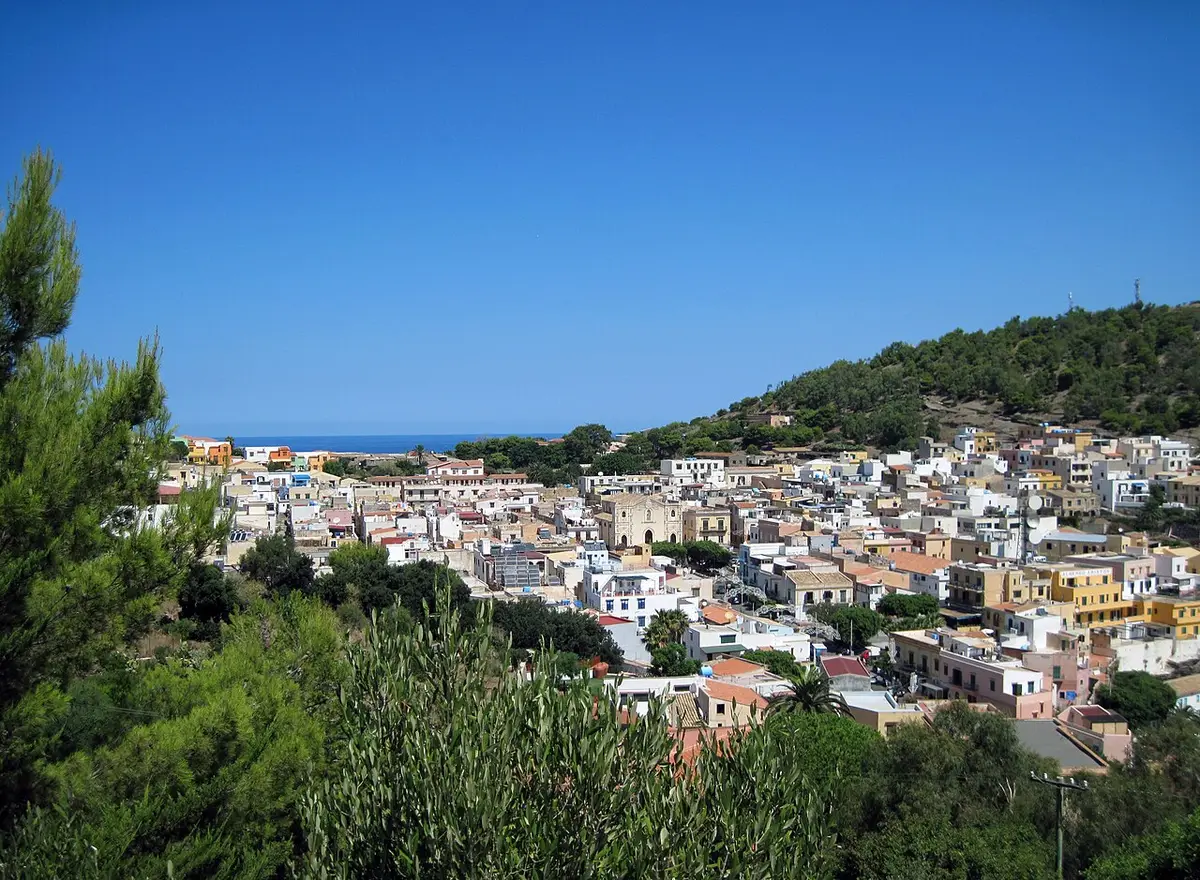
About Ustica
The village climbs from the port to the square and the church of San Ferdinando Re, built in 1771. Above it stands the Rocca Falconiera with its eighteenth-century fortifications; on the coast are the Torre di Santa Maria and the Torre dello Spalmatore of 1763. The island is a key stopover for migrating birds in spring and autumn.
Around the island lies the marine protected area, with clear water, caves and shoals, and many archaeological finds have come from shipwrecks on the seabed; the Spalmatore aquarium shows local sea life. Farming survives on terraces, famously for tiny organic lentils.
Living in Ustica
Ustica is busy in summer with divers and holidaymakers, then very quiet from autumn to spring, when ferries can be cancelled in rough seas. The population is stable. Shops cover basics, and anything bigger means the crossing to Palermo by ferry or hydrofoil; a shuttle bus runs round the island.
Pros: clean sea, peace and a close community. Cons: isolation in bad weather, limited services and seasonal work.
A short history
The Bronze Age village of the Faraglioni, thriving between about 1400 and 1200 BC, with walls 4 to 5 metres high, is one of the best preserved of its time in the Mediterranean. The Greeks called the island Osteodes, 'ossuary', after mercenaries said to have been left to die there; the Romans named it Ustica, 'burnt'.
Barbary raids left it empty for centuries until the Bourbons resettled it in the 1760s with families from Lipari, who brought their patron, Saint Bartholomew. It was later a place of internal exile; under Fascism Antonio Gramsci, Carlo Rosselli and Ferruccio Parri were confined here. Exile ended in 1961, and tourism began.
Food, festivals and traditions
Ustica's lentils, the smallest in Italy, are a Slow Food presidium, and fish dominates the table. Saint Bartholomew is celebrated on 24 August, the Madonna dei Pescatori on the last Sunday of May with a boat procession, and San Bartolicchio on 19 September.
Interesting facts about Ustica
- Ustica's marine reserve, created in 1986, was the first in Italy.
- Louis Prima's mother came from an Ustica family that emigrated to New Orleans.
- Antonio Gramsci was confined on the island under Fascism.
House prices in Ustica
The property market observatory publishes no average for Ustica, which usually means too few sales to give a reliable figure. Homes here are typically priced in line with the smaller towns of Palermo province.
Getting there and getting around
Ustica is reached by sea from Palermo: the hydrofoil takes about an hour and a quarter and the car ferry about two and a half hours. Crossings can be cancelled in rough weather, especially in winter.
Palermo airport is about 35 minutes by car from Palermo port.
Planning flights and trips? See the Schengen 90/180 calculator if you are from outside the EU.
Everyday life: shops, health and schools
- Medical emergencies
- Ustica has a medical post for emergencies. Serious cases are taken to hospital in Palermo by helicopter or boat. In an emergency anywhere in Italy, call 112.
- Pharmacies in the comune
- 1
- Supermarkets
- None mapped
- Schools
- State: 1 nursery school, 1 primary school, 1 middle school, 1 secondary school
- Banks and cash machines
- None mapped
- Cafés and bars
- 3
- Restaurants
- 9
- Full fibre broadband
- 48.9% of addresses
Pharmacies and schools come from the official Ministry of Health and Ministry of Education lists. The other counts are of places mapped in OpenStreetMap inside the comune's boundary, so a small shop or a doctor's surgery can be missing. “Not fully mapped yet” means the volunteer map clearly has gaps here, not that the town has none. For a family doctor (medico di base, what the British call a GP), you register with the local health authority (ASP Palermo) once you are resident.
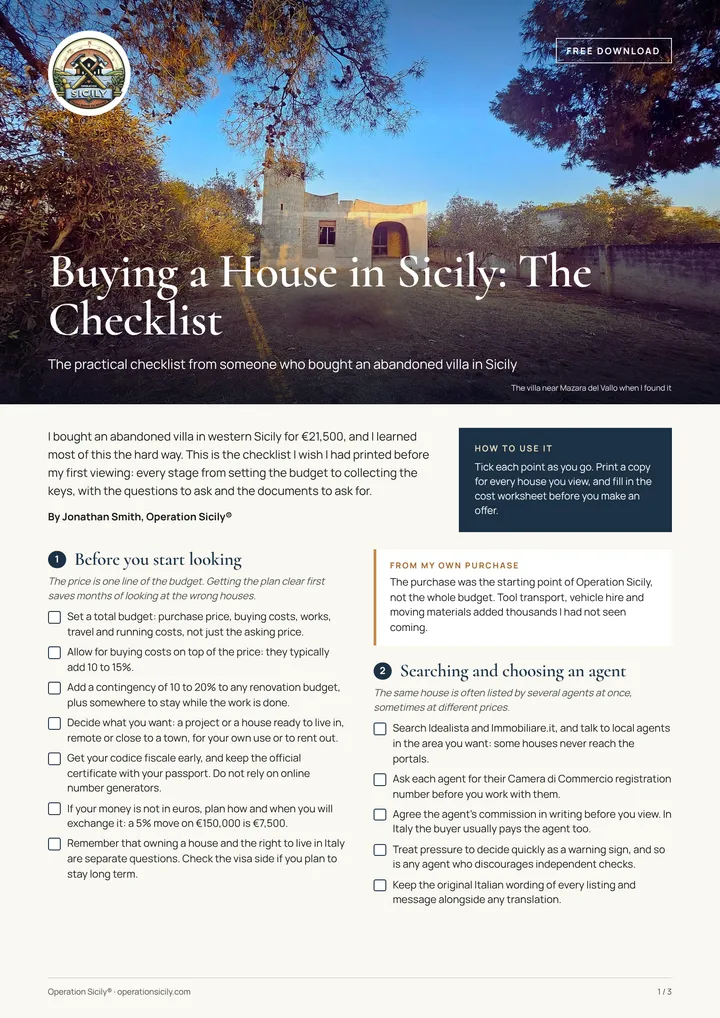
Free download
Buying a house in Sicily? Take my checklist.
Every step from budget to keys, the questions to ask at a viewing and the documents to ask for, as a PDF you can print.
Here is your checklist. Download the checklist (PDF)
Weather and climate in Ustica
30.6°Caverage July high
9.5°Caverage January low
609 mmrain a year, on about 86 days
1day a year above 30°C
| Month | Average temperature | Rain |
|---|---|---|
| January | 13°C | 83 mm |
| February | 13°C | 75 mm |
| March | 14°C | 60 mm |
| April | 16°C | 48 mm |
| May | 19°C | 21 mm |
| June | 22°C | 16 mm |
| July | 25°C | 7 mm |
| August | 26°C | 13 mm |
| September | 24°C | 55 mm |
| October | 21°C | 77 mm |
| November | 18°C | 72 mm |
| December | 15°C | 82 mm |
Averages for 2015 to 2024. Winters are mild, though stone houses still feel cold without heating. Summers are hot and dry.
See what each month brings in Sicily month by month, or size a solar system with the off-grid solar calculator.
Who lives there
- Population
- 1,319
- Change since 2019
- +0.5%
- Median age
- 49
- Foreign residents
- 41 (3.1%)
- People from Ustica are called
- usticesi
- Patron saint
- Bartholomew the Apostle
Registered residents from abroad include 1 British, 1 Dutch, 1 Irish, 3 Polish and 21 Romanian citizens.
Ustica sees a fair number of visitors, with about 389 tourist beds, so it is livelier in summer, but it is a working town all year round.
Beaches in Ustica
Ustica has 3 beaches in our beach guide. 100% of its officially monitored bathing waters were rated excellent in the latest EU assessment.
- Cala Santa Maria sand and pebbles, water excellent
- Cala Sidoti pebbles, water excellent
- Piscina Naturale Ustica rocks, water excellent
Things to see and do in and around Ustica
Dive or snorkel in the reserve, take a boat round the caves, and walk the coastal paths to the lighthouses at Punta Cavazzi and Punta Omo Morto. Visit the Faraglioni village and the island's archaeological museum.
- Ustica Island
- Torre di Santa Maria
- Scoglio del Medico
- Punta Omo Morto Lighthouse
- Punta Cavazzi Lighthouse
- Rocca della Falconiera
- Museo archeologico preistorico di Ustica
Earthquake, landslide and flood risk
Ustica is in seismic zone 2, the second highest of Italy’s four seismic zones. The zone sets the anti-seismic standard for any new building, extension or structural renovation, which affects both the design and the cost. A structural survey is worth paying for before you buy any older building, stone house or flat.
14.6% of the comune's land is mapped by ISPRA as high or very high landslide hazard, where 12.2% of residents live, and no medium-probability flood areas are mapped. Ask for the hazard maps (PAI) for any house you are considering; the comune's technical office or your geometra can check them.
Check what you can build or change with the building permit checker, and keep a margin with the renovation contingency calculator.
The comune: useful details
- Official name
- Comune di Ustica
- Province
- Palermo (Città metropolitana di Palermo)
- Postcode (CAP)
- 90051
- Dialling code
- 091
- Area
- 8 km²
- Height above sea level
- 49 m
- ISTAT code
- 082075
- Cadastral code
- L519 (used in the codice fiscale of people born here)
- Official website
- comune.ustica.pa.it
Registering as a resident, paying local taxes and building permits all go through the comune. If you were born abroad, get your Italian tax code first with the codice fiscale calculator.
Nearby towns
Ustica is an island comune: the towns of the main island are reached by ferry.
Towns like Ustica elsewhere in Sicily
- Malfa (Messina province)
- Santa Marina Salina (Messina province)
- Leni (Messina province)
- Favignana (Trapani province)
- Lampedusa e Linosa (Agrigento province)
- Pantelleria (Trapani province)
Ustica on our lists
See every town in Palermo province (82 comuni), or let Find your town suggest places that match what you want.
Frequently asked questions
Where is Ustica?
Ustica is an island comune in the province of Palermo, about 70 km north of Palermo. The centre sits about 49 metres above sea level.
What is Ustica known for?
Ustica's marine reserve, created in 1986, was the first in Italy. Louis Prima's mother came from an Ustica family that emigrated to New Orleans. Antonio Gramsci was confined on the island under Fascism.
Is Ustica a good place to live?
It depends what you want. Divers, walkers and birdwatchers who want genuine island life and are happy with the quiet of winter and a ferry as their link to the world.
How do you get to Ustica?
Ustica is reached by sea from Palermo: the hydrofoil takes about an hour and a quarter and the car ferry about two and a half hours. Crossings can be cancelled in rough weather, especially in winter. Palermo airport is about 35 minutes by car from Palermo port.
What is the weather like in Ustica?
Summers are hot and dry: July afternoons average about 30.6°C, with about one day a year above 30°C. Winter nights in January average about 9.5°C. Rain totals about 609 mm a year, falling mostly between October and March.
How many people live in Ustica?
1,319 people live in the comune of Ustica, according to ISTAT. The population grew by 0.5% between 2019 and 2025. Half the residents are older than 49.
Is there a hospital on Ustica?
Ustica has a medical post for emergencies. Serious cases are taken to hospital in Palermo by helicopter or boat. In an emergency anywhere in Italy, call 112.
Is Ustica in an earthquake zone?
Ustica is in seismic zone 2, the second highest of Italy’s four seismic zones. New building and structural work anywhere in Italy must follow anti-seismic rules, and the zone sets how strict they are, so ask your geometra or engineer to check any house you plan to buy or renovate.
Does Ustica count for the 7% flat tax for pensioners?
On population, yes: Ustica is a Sicilian town under the 30,000 resident limit for Italy's 7% flat tax for foreign pensioners. The other conditions are about you, not the town. Check the details with our 7% flat tax town checker and a qualified adviser.
Does Ustica have fast internet?
In parts. About 48.9% of addresses in Ustica can get full fibre (FTTH), according to AGCOM. Elsewhere, fibre to the cabinet, fixed wireless or 4G and 5G home broadband fill the gap. Check the exact address before you buy.
Did the 1980 Ustica air disaster happen on the island?
No. Itavia flight 870 from Bologna to Palermo came down in the sea a long way from the island on 27 June 1980, killing 81 people; it is known by Ustica's name because the island was the nearest landmark.
Credits
Photo: Pavla Mačoková from Praga, Repubblica Ceca, CC BY-SA 2.0, via Wikimedia Commons.
Figures: ISTAT, Agenzia delle Entrate (OMI), Copernicus ERA5-Land, AGCOM, Dipartimento della Protezione Civile, ISPRA, Ministero della Salute, Ministero dell'Istruzione e del Merito, IndicePA, Open-Meteo, NASA POWER, Wikidata and © OpenStreetMap contributors, with several series gathered by the expatliving-data open data collection. Map boundaries ISTAT via openpolis (CC BY 4.0). Sicily as a whole: 4,787,390 people in 391 comuni.
 The weekly YouTube series