
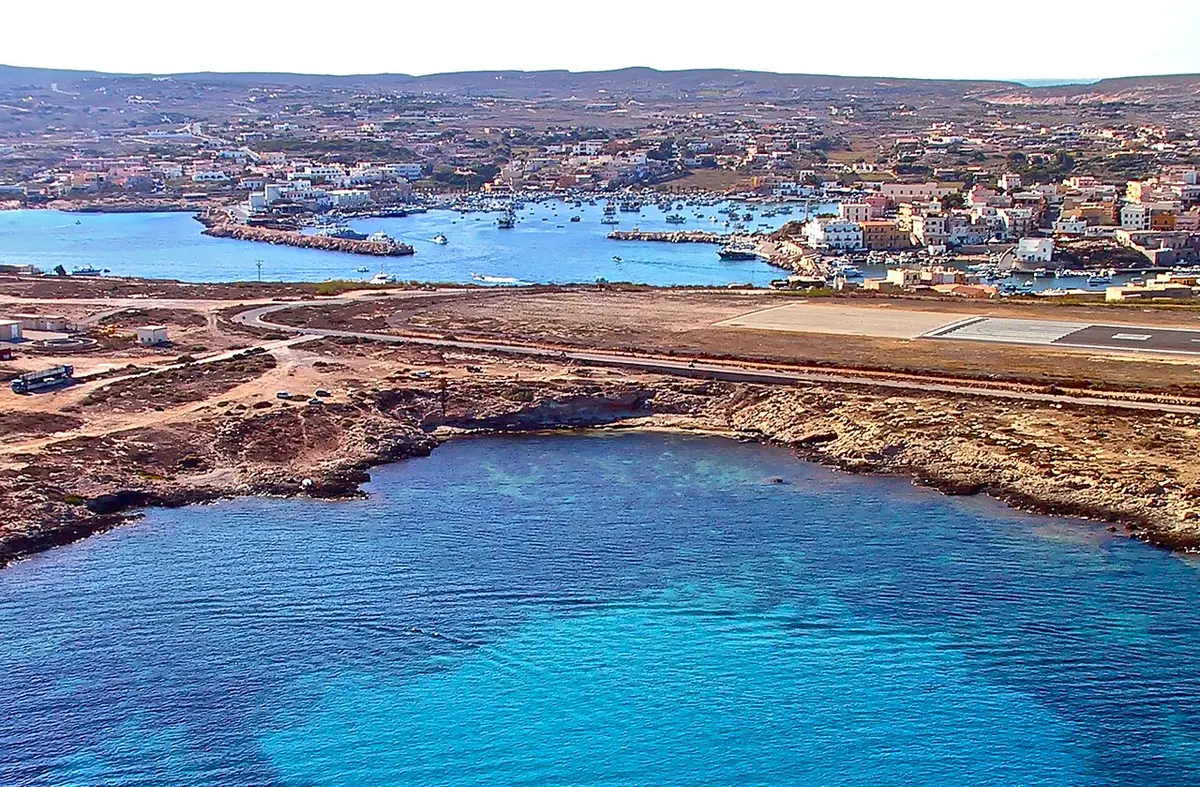
About Lampedusa e Linosa
Geologically, Lampedusa and Lampione sit on the African plate and rose from the sea about two million years ago, while Linosa is a volcano. Lampedusa is about 113 kilometres from Africa and 205 from Porto Empedocle; Linosa lies 40 kilometres away. The landscape is flat steppe cut by valleys of garrigue, dropping to coves such as Cala Croce, Cala Pisana, Cala Galera and the Spiaggia dei Conigli, Rabbit Beach, a nesting site for loggerhead turtles and part of the island's nature reserve.
Lampedusa town wraps around the harbour, with the airport on its edge. Linosa has a single village by its landing stage, and contrade with names like Fossa Cappellano, Monte Nero and Monte Bandiera, the old volcanic cones. Farming on both islands is limited to capers and pulses, and the economy runs on fishing and, above all, tourism.
Living in Lampedusa e Linosa
The islands have many tourist beds for their size, and it shows: from late spring to early autumn Lampedusa fills with visitors, boats and hire scooters, while in winter many businesses close and the place belongs to residents again. Unusually for the province, the population is growing slightly.
Everyday shopping is limited and pricier than on the mainland, since nearly everything arrives by ship, and bad weather can halt ferries. Specialist care, big shopping and bureaucracy mean a trip to Sicily. Lampedusa is also one of the main landing points for migrants crossing from Tunisia and Libya, which brings national attention and a strong presence of rescue services.
The rewards are obvious: sea, light, a tight-knit community and a winter climate that is mild by any European standard. The drawbacks are isolation, wind and a slower pace of everything.
A short history
The islands were known in antiquity but were thinly settled for most of their history, exposed to raids and lacking water. Lampedusa gave its title to the Tomasi family, princes of Lampedusa, whose descendant Giuseppe Tomasi di Lampedusa wrote Il Gattopardo.
Organised settlement began only in 1843, when the Bourbon government of Ferdinand II sent colonists to Lampedusa and Linosa. The islands were run by a special administration until a royal decree of the 1870s created the comune. In the second half of the nineteenth century sponge banks discovered offshore drew traders from around the Mediterranean, alongside fishing for sardines and anchovies.
Tourism took off in the late twentieth century, and films including Emanuele Crialese's Respiro and Terraferma and Gianfranco Rosi's documentary Fuocoammare made the islands known worldwide.
Food, festivals and traditions
Fish rules the table: tuna, amberjack, mackerel and sardines, couscous with fish, and pasta with fresh seafood. Linosa is known for its lentils and capers grown in volcanic soil.
The patron is the Madonna di Porto Salvo, celebrated in September with a procession and the whole island out in the streets.
Interesting facts about Lampedusa e Linosa
- Lampedusa e Linosa is the southernmost comune in Italy, and its islands are geographically part of Africa.
- Lampedusa and Lampione rose from the sea on the African plate, while Linosa is volcanic.
- Organised settlement of the islands began only in 1843 under the Bourbons.
- In the nineteenth century sponge fishing drew traders to Lampedusa from across the Mediterranean.
House prices in Lampedusa e Linosa
€1,231average price per m² to buy
€4.08average rent per m² a month
€123,000a 100 m² home at that price
These are the official averages from the Agenzia delle Entrate's property market observatory (OMI) for homes in normal condition across the town's 6 price zones. Prices in Lampedusa e Linosa are above the typical town in Agrigento province (€500 per m²) and above the typical Sicilian town (€593 per m²). Detached houses (villini) average about €1,608 per m².
Why these figures can look low: they come from the values on real sales, which sit below advertised asking prices, and the typical Sicilian town is the middle of all 391 comuni, most of them small inland towns. Island-wide averages quoted on property portals, around €1,100 to €1,300 per m², lean towards the cities and the coast, where most homes are listed. Rents work the same way: listings usually ask well above the official rent figure, often double or more.
Houses that need work, which is most of the cheap ones you see advertised, sell well below these figures. The renovation comes on top, so budget for both.
Work out the return on a let with the rental yield calculator, or see the steps from offer to keys in the buying timeline planner.
Getting there and getting around
Lampedusa has its own airport (LMP), with flights to Palermo and Catania all year and more routes in summer.
A car ferry sails overnight from Porto Empedocle, near Agrigento, taking about nine hours, and calls at Linosa on the way. In summer a hydrofoil also links the islands with Porto Empedocle.
Planning flights and trips? See the Schengen 90/180 calculator if you are from outside the EU.
Everyday life: shops, health and schools
- Medical emergencies
- There is no hospital on the islands. Lampedusa has a health centre with an emergency service, and serious cases are flown to hospital on the main island by helicopter. In an emergency anywhere in Italy, call 112.
- Pharmacies in the comune
- 2
- Supermarkets
- 6
- Schools
- State: 2 nursery schools, 2 primary schools, 2 middle schools, 1 secondary school
- Banks and cash machines
- 4
- Cafés and bars
- 12
- Restaurants
- 28
- Full fibre broadband
- 74.6% of addresses
Pharmacies and schools come from the official Ministry of Health and Ministry of Education lists. The other counts are of places mapped in OpenStreetMap inside the comune's boundary, so a small shop or a doctor's surgery can be missing. “Not fully mapped yet” means the volunteer map clearly has gaps here, not that the town has none. For a family doctor (medico di base, what the British call a GP), you register with the local health authority (ASP Agrigento) once you are resident.
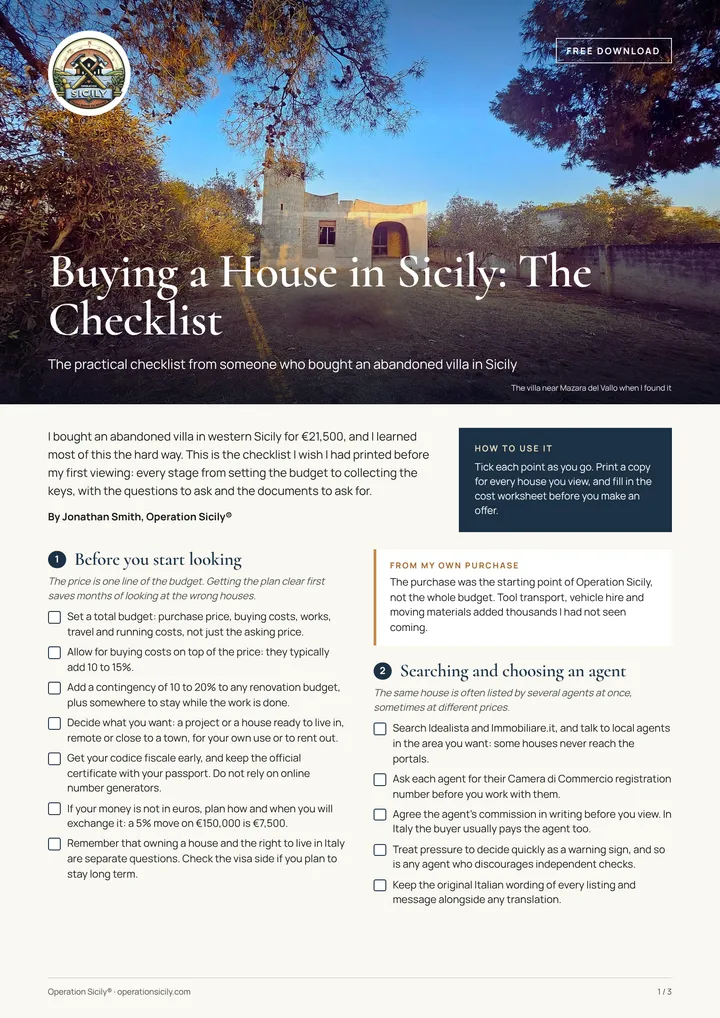
Free download
Buying a house in Sicily? Take my checklist.
Every step from budget to keys, the questions to ask at a viewing and the documents to ask for, as a PDF you can print.
Here is your checklist. Download the checklist (PDF)
Weather and climate in Lampedusa e Linosa
30.4°Caverage July high
11°Caverage January low
376 mmrain a year, on about 57 days
1day a year above 30°C
| Month | Average temperature | Rain |
|---|---|---|
| January | 15°C | 43 mm |
| February | 14°C | 38 mm |
| March | 15°C | 34 mm |
| April | 16°C | 21 mm |
| May | 19°C | 14 mm |
| June | 22°C | 6 mm |
| July | 25°C | 3 mm |
| August | 26°C | 10 mm |
| September | 25°C | 46 mm |
| October | 23°C | 56 mm |
| November | 20°C | 48 mm |
| December | 16°C | 56 mm |
Averages for 2015 to 2024. Winters are mild, though stone houses still feel cold without heating. Summers are hot and dry.
See what each month brings in Sicily month by month, or size a solar system with the off-grid solar calculator.
Who lives there
- Population
- 6,492
- Change since 2019
- +1.9%
- Median age
- 43
- Foreign residents
- 241 (3.7%)
Registered residents from abroad include 3 British, 4 German, 1 Dutch, 7 French, 1 Belgian, 2 Polish, 105 Romanian, 2 Albanian and 5 Ukrainian citizens. Most of the rest come from countries outside Europe and the Americas. Others own holiday homes here without registering as residents.
Lampedusa e Linosa sees a fair number of visitors, with about 1,845 tourist beds, so it is livelier in summer, but it is a working town all year round.
Beaches in Lampedusa e Linosa
Lampedusa e Linosa has 6 beaches in our beach guide. 100% of its officially monitored bathing waters were rated excellent in the latest EU assessment.
- Cala Croce fine sand, water excellent
- Cala Pozzolana Beach, Linosa sand
- Cala Pulcino sand and pebbles, water excellent
- Guitgia Beach fine sand, water excellent
- Rabbit Beach fine sand, water excellent
- Tabaccara sand and rocks
Things to see and do in and around Lampedusa e Linosa
On Lampedusa, Rabbit Beach is the famous one, a sandbar joining a small island in shallow, startlingly clear water; access is managed to protect the turtles. Take a boat trip round the island to see the coves and sea caves, swim at Cala Croce or Cala Pisana, and walk to Capo Ponente at sunset. The sanctuary of the Madonna di Porto Salvo sits in a quiet valley outside town.
Linosa rewards a day or more: climb Monte Nero or Monte Bandiera for views over the black lava coast, swim from the rocks near the Faraglioni, and wander the painted village. Diving and snorkelling are excellent around both islands.
- Lampedusa
- Riserva naturale orientata Isola di Lampedusa
- Rabbit beach
Beaches within the comune include Spiaggia dei Conigli, Cala Pulcino.
Earthquake, landslide and flood risk
Lampedusa e Linosa is in seismic zone 4, the lowest of Italy’s four seismic zones. The zone sets the anti-seismic standard for any new building, extension or structural renovation, which affects both the design and the cost. A structural survey is worth paying for before you buy any older building, stone house or flat.
11.7% of the comune's land is mapped by ISPRA as high or very high landslide hazard, where 1.7% of residents live, and no medium-probability flood areas are mapped. Ask for the hazard maps (PAI) for any house you are considering; the comune's technical office or your geometra can check them.
Check what you can build or change with the building permit checker, and keep a margin with the renovation contingency calculator.
The comune: useful details
- Official name
- Comune di Lampedusa e Linosa
- Province
- Agrigento (Libero consorzio comunale di Agrigento)
- Postcode (CAP)
- 92031
- Dialling code
- 0922
- Area
- 25 km²
- Height above sea level
- 16 m
- ISTAT code
- 084020
- Cadastral code
- E431 (used in the codice fiscale of people born here)
- Official website
- comune.lampedusaelinosa.ag.it
Registering as a resident, paying local taxes and building permits all go through the comune. If you were born abroad, get your Italian tax code first with the codice fiscale calculator.
Nearby towns
Lampedusa e Linosa is an island comune: the towns of the main island are reached by ferry.
Towns like Lampedusa e Linosa elsewhere in Sicily
- Pantelleria (Trapani province)
- Ustica (Palermo province)
- Lipari (Messina province)
- Favignana (Trapani province)
- Leni (Messina province)
- Santa Marina Salina (Messina province)
Lampedusa e Linosa on our lists
See every town in Agrigento province (43 comuni), or let Find your town suggest places that match what you want.
Frequently asked questions
Where is Lampedusa e Linosa?
Lampedusa e Linosa is an island comune in the province of Agrigento, about 220 km south-west of Agrigento. The centre sits about 16 metres above sea level.
What is Lampedusa e Linosa known for?
Lampedusa e Linosa is the southernmost comune in Italy, and its islands are geographically part of Africa. Lampedusa and Lampione rose from the sea on the African plate, while Linosa is volcanic. Organised settlement of the islands began only in 1843 under the Bourbons.
Is Lampedusa e Linosa a good place to live?
It depends what you want. Made for sea lovers, divers and people who genuinely want island life, and who can accept being a flight or a long ferry crossing from mainland services.
How much do houses cost in Lampedusa e Linosa?
Official figures from the Agenzia delle Entrate put homes in Lampedusa e Linosa at about €1,231 per square metre on average, so a 100 m² home in normal condition would be roughly €123,000. That is above the typical town in the province (€500) and above the typical Sicilian town (€593). Houses needing work sell for less, and the best homes for more.
How do you get to Lampedusa e Linosa?
Lampedusa has its own airport (LMP), with flights to Palermo and Catania all year and more routes in summer. A car ferry sails overnight from Porto Empedocle, near Agrigento, taking about nine hours, and calls at Linosa on the way. In summer a hydrofoil also links the islands with Porto Empedocle.
What is the weather like in Lampedusa e Linosa?
Summers are hot and dry: July afternoons average about 30.4°C, with about one day a year above 30°C. Winter nights in January average about 11°C. Rain totals about 376 mm a year, falling mostly between October and March.
How many people live in Lampedusa e Linosa?
6,492 people live in the comune of Lampedusa e Linosa, according to ISTAT. The population grew by 1.9% between 2019 and 2025. Half the residents are older than 43.
Is there a hospital on Lampedusa and Linosa?
There is no hospital on the islands. Lampedusa has a health centre with an emergency service, and serious cases are flown to hospital on the main island by helicopter. In an emergency anywhere in Italy, call 112.
Is Lampedusa e Linosa in an earthquake zone?
Lampedusa e Linosa is in seismic zone 4, the lowest of Italy’s four seismic zones. New building and structural work anywhere in Italy must follow anti-seismic rules, and the zone sets how strict they are, so ask your geometra or engineer to check any house you plan to buy or renovate.
Does Lampedusa e Linosa count for the 7% flat tax for pensioners?
On population, yes: Lampedusa e Linosa is a Sicilian town under the 30,000 resident limit for Italy's 7% flat tax for foreign pensioners. The other conditions are about you, not the town. Check the details with our 7% flat tax town checker and a qualified adviser.
Does Lampedusa e Linosa have fast internet?
Yes, for most homes: about 74.6% of addresses in Lampedusa e Linosa can get full fibre (FTTH), according to the communications regulator AGCOM. Check the exact address before you buy.
Can you get to Lampedusa all year?
Yes. Flights to Lampedusa run from Palermo and Catania all year, with more routes in summer, and ferries and hydrofoils link the islands to Porto Empedocle. Rough seas can delay crossings, especially in winter.
Credits
Photo: Luca Siragusa, CC BY 2.0, via Wikimedia Commons.
Figures: ISTAT, Agenzia delle Entrate (OMI), Copernicus ERA5-Land, AGCOM, Dipartimento della Protezione Civile, ISPRA, Ministero della Salute, Ministero dell'Istruzione e del Merito, IndicePA, Open-Meteo, NASA POWER, Wikidata and © OpenStreetMap contributors, with several series gathered by the expatliving-data open data collection. Map boundaries ISTAT via openpolis (CC BY 4.0). Sicily as a whole: 4,787,390 people in 391 comuni.
 The weekly YouTube series