
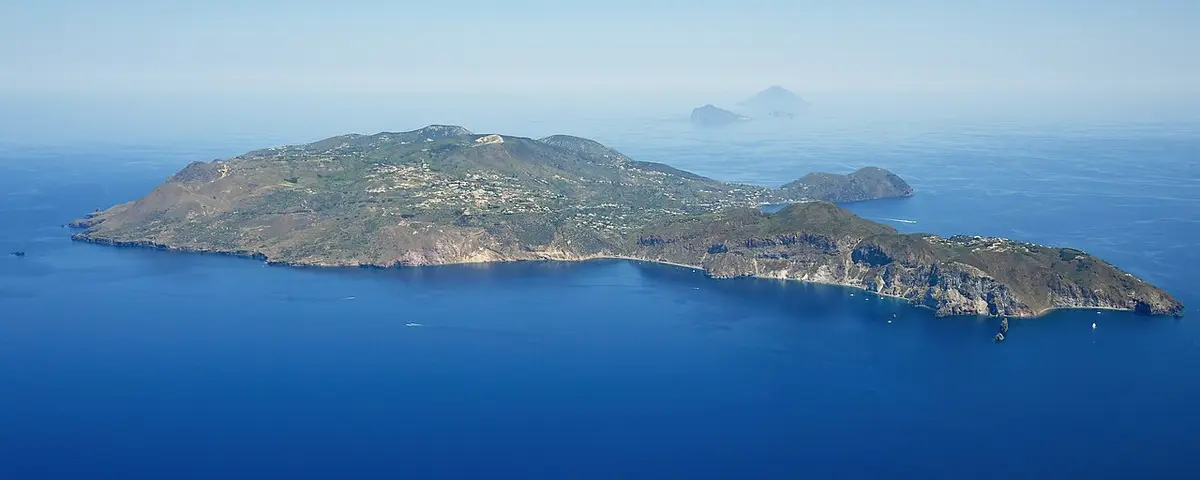
About Lipari
No other comune in Italy is spread across six inhabited islands. Lipari island, the largest, has around 10,700 people; Vulcano and Stromboli a few hundred each, with Stromboli's crater still active; Panarea and Filicudi around 250 each; and Alicudi about a hundred. Each island is a frazione with its own villages, such as Canneto on Lipari and Ginostra on Stromboli.
On Lipari, the old town of the Castello sits on its rock above the sea, walled by Charles V in the sixteenth century, with the Norman cathedral of San Bartolomeo of 1094, several baroque churches and the excavated layers of the ancient acropolis. The lower town spreads between the two harbours.
Strabo identified the island with Aeolia, home of the god of the winds; legend credits Liparus, son of Ausonius, with naming it.
Living in Lipari
Lipari is the only place in the archipelago that feels like a town all year. It has the islands' main shops, schools, offices and port, and a population that has been growing slightly, with a large foreign community. In summer numbers rise sharply with visitors and seasonal workers, and thousands of tourist beds fill.
Life on the smaller islands is far more limited, especially in winter, when bad weather can cut ferry links for days. Milazzo is the usual gateway to Sicily.
The rewards are the sea, the volcanic landscape and a strong identity. The costs are high island prices, crowded summers and dependence on boats, and Stromboli and Vulcano carry real volcanic risk.
A short history
People lived on Lipari by around 5000 BC, and the island grew rich trading obsidian, the sharp black volcanic glass, across the Mediterranean. In the Bronze Age Aegean traders and settlers used the islands as outposts on the routes through the Strait of Messina, and the excavated villages on the acropolis span the Neolithic to the Iron Age.
Greek colonists from Knidos founded Lipara around 580 BC on the castle rock and fought the Etruscans for control of the Tyrrhenian. The town later served Carthage as a naval base in the First Punic War, fell to Rome in 252 to 251 BC and became a place of baths and of exile.
Saracen raiders devastated the island in 839 and the relics of Saint Bartholomew were taken to Benevento. The Normans repopulated it, founding the abbey and cathedral in 1094. In 1544 the Ottoman admiral Barbarossa sacked Lipari and carried off its people into slavery; Charles V repopulated the town and in 1556 built the great walls that still ring the Castello.
Between the 1920s and the 1940s the Fascist regime used the islands as a place of confinement for political prisoners, among them Emilio Lussu and Carlo Rosselli. After the war the archaeologists Luigi Bernabò Brea and Madeleine Cavalier excavated the islands.
Food, festivals and traditions
Capers, Malvasia wine, fish and almond pastries are the island classics, with swordfish and squid in season and wine grown on the terraces of the farming villages.
Saint Bartholomew is the patron, shown on the town's arms at the castle gate, and his main feast falls on 24 August, the island's great celebration.
Interesting facts about Lipari
- Lipari is the only comune in Italy spread across six inhabited islands.
- Greek settlers from Knidos founded Lipara around 580 BC.
- In 1544 Barbarossa sacked the town and enslaved its people.
- Lipari's obsidian was traded across the Mediterranean in prehistoric times.
House prices in Lipari
€1,686average price per m² to buy
€5.51average rent per m² a month
€169,000a 100 m² home at that price
These are the official averages from the Agenzia delle Entrate's property market observatory (OMI) for homes in normal condition across the town's 11 price zones. Prices in Lipari are above the typical town in Messina province (€644 per m²) and above the typical Sicilian town (€593 per m²). Detached houses (villini) average about €1,923 per m².
Why these figures can look low: they come from the values on real sales, which sit below advertised asking prices, and the typical Sicilian town is the middle of all 391 comuni, most of them small inland towns. Island-wide averages quoted on property portals, around €1,100 to €1,300 per m², lean towards the cities and the coast, where most homes are listed. Rents work the same way: listings usually ask well above the official rent figure, often double or more.
Houses that need work, which is most of the cheap ones you see advertised, sell well below these figures. The renovation comes on top, so budget for both.
Work out the return on a let with the rental yield calculator, or see the steps from offer to keys in the buying timeline planner.
Getting there and getting around
Lipari is the main port of the Aeolian Islands. Hydrofoils from Milazzo take about an hour and car ferries about two hours, with sailings all year. Hydrofoils also run from Messina, and in summer from Palermo and Reggio Calabria.
Catania airport is about an hour and a half by car from Milazzo port. The comune includes the islands of Vulcano, Stromboli, Panarea, Filicudi and Alicudi.
Planning flights and trips? See the Schengen 90/180 calculator if you are from outside the EU.
Everyday life: shops, health and schools
- Medical emergencies
- Lipari has the only hospital in the Aeolian Islands, with an emergency department. Serious cases are flown to the main island. In an emergency anywhere in Italy, call 112.
- Pharmacies in the comune
- 8
- Supermarkets
- 16
- Schools
- State: 10 nursery schools, 10 primary schools, 3 middle schools, 2 secondary schools; plus 1 independent (paritaria)
- Banks and cash machines
- 13
- Cafés and bars
- 46
- Restaurants
- 103
- Full fibre broadband
- 81.2% of addresses
Pharmacies and schools come from the official Ministry of Health and Ministry of Education lists. The other counts are of places mapped in OpenStreetMap inside the comune's boundary, so a small shop or a doctor's surgery can be missing. “Not fully mapped yet” means the volunteer map clearly has gaps here, not that the town has none. For a family doctor (medico di base, what the British call a GP), you register with the local health authority (ASP Messina) once you are resident.
Free download
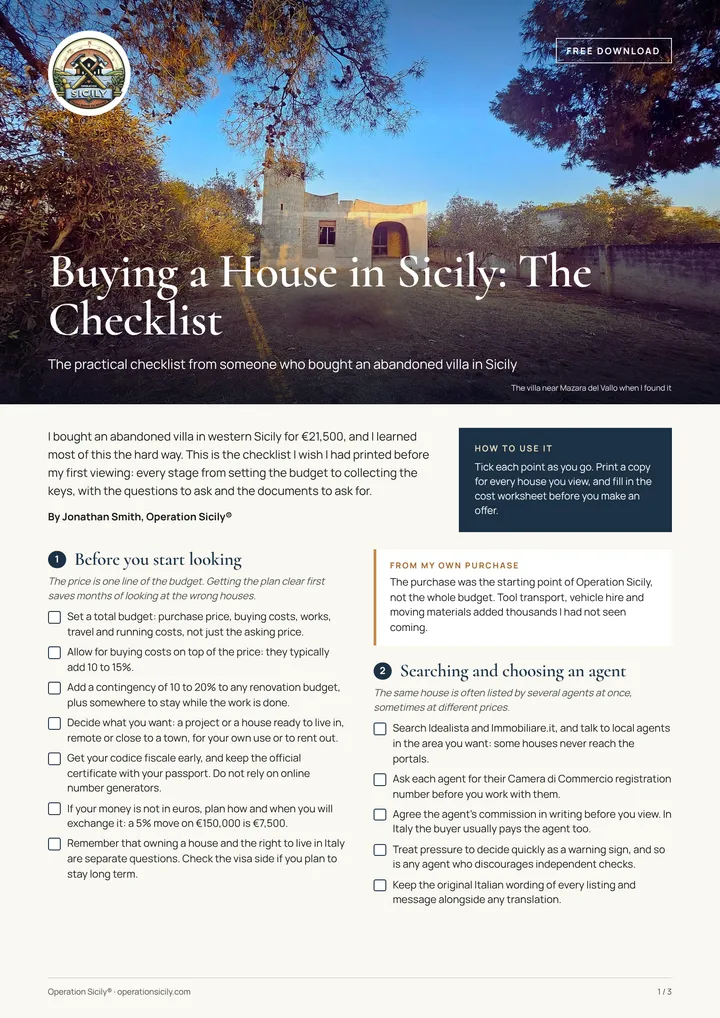
Buying a house in Sicily? Take my checklist.
Every step from budget to keys, the questions to ask at a viewing and the documents to ask for, as a PDF you can print.
Here is your checklist. Download the checklist (PDF)
Weather and climate in Lipari
31.5°Caverage July high
9.7°Caverage January low
617 mmrain a year, on about 95 days
3days a year above 30°C
| Month | Average temperature | Rain |
|---|---|---|
| January | 13°C | 79 mm |
| February | 13°C | 68 mm |
| March | 14°C | 60 mm |
| April | 16°C | 46 mm |
| May | 19°C | 22 mm |
| June | 23°C | 19 mm |
| July | 26°C | 11 mm |
| August | 27°C | 17 mm |
| September | 25°C | 59 mm |
| October | 22°C | 69 mm |
| November | 18°C | 83 mm |
| December | 15°C | 84 mm |
Averages for 2015 to 2024. Winters are mild, though stone houses still feel cold without heating. Summers are hot and dry.
See what each month brings in Sicily month by month, or size a solar system with the off-grid solar calculator.
Who lives there
- Population
- 12,766
- Change since 2019
- +2.3%
- Median age
- 46
- Foreign residents
- 999 (7.8%)
- People from Lipari are called
- liparesi
Registered residents from abroad include 10 British, 4 American, 50 German, 26 French, 2 Belgian, 1 Irish, 9 Australian, 2 Canadian, 1 Swedish, 21 Swiss, 3 Spanish, 44 Polish, 247 Romanian, 17 Albanian and 33 Ukrainian citizens. Most of the rest come from countries outside Europe and the Americas. Others own holiday homes here without registering as residents.
Lipari is a holiday town, with about 3 tourist beds for every 10 residents. It is busy from June to September and much quieter from November to March, when some hotels, restaurants and beach bars close. Visit in both seasons before you decide.
Beaches in Lipari
Lipari has 14 beaches in our beach guide, and 15 more named beaches and coves mapped along its coast. 100% of its officially monitored bathing waters were rated excellent in the latest EU assessment. It flies the Blue Flag this season.
- Acquacalda Beach, Lipari sand and pebbles, water excellent
- Acque Calde Beach, Vulcano sand and rocks, water excellent
- Bazzina Beach, Alicudi pebbles, water excellent
- Cala Junco, Panarea pebbles, water excellent
- Canneto Beach, Lipari pebbles, water excellent
- Capo Graziano Beach, Filicudi pebbles, water excellent
- Ficogrande Beach, Stromboli sand and rocks, water excellent
- Forgia Vecchia Beach, Stromboli pebbles, water excellent
- Gelso Beach, Vulcano sand and pebbles, water excellent
- Pecorini a Mare, Filicudi pebbles, water excellent
- Sabbie Nere Beach, Vulcano fine sand, water excellent
- Spiaggia Bianca, Lipari pebbles, water excellent
- Valle Muria Beach sand and pebbles
- Zimmari Beach, Panarea sand, water excellent
Things to see and do in and around Lipari
Start at the Castello, with the cathedral and the Museo archeologico regionale eoliano Luigi Bernabò Brea, whose collections run from prehistory to classical times. Walk to the Quattrocchi viewpoint for the classic view of Vulcano, and see the white pumice slopes and the old quarries near Acquacalda and the obsidian flows of Monte Pilato.
From the harbours, boats run to Vulcano for its crater walk and hot springs, to Stromboli for the evening eruptions, and to Panarea, Filicudi and Alicudi, each with its own character.
- Stromboli
- Vulcano
- Alicudi
- Panarea
- Filicudi
- Lipari
- Strombolicchio
- Basiluzzo
- Lipari Cathedral
- Vulcanello
- Mount Stromboli
- Filicudi Porto
- Capo Graziano
- Museo archeologico regionale eoliano (Lipari)
Beaches within the comune include Spiaggia delle piramidi, Spiaggia bianca, Spiaggia delle Sabbie nere, Spiaggia delle Acque Calde, Spiaggetta degli Zimmari, Spiagga della Papesca.
Earthquake, landslide and flood risk
Lipari is in seismic zone 2, the second highest of Italy’s four seismic zones. The zone sets the anti-seismic standard for any new building, extension or structural renovation, which affects both the design and the cost. A structural survey is worth paying for before you buy any older building, stone house or flat.
19.3% of the comune's land is mapped by ISPRA as high or very high landslide hazard, where 3% of residents live, and under 0.1% of the land could flood in a medium-probability flood. Ask for the hazard maps (PAI) for any house you are considering; the comune's technical office or your geometra can check them.
Check what you can build or change with the building permit checker, and keep a margin with the renovation contingency calculator.
The comune: useful details
- Official name
- Comune di Lipari
- Province
- Messina (Città metropolitana di Messina)
- Postcode (CAP)
- 98055
- Dialling code
- 090
- Area
- 89 km²
- Height above sea level
- 5 m
- ISTAT code
- 083041
- Cadastral code
- E606 (used in the codice fiscale of people born here)
- Official website
- comune.lipari.me.it
Registering as a resident, paying local taxes and building permits all go through the comune. If you were born abroad, get your Italian tax code first with the codice fiscale calculator.
Nearby towns
Lipari is an island comune: the towns of the main island are reached by ferry.
Towns like Lipari elsewhere in Sicily
- Pantelleria (Trapani province)
- Favignana (Trapani province)
- Lampedusa e Linosa (Agrigento province)
- Ustica (Palermo province)
- Leni (Messina province)
- Santa Marina Salina (Messina province)
Lipari on our lists
See every town in Messina province (108 comuni), or let Find your town suggest places that match what you want.
Frequently asked questions
Where is Lipari?
Lipari is an island comune in the province of Messina, about 60 km north-west of Messina. The centre sits about 5 metres above sea level.
What is Lipari known for?
Lipari is the only comune in Italy spread across six inhabited islands. Greek settlers from Knidos founded Lipara around 580 BC. In 1544 Barbarossa sacked the town and enslaved its people.
Is Lipari a good place to live?
It depends what you want. Islanders by choice who want sea, volcanoes and a real working town with year round services, and who accept that the ferry shapes the week.
How much do houses cost in Lipari?
Official figures from the Agenzia delle Entrate put homes in Lipari at about €1,686 per square metre on average, so a 100 m² home in normal condition would be roughly €169,000. That is above the typical town in the province (€644) and above the typical Sicilian town (€593). Houses needing work sell for less, and the best homes for more.
How do you get to Lipari?
Lipari is the main port of the Aeolian Islands. Hydrofoils from Milazzo take about an hour and car ferries about two hours, with sailings all year. Hydrofoils also run from Messina, and in summer from Palermo and Reggio Calabria. Catania airport is about an hour and a half by car from Milazzo port. The comune includes the islands of Vulcano, Stromboli, Panarea, Filicudi and Alicudi.
What is the weather like in Lipari?
Summers are hot and dry: July afternoons average about 31.5°C, with around 3 days a year above 30°C. Winter nights in January average about 9.7°C. Rain totals about 617 mm a year, falling mostly between October and March.
How many people live in Lipari?
12,766 people live in the comune of Lipari, according to ISTAT. The population grew by 2.3% between 2019 and 2025. Half the residents are older than 46.
Is there a hospital on Lipari?
Lipari has the only hospital in the Aeolian Islands, with an emergency department. Serious cases are flown to the main island. In an emergency anywhere in Italy, call 112.
Is Lipari in an earthquake zone?
Lipari is in seismic zone 2, the second highest of Italy’s four seismic zones. New building and structural work anywhere in Italy must follow anti-seismic rules, and the zone sets how strict they are, so ask your geometra or engineer to check any house you plan to buy or renovate.
Does Lipari count for the 7% flat tax for pensioners?
On population, yes: Lipari is a Sicilian town under the 30,000 resident limit for Italy's 7% flat tax for foreign pensioners. The other conditions are about you, not the town. Check the details with our 7% flat tax town checker and a qualified adviser.
Does Lipari have fast internet?
Yes, for most homes: about 81.2% of addresses in Lipari can get full fibre (FTTH), according to the communications regulator AGCOM. Check the exact address before you buy.
Which Aeolian Islands belong to the comune of Lipari?
All the inhabited islands except Salina: Lipari, Vulcano, Stromboli, Panarea, Filicudi and Alicudi.
Is Lipari lively outside the summer?
Lipari town stays active all year with shops, schools and offices, though many hotels and restaurants close in winter and the smaller islands become very quiet.
Credits
Photo: Carsten Steger, CC BY-SA 4.0, via Wikimedia Commons.
Figures: ISTAT, Agenzia delle Entrate (OMI), Copernicus ERA5-Land, AGCOM, Dipartimento della Protezione Civile, ISPRA, Ministero della Salute, Ministero dell'Istruzione e del Merito, IndicePA, Open-Meteo, NASA POWER, Wikidata and © OpenStreetMap contributors, with several series gathered by the expatliving-data open data collection. Map boundaries ISTAT via openpolis (CC BY 4.0). Sicily as a whole: 4,787,390 people in 391 comuni.
 The weekly YouTube series