
About Capo Feto Beach
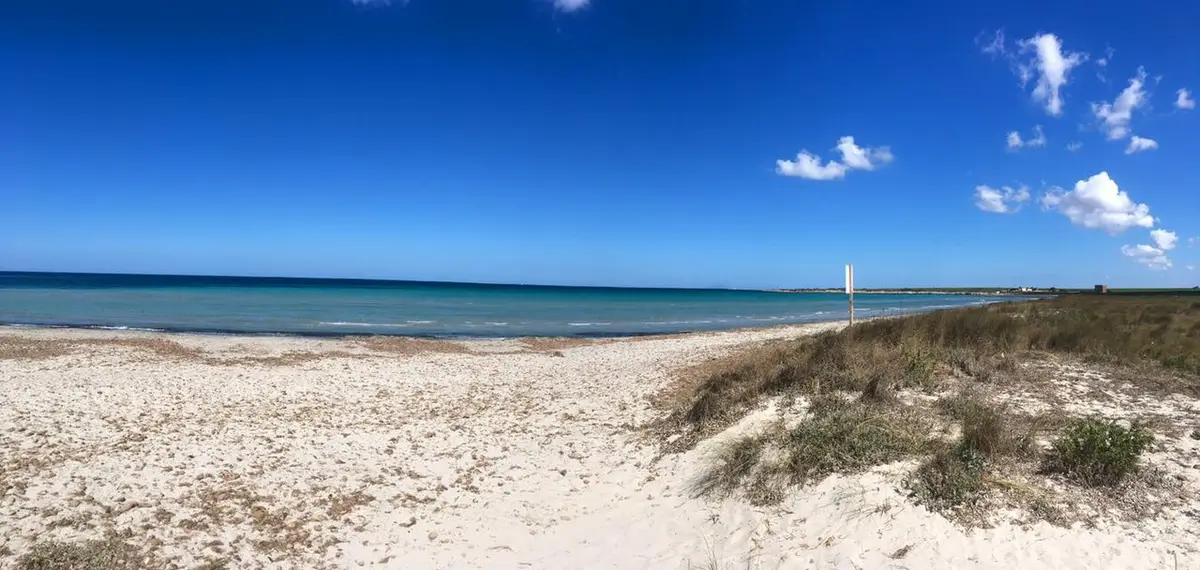
West of Mazara del Vallo the town gives way to a stretch of coast with no buildings at all. Capo Feto is a long beach of fine pale sand, about five kilometres, backed by sand dunes and seasonal pools and salt marshes.
The area is protected as a European Natura 2000 site, Paludi di Capo Feto e Margi Spanò, designated as both a site of community importance and a special protection area for birds. Flamingos, herons and avocets are among the birds seen in the wetlands, and junipers and salt loving plants grow on the dunes.
The sea here shades from green to turquoise over a sandy bottom. Because the coast is open and often windy, it is popular with kitesurfers, and seagrass washes up in banks. There are no lidos: bring everything you need.
How to get to Capo Feto Beach
From Mazara del Vallo follow the seafront west along the Lungomare Fata Morgana past Tonnarella until the road ends at the edge of the protected area. Park where you can and walk over the sand.
The A29 motorway exit for Mazara del Vallo is the easiest approach from Palermo or Trapani.
Reached from the end of the Lungomare Fata Morgana west of Mazara, with a walk over the sand and dunes.
By car, Capo Feto Beach is about 1 hour 37 minutes from Trapani Birgi airport and 2 hours 9 minutes from Palermo Falcone Borsellino airport.
Tips for visiting Capo Feto Beach
- Bring shade, water and food; there are no services.
- Keep to existing paths through the dunes to protect them.
- Bring binoculars for the birds in the marsh pools, especially in spring and autumn.
- Expect wind; check the forecast if you want a calm swim.
What is there
- No lidos or sunbed hire, with a free public stretch.
- Inside the Paludi di Capo Feto e Margi Spanò (Natura 2000 site): follow the reserve’s rules on access, fires, dogs and taking sand or shells.
- A public car park mapped within 600 metres; in July and August they fill early.
Facts about Capo Feto Beach
- Capo Feto is one of the few coastal wetlands left in Sicily.
- It is protected as the Natura 2000 site ITA010006, Paludi di Capo Feto e Margi Spanò.
- The beach runs for about five kilometres west of Mazara del Vallo.
- Flamingos, herons and avocets use the marshes behind the beach.
Mazara del Vallo: the town
Mazara del Vallo is a fishing city of about 50,000 people at the mouth of the Màzaro river, less than 200 km from Tunisia, home of Italy's largest deep-sea fishing fleet, a kasbah of narrow lanes and the bronze Dancing Satyr. Read our guide to living in Mazara del Vallo: house prices, the weather month by month, the nearest hospital and airports, history and food.
Beaches near Capo Feto Beach
- Tonnarella Beach, Mazara del Vallo Mazara del Vallo, 3 km, fine sand
- Lido Signorino Beach Marsala, 10 km, fine sand
- Tre Fontane Beach Campobello di Mazara, 19 km, fine sand
- Triscina Beach Castelvetrano, 24 km, fine sand
- Marinella di Selinunte Beach Castelvetrano, 28 km, fine sand
- San Teodoro Beach Marsala, 28 km, fine sand
- Marausa Beach Misiliscemi, 32 km, fine sand
- Foce del Belice Beach Castelvetrano, 34 km, fine sand
Frequently asked questions
Are there lidos at Capo Feto?
No. Capo Feto is a protected natural beach with no lidos and almost no facilities. For sunbeds and bars, go to Tonnarella beach a little closer to Mazara.
Is Capo Feto a nature reserve?
It is protected as a European Natura 2000 site, Paludi di Capo Feto e Margi Spanò, both for its habitats and as a special protection area for birds. Behave as you would in a reserve and keep off the dunes.
Is Capo Feto good for swimming?
Yes, on calm days the water over the sandy bottom is clear and inviting. The coast is often windy, though, and banks of seagrass can line the shore.
Is Capo Feto Beach sandy?
Yes, Capo Feto Beach is a white sand beach.
Credits
Photo: sicilian_dunes, CC BY 2.0, via Wikimedia Commons.
Written from 5 or more independent sources and checked. Figures: bathing water quality from the European Environment Agency (EU Bathing Water Directive), drive times and facilities from © OpenStreetMap contributors, map boundaries ISTAT via openpolis (CC BY 4.0).
Before you go: the latest sampling results and any bathing bans are on the Ministry of Health's Portale Acque, and local notices on the comune of Mazara del Vallo's website.
 The weekly YouTube series