
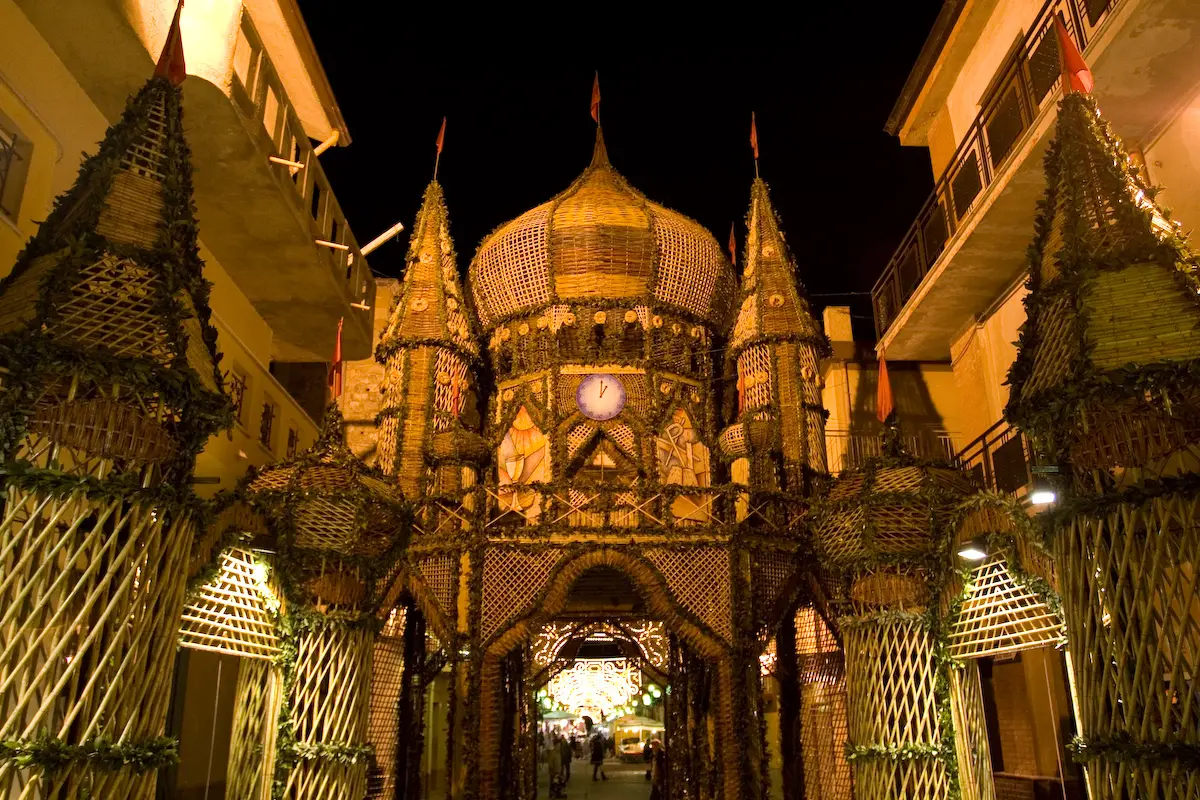
About San Biagio Platani
The village lies on the middle slope of a hill that rises to contrada Garipi and falls away towards the Platani. Its plan is unusually regular: the main axis, today's Corso Umberto I, once called strada Piazza, or La Chiazza, runs past the Chiesa Madre and the ducal palace, and the other streets cross it at right angles.
Each Easter the village's two great confraternities, the Signurara and the Madunnara, build the Archi di Pasqua. These arches, domes and bell towers are woven from domestic cane and other plants, laurel and rosemary, and decorated with bread, cereals and pulses, in a tradition that goes back to the seventeenth century. The confraternities compete to outdo each other, and the result covers the whole main street. A museum in the village explains the history of the arches and how they are made, and bread souvenirs are sold during the festival.
The land around is farmed for wheat, almonds, olives, vines and pistachios; the territory lies within the production zone of the protected Pistacchio di Raffadali.
Living in San Biagio Platani
San Biagio has almost no tourist accommodation, and outside Easter it is a quiet agricultural village. The population is ageing and has fallen sharply, by about a tenth in the last decade, which explains the empty houses on offer. Basic shops and services are in the village; Casteltermini and Agrigento, the provincial capital, have more.
Many families have relatives abroad, with large communities of San Biagio descent in Chicago, Tampa, Argentina and Germany, and emigrants often return in summer. Pros: very low costs, a beautiful tradition and a welcoming community. Cons: few jobs, limited services and a long, steep decline in numbers.
A short history
San Biagio began in 1635, when Giovanni Battista Gerardi obtained a licentia populandi, a licence to settle the land. A local historian credits Mariano Gianguercio with founding the village in 1648, but the licence suggests that a few houses were already clustered around a small church some years earlier. Founding villages brought nobles prestige as well as income: a settlement of more than 80 people gave its lord a seat in the Sicilian parliament.
The fief grew steadily and had about 300 people by 1653. It passed through the Gianguercio and Ioppolo families and became a duchy in 1687. In the eighteenth century a reliance on wheat alone led to three famines, and the lords, by then living in Palermo, leased out all their lands. Feudalism ended in 1812, and in 1864 the name Platani was added to distinguish the town from others called San Biagio.
Like many villages of the Sicilian interior, San Biagio lost much of its population to emigration, which created a scattered global community. The village is twinned with Remchingen in Germany.
Food, festivals and traditions
Bread is at the heart of the village's culture, from the loaves woven into the Easter arches to the everyday durum wheat loaf. Pistachios, almonds and olive oil come from the surrounding farms. The patron is Saint Blaise, celebrated on 3 February.
Interesting facts about San Biagio Platani
- The Easter arches are built by two rival confraternities from cane, laurel, bread and grain.
- The village was settled under a licence granted in 1635.
- The name Platani was added in 1864 to tell it apart from other towns called San Biagio.
- San Biagio Platani has run a scheme offering empty houses for one euro.
House prices in San Biagio Platani
€363average price per m² to buy
€1.62average rent per m² a month
€36,000a 100 m² home at that price
These are the official averages from the Agenzia delle Entrate's property market observatory (OMI) for homes in normal condition across the town's 2 price zones. Prices in San Biagio Platani are below the typical town in Agrigento province (€500 per m²) and below the typical Sicilian town (€593 per m²).
Why these figures can look low: they come from the values on real sales, which sit below advertised asking prices, and the typical Sicilian town is the middle of all 391 comuni, most of them small inland towns. Island-wide averages quoted on property portals, around €1,100 to €1,300 per m², lean towards the cities and the coast, where most homes are listed. Rents work the same way: listings usually ask well above the official rent figure, often double or more.
Houses that need work, which is most of the cheap ones you see advertised, sell well below these figures. The renovation comes on top, so budget for both.
San Biagio Platani has run a €1 homes scheme. Check the comune's own website for the houses on offer now and the conditions.
Work out the return on a let with the rental yield calculator, or see the steps from offer to keys in the buying timeline planner.
Getting there and getting around
| From the centre to | By car | Distance |
|---|---|---|
| Palermo Falcone Borsellino airport (PMO) | 2 hours 34 minutes | 146 km |
| Catania Fontanarossa airport (CTA) | 2 hours 37 minutes | 181 km |
| Comiso airport (CIY) | 2 hours 55 minutes | 157 km |
| Trapani Birgi airport (TPS) | 3 hours 3 minutes | 175 km |
| Palermo city centre | 2 hours 4 minutes | 115 km |
| Catania city centre | 2 hours 35 minutes | 182 km |
| Messina, for ferries to the mainland | 3 hours 41 minutes | 275 km |
| Nearest motorway or main road junction (Fontanelle, Zona Industriale) | 40 minutes | 36 km |
| Nearest railway station (Acquaviva-Casteltermini) | 30 minutes | 27 km |
Times are by road on a clear day, worked out from OpenStreetMap. Allow longer in summer and on market days. Most people living in San Biagio Platani rely on a car; buses link the bigger towns but are infrequent on Sundays and in August.
Planning flights and trips? See the Schengen 90/180 calculator if you are from outside the EU.
Everyday life: shops, health and schools
- Hospital with A&E
- Ospedale San Giovanni di Dio, about 43 minutes by car
- Pharmacies in the comune
- 1
- Supermarkets
- Not fully mapped yet
- Schools
- State: 1 nursery school, 1 primary school, 1 middle school
- Banks and cash machines
- Not fully mapped yet
- Cafés and bars
- Not fully mapped yet
- Restaurants
- Not fully mapped yet
- Full fibre broadband
- 93% of addresses
Pharmacies and schools come from the official Ministry of Health and Ministry of Education lists. The other counts are of places mapped in OpenStreetMap inside the comune's boundary, so a small shop or a doctor's surgery can be missing. “Not fully mapped yet” means the volunteer map clearly has gaps here, not that the town has none. For a family doctor (medico di base, what the British call a GP), you register with the local health authority (ASP Agrigento) once you are resident.
Free download
Buying a house in Sicily? Take my checklist.
Every step from budget to keys, the questions to ask at a viewing and the documents to ask for, as a PDF you can print.
Here is your checklist. Download the checklist (PDF)
Weather and climate in San Biagio Platani
31°Caverage July high
3.6°Caverage January low
522 mmrain a year, on about 82 days
| Month | Average temperature | Rain |
|---|---|---|
| January | 8°C | 72 mm |
| February | 8°C | 61 mm |
| March | 10°C | 56 mm |
| April | 13°C | 39 mm |
| May | 17°C | 18 mm |
| June | 23°C | 15 mm |
| July | 26°C | 5 mm |
| August | 26°C | 9 mm |
| September | 22°C | 41 mm |
| October | 18°C | 66 mm |
| November | 14°C | 70 mm |
| December | 10°C | 69 mm |
Averages for 2015 to 2024. Winter nights are cold, with frost and some snow on the higher ground, so plan on heating from November to March. Summers are hot and dry.
See what each month brings in Sicily month by month, or size a solar system with the off-grid solar calculator.
Who lives there
- Population
- 2,778
- Change since 2019
- -10.4%
- Median age
- 50
- Foreign residents
- 38 (1.4%)
- People from San Biagio Platani are called
- sambiagesi
Registered residents from abroad include 4 German, 1 Belgian and 6 Romanian citizens. Most of the rest come from countries outside Europe and the Americas.
San Biagio Platani lives mainly for its own residents rather than for visitors, so everyday life changes little between summer and winter.
Beaches near San Biagio Platani
- Siculiana Marina Beach Siculiana, 23 km, sand, water excellent
- Torre Salsa Beach Siculiana, 23 km, sand
- Giallonardo Beach Realmonte, 23 km, sand, water excellent
- Capo Rossello Beach Realmonte, 25 km, sand, water excellent
Things to see and do in and around San Biagio Platani
Come at Easter for the arches, which stay up for some time after the feast, and visit the museum dedicated to them. At other times, walk the grid of the old centre past the Chiesa Madre and the ducal palace, and explore the Platani valley below. Sant'Angelo Muxaro and its prehistoric tombs are nearby.
The quickest beach to reach by car, Spiaggia di Siculiana Marina, is about 47 minutes away.
Famous people born in San Biagio Platani include Vincenzo Bertolone (Italian archbishop).
Earthquake, landslide and flood risk
San Biagio Platani is in seismic zone 2, the second highest of Italy’s four seismic zones. The zone sets the anti-seismic standard for any new building, extension or structural renovation, which affects both the design and the cost. A structural survey is worth paying for before you buy any older building, stone house or flat.
0.6% of the comune's land is mapped by ISPRA as high or very high landslide hazard, where 1% of residents live, and no medium-probability flood areas are mapped. Ask for the hazard maps (PAI) for any house you are considering; the comune's technical office or your geometra can check them.
Check what you can build or change with the building permit checker, and keep a margin with the renovation contingency calculator.
The comune: useful details
- Official name
- Comune di San Biagio Platani
- Province
- Agrigento (Libero consorzio comunale di Agrigento)
- Postcode (CAP)
- 92020
- Dialling code
- 0922
- Area
- 43 km²
- Height above sea level
- 416 m
- ISTAT code
- 084035
- Cadastral code
- H778 (used in the codice fiscale of people born here)
- Official website
- comunesanbiagioplatani.it
Registering as a resident, paying local taxes and building permits all go through the comune. If you were born abroad, get your Italian tax code first with the codice fiscale calculator.
Nearby towns
San Biagio Platani borders 4 other comuni:
- Alessandria della Rocca €400/m²
- Casteltermini €507/m²
- Sant'Angelo Muxaro
- Santo Stefano Quisquina €445/m²
Towns like San Biagio Platani elsewhere in Sicily
- San Michele di Ganzaria (Catania province)
- Milena (Caltanissetta province)
- Raddusa (Catania province)
- Campofranco (Caltanissetta province)
- Camporeale (Palermo province)
- Ciminna (Palermo province)
San Biagio Platani on our lists
See every town in Agrigento province (43 comuni), or let Find your town suggest places that match what you want.
Frequently asked questions
Where is San Biagio Platani in Sicily?
San Biagio Platani is in the province of Agrigento, about 25 km north of Agrigento. The centre sits about 416 metres above sea level.
What is San Biagio Platani known for?
The Easter arches are built by two rival confraternities from cane, laurel, bread and grain. The village was settled under a licence granted in 1635. The name Platani was added in 1864 to tell it apart from other towns called San Biagio.
Is San Biagio Platani a good place to live?
It depends what you want. A good fit for buyers who want a very affordable village with strong traditions and a close community, deep in the hills of the Agrigento interior. The nearest emergency department is about 43 minutes away, and homes average about €363 per m².
How much do houses cost in San Biagio Platani?
Official figures from the Agenzia delle Entrate put homes in San Biagio Platani at about €363 per square metre on average, so a 100 m² home in normal condition would be roughly €36,000. That is below the typical town in the province (€500) and below the typical Sicilian town (€593). Houses needing work sell for less, and the best homes for more.
What is the nearest airport to San Biagio Platani?
Palermo Falcone Borsellino airport is the nearest, about 2 hours 34 minutes away by car (146 km). Catania Fontanarossa is about 2 hours 37 minutes away. Times are for a clear road and will be longer in summer traffic.
What is the weather like in San Biagio Platani?
Summers are hot and dry: July afternoons average about 31°C. Winter nights in January average about 3.6°C. Rain totals about 522 mm a year, falling mostly between October and March.
How many people live in San Biagio Platani?
2,778 people live in the comune of San Biagio Platani, according to ISTAT. The population fell by 10.4% between 2019 and 2025. Half the residents are older than 50.
Is there a hospital near San Biagio Platani?
The nearest hospital with an emergency department (pronto soccorso) is Ospedale San Giovanni di Dio, about 43 minutes away by car. In an emergency anywhere in Italy, call 112.
Is San Biagio Platani in an earthquake zone?
San Biagio Platani is in seismic zone 2, the second highest of Italy’s four seismic zones. New building and structural work anywhere in Italy must follow anti-seismic rules, and the zone sets how strict they are, so ask your geometra or engineer to check any house you plan to buy or renovate.
Does San Biagio Platani count for the 7% flat tax for pensioners?
On population, yes: San Biagio Platani is a Sicilian town under the 30,000 resident limit for Italy's 7% flat tax for foreign pensioners. The other conditions are about you, not the town. Check the details with our 7% flat tax town checker and a qualified adviser.
Does San Biagio Platani sell houses for €1?
San Biagio Platani is one of the Sicilian towns that has run a €1 homes scheme. Schemes open, close and change, so check the comune's own website for the houses on offer now and the conditions, which usually include renovating within about three years.
Does San Biagio Platani have fast internet?
Yes, for most homes: about 93% of addresses in San Biagio Platani can get full fibre (FTTH), according to the communications regulator AGCOM. Check the exact address before you buy.
Credits
Photo: Carlo Columba, CC BY-SA 2.5 it, via Wikimedia Commons.
Figures: ISTAT, Agenzia delle Entrate (OMI), Copernicus ERA5-Land, AGCOM, Dipartimento della Protezione Civile, ISPRA, Ministero della Salute, Ministero dell'Istruzione e del Merito, IndicePA, Open-Meteo, NASA POWER, Wikidata and © OpenStreetMap contributors, with several series gathered by the expatliving-data open data collection. Map boundaries ISTAT via openpolis (CC BY 4.0). Sicily as a whole: 4,787,390 people in 391 comuni.
 The weekly YouTube series