
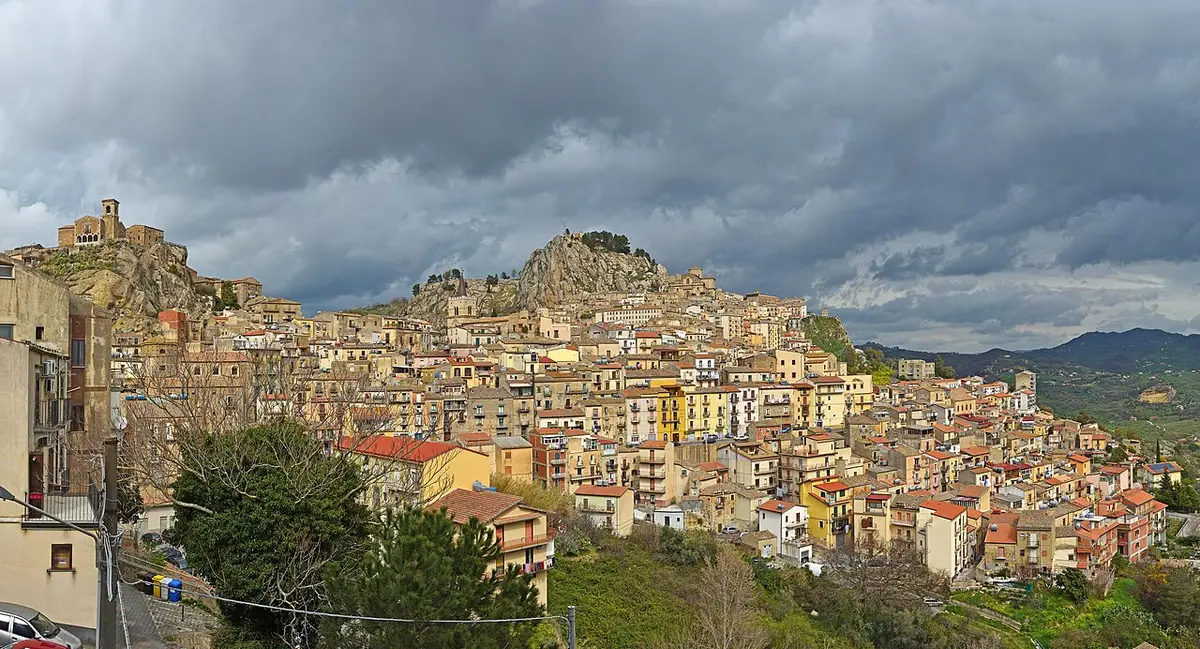
About Nicosia
The cathedral of San Nicolò was built around 1340 as an enlargement of an older chapel and became a cathedral in 1817. It has a Gothic portal, a north portico carved in 1489 and 1490, a font by Antonello Gagini and, above the later vault, a painted fifteenth century wooden ceiling. Santa Maria Maggiore, the church of the Latin community, was destroyed by a landslide in 1757 and rebuilt on a new site; it keeps the small throne made for Charles V and a marble polyptych by Gagini. San Vincenzo Ferreri has frescoes by Guglielmo Borremans from 1717, San Biagio houses the diocesan museum, and the Santissimo Salvatore stands on the peak above the town.
The town spreads over the hills of the Castello, the Salvatore, Monteoliveto and the Cappuccini, with palazzi such as La Motta San Silvestro, La Via and Cirino. The territory is mountainous and wooded, rising to over 1,500 metres, and takes in the hamlet of Villadoro and parts of the Sambuchetti-Campanito and Monte Altesina reserves.
Living in Nicosia
Nicosia is a town for residents, with few tourist beds, and it is losing population steadily. As a bishop's seat and the main centre of the north of the province it has schools, shops, offices and services, so daily life does not depend on other towns. Enna is the provincial capital for anything more, and the nearest station is Leonforte Pirato in the valley.
Pros: real history, a complete town, mountain air and a lively religious and civic calendar. Cons: cold, damp winters, steep streets, a long way to the motorway and the coast, and limited work.
A short history
Historians have tried to identify Nicosia with the ancient Engio, Erbita or Imachara, without proof. The town was a Byzantine stronghold, and after the Norman conquest settlers from Monferrato and Liguria came to live in the upper quarter around Santa Maria Maggiore, while the Greek population gathered lower down around San Nicolò. The rivalry between the Mariani and the Nicoleti lasted for centuries, and the settlers' speech survives in the local dialect.
In the Middle Ages Nicosia was the fourth royal town of Sicily after Palermo, Messina and Catania, and Frederick II named it Civitas Costantissima in 1209. Charles V visited in 1535. By the early eighteenth century it had 84 churches, six friaries and four convents, and it counted 24 barons among its nobility. It became a bishop's seat in 1817 and moved from the province of Catania to the new province of Enna in 1927.
Food, festivals and traditions
Local sweets include nocattoli, braccialetti, pizzillati and mustazzole, alongside the mountain staples of lamb, cheese and ricotta.
On Easter Sunday the statues of the risen Christ and the Madonna meet and embrace in Piazza Garibaldi. Good Friday centres on a wooden crucifix kept in the cathedral, a historical parade recalls the visit of Charles V in August, the Infiorata fills the streets in June, and the Madonna dell'Aiuto on the third Sunday of September draws the biggest crowds after Good Friday.
Interesting facts about Nicosia
- Nicosia was the fourth royal town of Sicily in the Middle Ages.
- Frederick II named it Civitas Costantissima in 1209.
- Santa Maria Maggiore keeps a small throne made for the visit of Charles V in 1535.
- In the early eighteenth century the town had 84 churches.
- Saint Felix of Nicosia, a Capuchin brother born here in 1715, is co-patron of the town.
House prices in Nicosia
€708average price per m² to buy
€2.60average rent per m² a month
€71,000a 100 m² home at that price
These are the official averages from the Agenzia delle Entrate's property market observatory (OMI) for homes in normal condition across the town's 7 price zones. Prices in Nicosia are above the typical town in Enna province (€554 per m²) and above the typical Sicilian town (€593 per m²). Detached houses (villini) average about €1,088 per m².
Why these figures can look low: they come from the values on real sales, which sit below advertised asking prices, and the typical Sicilian town is the middle of all 391 comuni, most of them small inland towns. Island-wide averages quoted on property portals, around €1,100 to €1,300 per m², lean towards the cities and the coast, where most homes are listed. Rents work the same way: listings usually ask well above the official rent figure, often double or more.
Houses that need work, which is most of the cheap ones you see advertised, sell well below these figures. The renovation comes on top, so budget for both.
Work out the return on a let with the rental yield calculator, or see the steps from offer to keys in the buying timeline planner.
Getting there and getting around
| From the centre to | By car | Distance |
|---|---|---|
| Catania Fontanarossa airport (CTA) | 1 hour 34 minutes | 97 km |
| Palermo Falcone Borsellino airport (PMO) | 2 hours 27 minutes | 173 km |
| Comiso airport (CIY) | 2 hours 35 minutes | 142 km |
| Trapani Birgi airport (TPS) | 3 hours 25 minutes | 251 km |
| Palermo city centre | 1 hour 57 minutes | 141 km |
| Catania city centre | 1 hour 32 minutes | 98 km |
| Messina, for ferries to the mainland | 2 hours 20 minutes | 176 km |
| Nearest railway station (Leonforte Pirato) | 37 minutes | 34 km |
Times are by road on a clear day, worked out from OpenStreetMap. Allow longer in summer and on market days. Most people living in Nicosia rely on a car; buses link the bigger towns but are infrequent on Sundays and in August.
Planning flights and trips? See the Schengen 90/180 calculator if you are from outside the EU.
Everyday life: shops, health and schools
- Hospital with A&E
- Ospedale Carlo Basilotta, about 4 minutes by car
- Pharmacies in the comune
- 5
- Supermarkets
- 2
- Schools
- State: 8 nursery schools, 6 primary schools, 1 middle school, 7 secondary schools; plus 2 independent (paritaria)
- Banks and cash machines
- Not fully mapped yet
- Cafés and bars
- Not fully mapped yet
- Restaurants
- Not fully mapped yet
- Full fibre broadband
- 52.2% of addresses
Pharmacies and schools come from the official Ministry of Health and Ministry of Education lists. The other counts are of places mapped in OpenStreetMap inside the comune's boundary, so a small shop or a doctor's surgery can be missing. “Not fully mapped yet” means the volunteer map clearly has gaps here, not that the town has none. For a family doctor (medico di base, what the British call a GP), you register with the local health authority (ASP Enna) once you are resident.
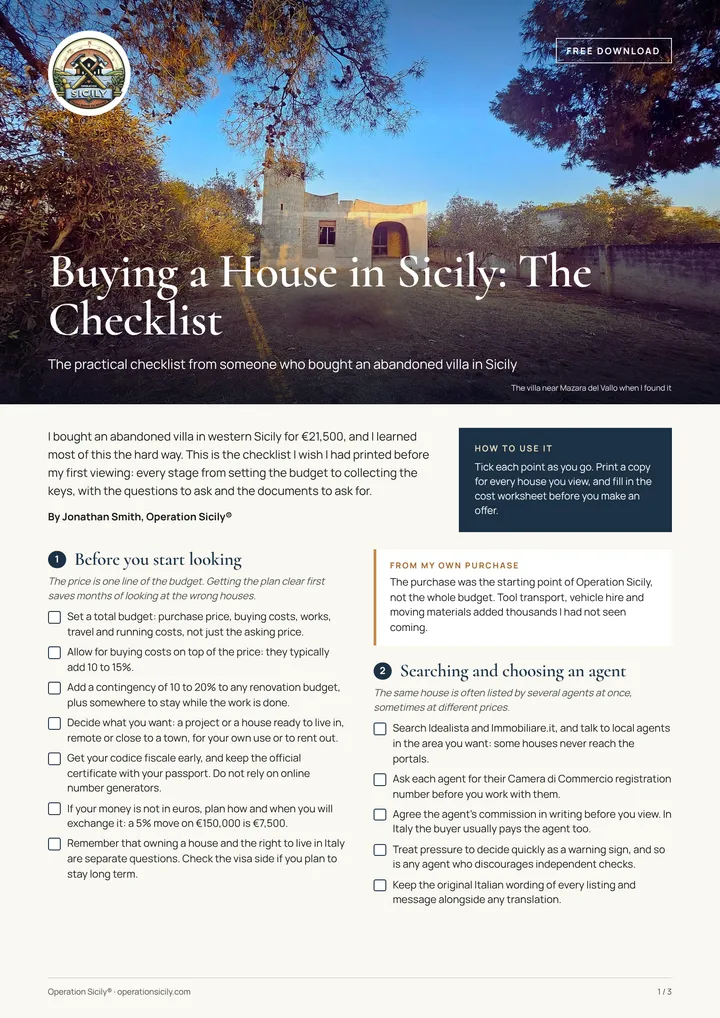
Free download
Buying a house in Sicily? Take my checklist.
Every step from budget to keys, the questions to ask at a viewing and the documents to ask for, as a PDF you can print.
Here is your checklist. Download the checklist (PDF)
Weather and climate in Nicosia
29.3°Caverage July high
2.5°Caverage January low
835 mmrain a year, on about 123 days
25days a year above 30°C
| Month | Average temperature | Rain |
|---|---|---|
| January | 7°C | 108 mm |
| February | 7°C | 93 mm |
| March | 9°C | 86 mm |
| April | 12°C | 61 mm |
| May | 15°C | 28 mm |
| June | 20°C | 26 mm |
| July | 23°C | 12 mm |
| August | 23°C | 18 mm |
| September | 20°C | 75 mm |
| October | 17°C | 104 mm |
| November | 12°C | 112 mm |
| December | 9°C | 112 mm |
Averages for 2015 to 2024. At 724 metres, Nicosia is cooler than the coast. Winter nights are cold, with frost and some snow on the higher ground, so plan on heating from November to March. Summers are warm rather than scorching, which is why Sicilians head for the hills in August.
See what each month brings in Sicily month by month, or size a solar system with the off-grid solar calculator.
Who lives there
- Population
- 12,511
- Change since 2019
- -6.3%
- Median age
- 46
- Foreign residents
- 196 (1.6%)
- Patron saint
- Saint Nicholas
Registered residents from abroad include 3 German, 2 Dutch, 1 French, 10 Spanish, 1 Polish, 80 Romanian, 2 Albanian and 5 Ukrainian citizens. Most of the rest come from countries outside Europe and the Americas.
Nicosia lives mainly for its own residents rather than for visitors, with only about 184 tourist beds, so everyday life changes little between summer and winter.
Beaches near Nicosia
- Castel di Tusa Beach Tusa, 32 km, pebbles, water good
- Costa Turchina Beach Pollina, 36 km, sand and pebbles, water excellent
- Torre Conca Beach Pollina, 38 km, sand and pebbles, water excellent
- Sant'Ambrogio Beach Cefalù, 41 km, sand and pebbles, water excellent
Things to see and do in and around Nicosia
Start at the cathedral and Santa Maria Maggiore, then walk up through the old quarters to the castle ruins and the Salvatore for the views. The diocesan museum in San Biagio holds a Saint Bartholomew by Jusepe de Ribera. Sperlinga, with its rock castle, is next door, and the reserves of Sambuchetti-Campanito and Monte Altesina offer woodland walks.
- Cathedral Basilica of St. Nicholas of Bari
- Basilica of Santa Maria Maggiore
- Riserva naturale orientata Monte Altesina
- Riserva naturale orientata Sambuchetti-Campanito
- Santissimo Salvatore, Nicosia
- Santi Simone e Giuda
- Museo della montagna siciliana
The quickest beach to reach by car, Marina, is about 53 minutes away.
Famous people born in Nicosia include Felix of Nicosia (Catholic Saint); Marracash (Italian rapper).
Earthquake, landslide and flood risk
Nicosia is in seismic zone 2, the second highest of Italy’s four seismic zones. The zone sets the anti-seismic standard for any new building, extension or structural renovation, which affects both the design and the cost. A structural survey is worth paying for before you buy any older building, stone house or flat.
1.2% of the comune's land is mapped by ISPRA as high or very high landslide hazard, where 4.2% of residents live, and no medium-probability flood areas are mapped. Ask for the hazard maps (PAI) for any house you are considering; the comune's technical office or your geometra can check them.
Check what you can build or change with the building permit checker, and keep a margin with the renovation contingency calculator.
The comune: useful details
- Official name
- Comune di Nicosia
- Province
- Enna (Libero consorzio comunale di Enna)
- Postcode (CAP)
- 94014
- Dialling code
- 0935
- Area
- 217 km²
- Height above sea level
- 724 m
- ISTAT code
- 086012
- Cadastral code
- F892 (used in the codice fiscale of people born here)
- Official website
- comune.nicosia.en.it
Registering as a resident, paying local taxes and building permits all go through the comune. If you were born abroad, get your Italian tax code first with the codice fiscale calculator.
Nearby towns
Nicosia borders 10 other comuni:
- Calascibetta €605/m²
- Castel di Lucio €483/m²
- Cerami €453/m²
- Gagliano Castelferrato €373/m²
- Gangi €506/m²
- Geraci Siculo €426/m²
- Leonforte €625/m²
- Mistretta €427/m²
- Nissoria €536/m²
- Sperlinga €428/m²
Towns like Nicosia elsewhere in Sicily
- Nicolosi (Catania province)
- Chiaramonte Gulfi (Ragusa province)
- Palazzolo Acreide (Siracusa province)
- Zafferana Etnea (Catania province)
- Corleone (Palermo province)
- Trecastagni (Catania province)
See every town in Enna province (20 comuni), or let Find your town suggest places that match what you want.
Frequently asked questions
Where is Nicosia in Sicily?
Nicosia is in the province of Enna, about 25 km north-east of Enna. The centre sits about 724 metres above sea level.
What is Nicosia known for?
Nicosia was the fourth royal town of Sicily in the Middle Ages. Frederick II named it Civitas Costantissima in 1209. Santa Maria Maggiore keeps a small throne made for the visit of Charles V in 1535.
Is Nicosia a good place to live?
It depends what you want. Buyers who want a self-sufficient, historic mountain town with genuine character, a strong religious calendar and countryside to explore. The nearest emergency department is about 4 minutes away, and homes average about €708 per m².
How much do houses cost in Nicosia?
Official figures from the Agenzia delle Entrate put homes in Nicosia at about €708 per square metre on average, so a 100 m² home in normal condition would be roughly €71,000. That is above the typical town in the province (€554) and above the typical Sicilian town (€593). Houses needing work sell for less, and the best homes for more.
What is the nearest airport to Nicosia?
Catania Fontanarossa airport is the nearest, about 1 hour 34 minutes away by car (97 km). Palermo Falcone Borsellino is about 2 hours 27 minutes away. Times are for a clear road and will be longer in summer traffic.
What is the weather like in Nicosia?
Summers are warm rather than scorching: July afternoons average about 29.3°C, with around 25 days a year above 30°C. Winter nights in January average about 2.5°C. Rain totals about 835 mm a year, falling mostly between October and March.
How many people live in Nicosia?
12,511 people live in the comune of Nicosia, according to ISTAT. The population fell by 6.4% between 2019 and 2025. Half the residents are older than 46.
Is there a hospital near Nicosia?
The nearest hospital with an emergency department (pronto soccorso) is Ospedale Carlo Basilotta, about 4 minutes away by car. In an emergency anywhere in Italy, call 112.
Is Nicosia in an earthquake zone?
Nicosia is in seismic zone 2, the second highest of Italy’s four seismic zones. New building and structural work anywhere in Italy must follow anti-seismic rules, and the zone sets how strict they are, so ask your geometra or engineer to check any house you plan to buy or renovate.
Does Nicosia count for the 7% flat tax for pensioners?
On population, yes: Nicosia is a Sicilian town under the 30,000 resident limit for Italy's 7% flat tax for foreign pensioners. The other conditions are about you, not the town. Check the details with our 7% flat tax town checker and a qualified adviser.
Does Nicosia have fast internet?
Yes, for most homes: about 52.2% of addresses in Nicosia can get full fibre (FTTH), according to the communications regulator AGCOM. Check the exact address before you buy.
Credits
Photo: Ludvig14, CC BY-SA 4.0, via Wikimedia Commons.
Figures: ISTAT, Agenzia delle Entrate (OMI), Copernicus ERA5-Land, AGCOM, Dipartimento della Protezione Civile, ISPRA, Ministero della Salute, Ministero dell'Istruzione e del Merito, IndicePA, Open-Meteo, NASA POWER, Wikidata and © OpenStreetMap contributors, with several series gathered by the expatliving-data open data collection. Map boundaries ISTAT via openpolis (CC BY 4.0). Sicily as a whole: 4,787,390 people in 391 comuni.
 The weekly YouTube series