
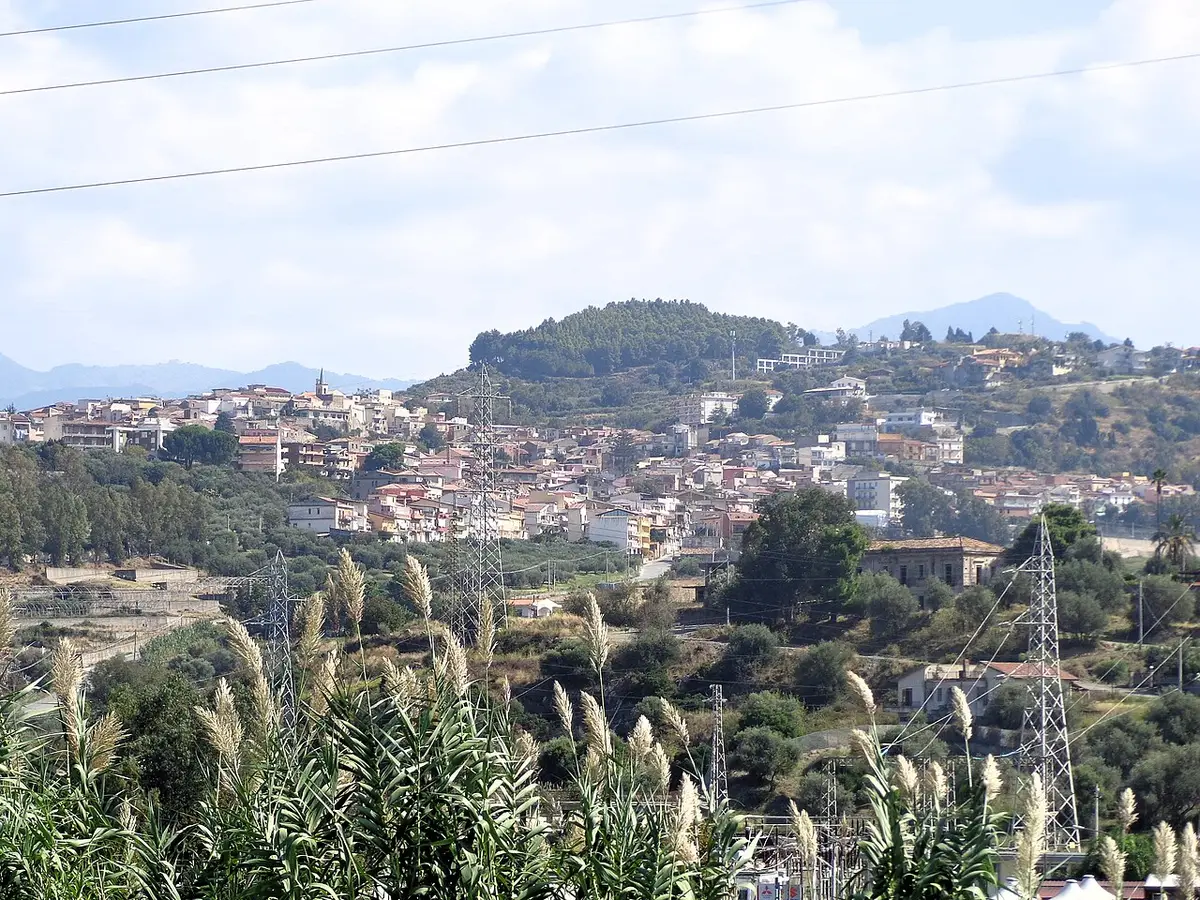
About Furnari
The comune covers about 13 square kilometres, from Monte le Croci at 247 metres down to the sea, and its land is rich in iron and sulphur springs. Furnari collina is the old centre; Furnari marina takes in Tonnarella, Portorosa and the contrade of Bazia, Saiatine and Torre Forte.
In the Chiesa Madre of Santa Croce, built on the ruins of the baronial castle of 1375, is a crucifix carved in 1630 by Fra Innocenzo da Petralia, which seems to show agony, death and the smile of resurrection depending on where you stand. The church of Gesù e Maria, from the mid fifteenth century, has four eighteenth century canvases in the manner of Polidoro da Caravaggio.
Tonnarella's main square has a monument to the fisherman, a reminder of its seafaring roots.
Living in Furnari
Furnari has two rhythms. The marina at Portorosa and Tonnarella fills in summer with holidaymakers and boat owners and is much quieter in winter, while the hill village keeps a steady year round life. The population has been rising, and almost one resident in ten is foreign born, with Moroccan, Romanian and Argentine communities.
Daily shopping is local, and the Novara Montalbano Furnari station on the Palermo to Messina line serves the area. Barcellona Pozzo di Gotto and Milazzo are close for bigger shops, services and the Aeolian ferries.
The pros are sea, marina, motorway and a growing community. The cons are a seasonal feel at the marina, summer traffic and some flood exposure on the low ground.
A short history
Prehistoric tombs at Contrada Grotte, Greek settlement traces at Pezza Grande and Villa Arangia, and Roman remains at Cinque Fontane show a long human presence. The town takes its name from the Furnari family, of Genoese origin, who came to Sicily in 1229; in the late fourteenth century Filippo Furnari became baron, built a castle and founded a feudal village his descendants held for four centuries.
A legend tells instead that Roger II left his wounded greyhound with a peasant called Furnari, who cared for it until the king returned and made him a baron; the town's arms still show a hound and the motto Finché venga, until he comes.
In 1678 Duke Ferdinando Furnari joined the Messina revolt and fled to France, and in 1691 Spain sold the territory to the Marziano of Patti. Feudal rights ended in 1819 and Furnari began life as a comune.
Food, festivals and traditions
Fish from the Tyrrhenian and citrus and olives from the hills are the local produce. Saint Anthony of Padua, the patron, is celebrated on 13 June. Tonnarella honours its own patron, Santa Maria di Trapani, on the second Sunday of August, and the Madonna Addolorata has her feast on 8 September.
Interesting facts about Furnari
- The town's arms show a greyhound with the motto Finché venga, from a legend about Roger II.
- Fra Innocenzo da Petralia's crucifix of 1630 in Santa Croce is said to show three expressions depending on the viewpoint.
- Feudal rule ended in 1819, when Furnari became a comune.
House prices in Furnari
€863average price per m² to buy
€2.62average rent per m² a month
€86,000a 100 m² home at that price
These are the official averages from the Agenzia delle Entrate's property market observatory (OMI) for homes in normal condition across the town's 4 price zones. Prices in Furnari are above the typical town in Messina province (€644 per m²) and above the typical Sicilian town (€593 per m²). Detached houses (villini) average about €1,267 per m².
Why these figures can look low: they come from the values on real sales, which sit below advertised asking prices, and the typical Sicilian town is the middle of all 391 comuni, most of them small inland towns. Island-wide averages quoted on property portals, around €1,100 to €1,300 per m², lean towards the cities and the coast, where most homes are listed. Rents work the same way: listings usually ask well above the official rent figure, often double or more.
Houses that need work, which is most of the cheap ones you see advertised, sell well below these figures. The renovation comes on top, so budget for both.
Work out the return on a let with the rental yield calculator, or see the steps from offer to keys in the buying timeline planner.
Getting there and getting around
| From the centre to | By car | Distance |
|---|---|---|
| Catania Fontanarossa airport (CTA) | 2 hours | 119 km |
| Palermo Falcone Borsellino airport (PMO) | 2 hours 41 minutes | 210 km |
| Comiso airport (CIY) | 3 hours 19 minutes | 203 km |
| Trapani Birgi airport (TPS) | 3 hours 39 minutes | 288 km |
| Palermo city centre | 2 hours 12 minutes | 178 km |
| Catania city centre | 1 hour 49 minutes | 109 km |
| Messina, for ferries to the mainland | 48 minutes | 54 km |
| Nearest railway station (Novara-Montalbano-Furnari) | 6 minutes | 4 km |
Times are by road on a clear day, worked out from OpenStreetMap. Allow longer in summer and on market days. Most people living in Furnari rely on a car; buses link the bigger towns but are infrequent on Sundays and in August.
Planning flights and trips? See the Schengen 90/180 calculator if you are from outside the EU.
Everyday life: shops, health and schools
- Hospital with A&E
- Ospedale Cutroni Zodda, about 18 minutes by car
- Pharmacies in the comune
- 2
- Supermarkets
- 6
- Schools
- State: 2 nursery schools, 2 primary schools, 1 middle school
- Banks and cash machines
- Not fully mapped yet
- Cafés and bars
- 10
- Restaurants
- 6
- Full fibre broadband
- 48.3% of addresses
Pharmacies and schools come from the official Ministry of Health and Ministry of Education lists. The other counts are of places mapped in OpenStreetMap inside the comune's boundary, so a small shop or a doctor's surgery can be missing. “Not fully mapped yet” means the volunteer map clearly has gaps here, not that the town has none. For a family doctor (medico di base, what the British call a GP), you register with the local health authority (ASP Messina) once you are resident.
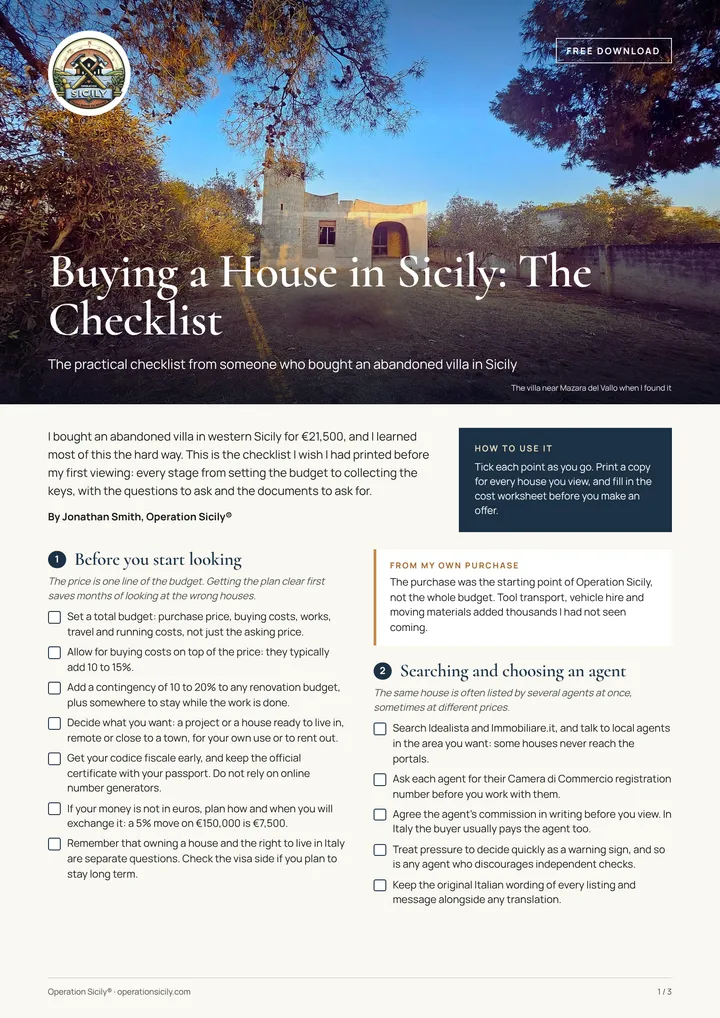
Free download
Buying a house in Sicily? Take my checklist.
Every step from budget to keys, the questions to ask at a viewing and the documents to ask for, as a PDF you can print.
Here is your checklist. Download the checklist (PDF)
Weather and climate in Furnari
32.7°Caverage July high
6.1°Caverage January low
908 mmrain a year, on about 124 days
40days a year above 30°C
| Month | Average temperature | Rain |
|---|---|---|
| January | 11°C | 110 mm |
| February | 11°C | 98 mm |
| March | 13°C | 87 mm |
| April | 16°C | 64 mm |
| May | 19°C | 30 mm |
| June | 24°C | 28 mm |
| July | 28°C | 14 mm |
| August | 28°C | 23 mm |
| September | 24°C | 87 mm |
| October | 21°C | 110 mm |
| November | 16°C | 129 mm |
| December | 13°C | 127 mm |
Averages for 2015 to 2024. Winters are cool and damp, and you will want heating for three or four months. Summers are hot and dry.
See what each month brings in Sicily month by month, or size a solar system with the off-grid solar calculator.
Who lives there
- Population
- 4,147
- Change since 2019
- +8.8%
- Median age
- 47
- Foreign residents
- 409 (9.9%)
- People from Furnari are called
- furnaresi
Registered residents from abroad include 2 American, 5 German, 3 French, 2 Spanish, 9 Polish, 83 Romanian, 5 Albanian and 4 Ukrainian citizens. Most of the rest come from countries outside Europe and the Americas. Others own holiday homes here without registering as residents.
Furnari sees a fair number of visitors, with about 802 tourist beds, so it is livelier in summer, but it is a working town all year round.
Beaches in Furnari
Furnari has one beach in our beach guide. 100% of its officially monitored bathing waters were rated excellent in the latest EU assessment.
- Tonnarella Beach, Furnari sand and pebbles, water excellent
Things to see and do in and around Furnari
In the village, see the Fra Innocenzo crucifix in Santa Croce, the Gesù e Maria church and the Carmine. On the coast, walk the Portorosa marina and swim at Tonnarella.
Tindari's sanctuary and Greek theatre and the Marinello lagoons are a short drive west, Milazzo and its castle east. Inland, Tripi, the ruins of Abakainon and Montalbano Elicona are easy outings, and ferries leave Milazzo for the Aeolian Islands.
- Marina di Portorosa
- Gesù e Maria
- Chiesa di Maria Santissima di Trapani
- Carmine
Beaches within the comune include Spiaggia di Tonnarella.
Earthquake, landslide and flood risk
Furnari is in seismic zone 2, the second highest of Italy’s four seismic zones. The zone sets the anti-seismic standard for any new building, extension or structural renovation, which affects both the design and the cost. A structural survey is worth paying for before you buy any older building, stone house or flat.
0.1% of the comune's land is mapped by ISPRA as high or very high landslide hazard, where 0.2% of residents live, and 7.6% of the land could flood in a medium-probability flood (1.8% of residents). Ask for the hazard maps (PAI) for any house you are considering; the comune's technical office or your geometra can check them.
Check what you can build or change with the building permit checker, and keep a margin with the renovation contingency calculator.
The comune: useful details
- Official name
- Comune di Furnari
- Province
- Messina (Città metropolitana di Messina)
- Postcode (CAP)
- 98054
- Dialling code
- 0941
- Area
- 14 km²
- Height above sea level
- 145 m
- ISTAT code
- 083028
- Cadastral code
- D825 (used in the codice fiscale of people born here)
- Official website
- comune.furnari.me.it
Registering as a resident, paying local taxes and building permits all go through the comune. If you were born abroad, get your Italian tax code first with the codice fiscale calculator.
Nearby towns
Furnari borders 4 other comuni:
- Falcone €890/m²
- Mazzarrà Sant'Andrea €625/m²
- Terme Vigliatore €820/m²
- Tripi-Abakainon €469/m²
Towns like Furnari elsewhere in Sicily
- Realmonte (Agrigento province)
- Lascari (Palermo province)
- Siculiana (Agrigento province)
- Trappeto (Palermo province)
- Campofelice di Roccella (Palermo province)
- Balestrate (Palermo province)
See every town in Messina province (108 comuni), or let Find your town suggest places that match what you want.
Frequently asked questions
Where is Furnari in Sicily?
Furnari is in the province of Messina, about 40 km west of Messina. The centre sits about 145 metres above sea level and its land runs down to the coast.
What is Furnari known for?
The town's arms show a greyhound with the motto Finché venga, from a legend about Roger II. Fra Innocenzo da Petralia's crucifix of 1630 in Santa Croce is said to show three expressions depending on the viewpoint. Feudal rule ended in 1819, when Furnari became a comune.
Is Furnari a good place to live?
It depends what you want. Sailors, beach lovers and families wanting a growing, practical coastal comune near Milazzo and the Aeolian ferries, with a real village up the hill. The nearest emergency department is about 18 minutes away, and homes average about €863 per m².
How much do houses cost in Furnari?
Official figures from the Agenzia delle Entrate put homes in Furnari at about €863 per square metre on average, so a 100 m² home in normal condition would be roughly €86,000. That is above the typical town in the province (€644) and above the typical Sicilian town (€593). Houses needing work sell for less, and the best homes for more.
What is the nearest airport to Furnari?
Catania Fontanarossa airport is the nearest, about 2 hours away by car (119 km). Palermo Falcone Borsellino is about 2 hours 41 minutes away. Times are for a clear road and will be longer in summer traffic.
What is the weather like in Furnari?
Summers are hot and dry: July afternoons average about 32.7°C, with around 40 days a year above 30°C. Winter nights in January average about 6.1°C. Rain totals about 908 mm a year, falling mostly between October and March.
How many people live in Furnari?
4,147 people live in the comune of Furnari, according to ISTAT. The population grew by 8.8% between 2019 and 2025. Half the residents are older than 47.
Is there a hospital near Furnari?
The nearest hospital with an emergency department (pronto soccorso) is Ospedale Cutroni Zodda, about 18 minutes away by car. In an emergency anywhere in Italy, call 112.
Is Furnari in an earthquake zone?
Furnari is in seismic zone 2, the second highest of Italy’s four seismic zones. New building and structural work anywhere in Italy must follow anti-seismic rules, and the zone sets how strict they are, so ask your geometra or engineer to check any house you plan to buy or renovate.
Does Furnari count for the 7% flat tax for pensioners?
On population, yes: Furnari is a Sicilian town under the 30,000 resident limit for Italy's 7% flat tax for foreign pensioners. The other conditions are about you, not the town. Check the details with our 7% flat tax town checker and a qualified adviser.
Does Furnari have fast internet?
In parts. About 48.3% of addresses in Furnari can get full fibre (FTTH), according to AGCOM. Elsewhere, fibre to the cabinet, fixed wireless or 4G and 5G home broadband fill the gap. Check the exact address before you buy.
Is Portorosa part of Furnari?
Yes. The Portorosa marina and holiday district lie in the coastal part of the comune, alongside the fishing hamlet of Tonnarella.
Credits
Photo: Effems, CC BY-SA 4.0, via Wikimedia Commons.
Figures: ISTAT, Agenzia delle Entrate (OMI), Copernicus ERA5-Land, AGCOM, Dipartimento della Protezione Civile, ISPRA, Ministero della Salute, Ministero dell'Istruzione e del Merito, IndicePA, Open-Meteo, NASA POWER, Wikidata and © OpenStreetMap contributors, with several series gathered by the expatliving-data open data collection. Map boundaries ISTAT via openpolis (CC BY 4.0). Sicily as a whole: 4,787,390 people in 391 comuni.
 The weekly YouTube series