
Where was The Godfather filmed in Sicily?
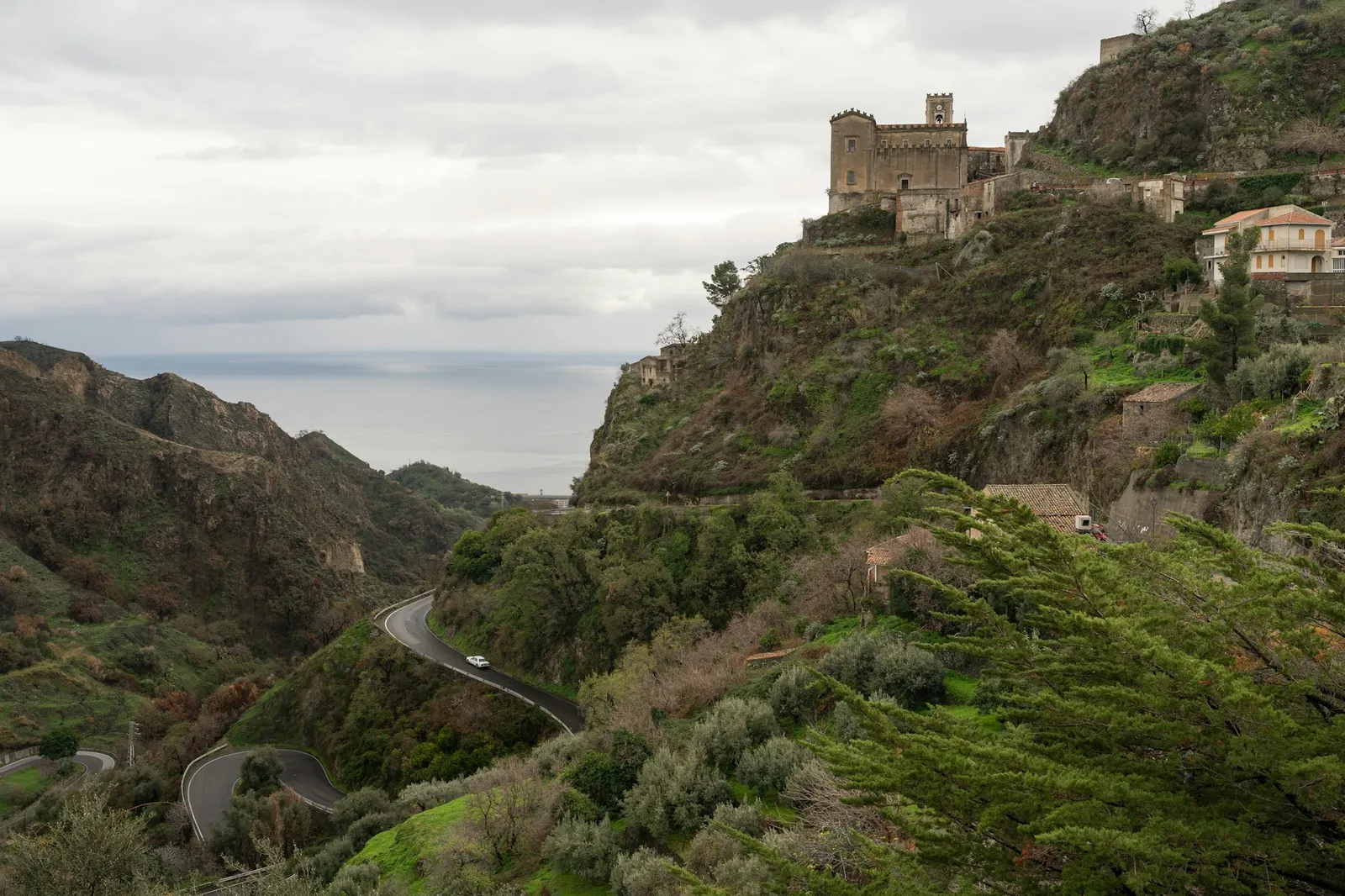
Principal photography on The Godfather ran from 29 March to 6 August 1971, mostly in and around New York. For the Sicilian chapter, when Michael hides in his father's homeland after the killings at the restaurant, the crew spent a few weeks in the summer of 1971 in the hills above the Ionian coast. The two villages they used, Savoca and Forza d'Agrò, are about 12 km apart in the Val d'Agrò, between Taormina and Messina.
| Place | Film | What was filmed there |
|---|---|---|
| Savoca: Bar Vitelli | The Godfather (1972) | Michael meets Apollonia’s father and asks to marry her |
| Savoca: church of San Nicolò and the old streets | The Godfather (1972) | The wedding of Michael and Apollonia, and the procession through the village |
| Forza d’Agrò | The Godfather (1972), Part II (1974) and Part III (1990) | The village that plays Corleone |
| Castello degli Schiavi, Fiumefreddo di Sicilia | The Godfather (1972) and Part III | By the owners’ account, the villa where Michael lives in hiding, and where he dies in Part III |
| Teatro Massimo, Palermo | The Godfather Part III (1990) | The opera night and the final scenes on the steps |
Savoca and Bar Vitelli
Savoca is the village most people mean when they search for the Godfather in Sicily. The scenes were shot at the church of San Nicolò, in the streets of the old centre and at Palazzo Trimarchi, whose ground floor became Bar Vitelli, the bar from Mario Puzo's novel. The sign reading "Bar Vitelli" is still on the front of the building, and it is still a bar. It is where Michael, played by Al Pacino, sits down with Apollonia's father to ask for her hand.
The church of San Nicolò is where the couple marry; the wedding procession was filmed in the lanes below it. In the village there is also a sculpture of Coppola himself, who was made an honorary citizen of Savoca in 2022.
Two practical points. The family that runs Bar Vitelli also has a small hotel upstairs, and in peak season access to the bar can be restricted when it is busy with tour groups. And Savoca is a very small place on a steep ridge: come in the morning, or late in the afternoon when the coaches have gone, and wear shoes that grip. My Savoca town page has more on the village itself.
Forza d’Agrò: the village that played Corleone
Forza d'Agrò, a stone village on a ridge above the sea about 15 km (9 miles) north of Taormina, is the other half of the story. It was used in the first film and again in The Godfather Part II, where it is the Corleone of the young Vito's childhood, and Coppola returned for Part III in the spring of 1990. If you know the films, its lanes and steps will look familiar.
I would see both in one morning or afternoon: the drive between them is about 12 km (7.5 miles), roughly half an hour on narrow mountain roads. See the Forza d'Agrò town page.
Castello degli Schiavi in Fiumefreddo
Castello degli Schiavi is an 18th to 19th century villa in the countryside at Fiumefreddo di Sicilia, south of Taormina. According to its owners, it is the house where Michael lives in his Sicilian exile, where Apollonia dies in the car bomb after the wedding, where Michael talks politics with Don Tommasino, and where, in Part III, the old Michael dies in a chair in front of the house. It has a long screen career beyond the Godfather: Pasolini filmed there in 1968, Coldplay shot the video for Violet Hill there in 2008, and it appears in season 2 of The White Lotus.
It is a private home, so check the owners' site before you go rather than turning up at the gate.
Corleone and The Godfather: the real town
Corleone is a real town, in the hills about 58 km (36 miles), roughly 75 minutes' drive, south of Palermo. Puzo took the family's name from it, but none of the films was shot there, and you will not find film sets or Bar Vitelli in Corleone.
What you will find is the CIDMA, the International Centre for Documentation on the Mafia and the Anti-Mafia Movement, which tells the story of the real mafia in this area and of the people who fought it. Visits are booked through its website. If the films are what brought you to Sicily, an hour there is a sober and useful counterweight, and my guide to the mafia in Sicily covers the same ground for visitors. See also the Corleone town page.
The Godfather Part III at the Teatro Massimo, Palermo
For Part III, filming moved in early 1990 to Palermo, Taormina and Forza d'Agrò. Its long final sequence is set at the Teatro Massimo in Palermo, Italy's largest opera house, during a performance of Cavalleria rusticana, conducted on screen by Anton Coppola. The theatre and its steps are on Piazza Verdi, and the theatre runs guided tours; my walk around Palermo from the cruise port passes it.
How to visit the Godfather villages
| From | To | By car | Without a car |
|---|---|---|---|
| Taormina | Forza d’Agrò | About 15 km (9 miles), 30 minutes | A tour, or a taxi |
| Taormina | Savoca | About 27 km (17 miles), 40 to 45 minutes | A tour, or a taxi |
| Messina | Savoca | About 42 km (26 miles), 50 minutes | Train to Santa Teresa di Riva (about 30 minutes), then the Interbus bus up to Savoca |
| Palermo | Corleone | About 58 km (36 miles), 75 minutes | A car or a tour |
Renting a car in Taormina for a morning is the easiest way to see both villages, and expect to walk uphill once you have parked. Without one, a taxi or an organised Godfather tour is the practical answer, and CNN reports that cruise passengers from Messina come up on such tours. If you are coming by ship, my Messina and Catania cruise port guide covers the timings.
For the films that came after The Godfather, from Cinema Paradiso to The White Lotus, see my guide to films and TV shot in Sicily.
Frequently asked questions
Was The Godfather filmed in Corleone?
No. Corleone is a real town south of Palermo, and the family takes its name from it, but the Sicilian scenes were filmed in Savoca and Forza d’Agrò, two villages near Taormina. Forza d’Agrò plays Corleone on screen.
Where is Bar Vitelli from The Godfather?
In Savoca, a hill village about 27 km (17 miles) north of Taormina. The bar is on the ground floor of Palazzo Trimarchi, the building used in the film, and the Bar Vitelli sign is still on its front. It is still a working bar.
Where was the wedding in The Godfather filmed?
In Savoca. Michael and Apollonia marry in the church of San Nicolò, and the wedding procession was filmed in the streets of the old centre below it.
Can you visit Savoca from Taormina?
Yes. It is about 27 km (17 miles), 40 to 45 minutes by car. Organised Godfather tours run there too. By public transport the usual route is a train along the coast to Santa Teresa di Riva and then a bus up the hill.
Was The Godfather Part II filmed in Sicily?
Yes. The scenes of the young Vito’s childhood in Corleone were filmed in Forza d’Agrò, the same village used in the first film.
Where was The Godfather Part III filmed in Sicily?
In Palermo, Taormina and Forza d’Agrò, in early 1990. The final opera night and the scenes on the steps were filmed at the Teatro Massimo in Palermo.
Is Corleone worth visiting?
Yes, but not for the films. Corleone was never a filming location. Go for the CIDMA, the anti-mafia documentation centre, which tells the real story of the mafia in the area and of those who fought it. It is about 75 minutes by car from Palermo, and visits are booked through its website.
Sources and small print
- CNN Travel, Silvia Marchetti on Savoca, the filming in 1971 and Coppola's honorary citizenship of 2022 (April 2026)
- Val d'Agrò visitor guide (PDF, in Italian), on San Nicolò, Palazzo Trimarchi and Bar Vitelli, and the Comune di Savoca on Palazzo Trimarchi
- Castello degli Schiavi, the owners, on the castle in the films
- Afar, on Castello degli Schiavi and the other Sicilian locations of The White Lotus
- CIDMA Corleone, visits
- Production histories on Wikipedia of The Godfather, Part II and Part III, and of the Teatro Massimo
Driving times are measured on the road network without traffic and rounded. Bars, tours and museums change their hours with the season, so check before you go.
Credits
Photo: Andy Fluet, Unsplash Licence, via Unsplash.
 The weekly YouTube series