
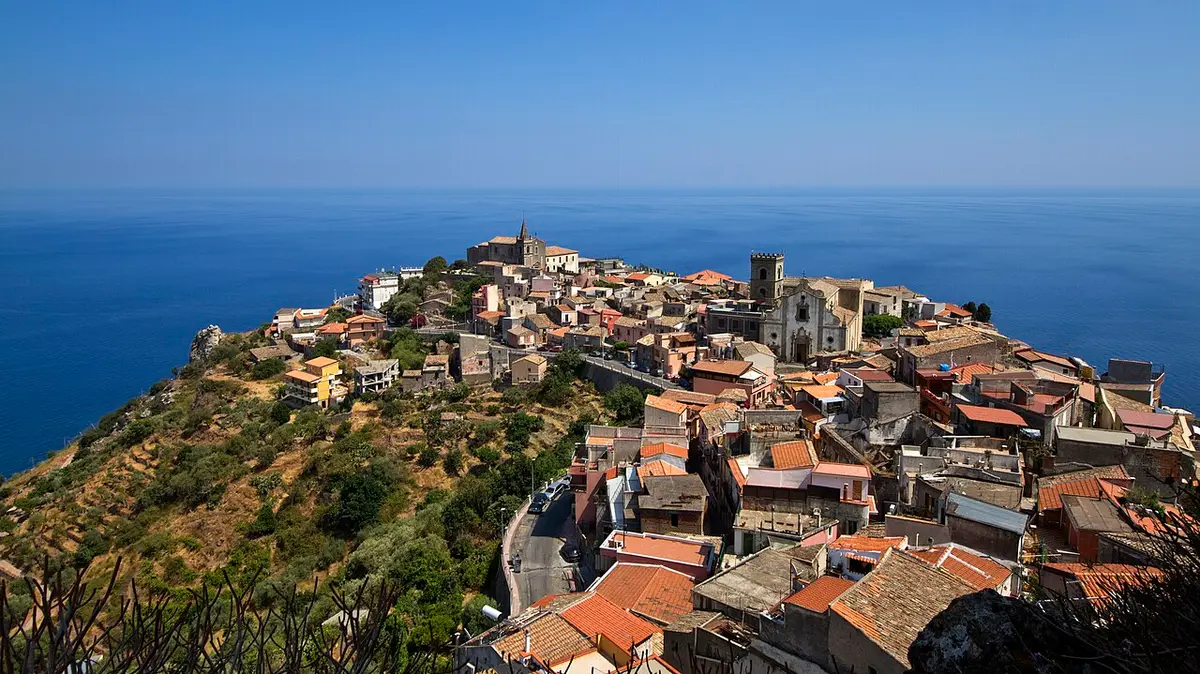
About Forza d'Agrò
The village has grown on its present site since around 1300, after a landslide destroyed the older settlement at Casale, west of Monte Calvario. Its streets climb past the Chiesa Madre of the Santissima Annunziata, rebuilt in 1707, and the Santissima Trinità, reached by a theatrical stairway through the Porta Durazzesca, a fifteenth century arch.
Next door the Augustinian convent, built between 1559 and 1591, has a fine cloister and a crypt where dead monks were seated on stone benches to mummify. It now hosts conferences and events.
The seventeenth century palazzi of the Miano, Mauro and Garufi families show the wealth of a farming elite whose cellars once held wine and oil.
Living in Forza d'Agrò
Forza d'Agrò is busier than most villages of its size, with a good number of visitor beds and day trippers drawn by the views and the films; in winter it quietens but does not empty. Its population has actually grown a little in recent years, with a foreign community of more than a hundred.
Everyday shopping is limited in the village. Down on the coast, Sant'Alessio Siculo and Santa Teresa di Riva have shops, the station and beaches, and Taormina is close for restaurants and culture. Messina is the city for larger needs.
On the plus side: beauty, views, a social atmosphere and the sea just below. On the minus side: steep streets, limited parking, summer crowds and landslide risk on the slopes.
A short history
Finds near the castle show the site was used by Sicels and Greeks; it lay on the border between the spheres of Messana and Naxos. Under Roman rule the area was known as Agrillae. In 1116 Roger II gave the village of Agrilla to the abbot of Santi Pietro e Paolo d'Agrò, who ruled it for centuries; villagers had to farm the abbot's fields and give two hens and a goat at Christmas and Easter.
During the Vespers war in 1282, Peter of Aragon ordered thirty archers from Forza to Taormina. The fifteenth century brought a building boom. An earthquake in 1649 brought down the old Chiesa Madre. In 1654 the population peaked at 1,947. Loyal to Spain in the revolt of 1674, the village was occupied by the French in 1676. In the early nineteenth century British forces held its castle against Napoleonic attack.
Many emigrated to America in the early twentieth century, and in 1948 the coastal hamlet of Sant'Alessio became a separate comune. Film crews arrived from the 1960s, and tourism followed.
Food, festivals and traditions
The kitchen draws on the Ionian below and the terraced hills around: fish, olive oil, citrus and wine, the same produce once stored in the cellars of the Garufi palace. The Chiesa Madre is dedicated to the Santissima Annunziata.
Interesting facts about Forza d'Agrò
- Forza d'Agrò and Savoca stood in for Corleone in The Godfather, and Forza also appears in Parts II and III.
- Under the abbots of Agrò, each household owed the monastery two hens and a goat at Christmas and Easter.
- In 1654 the village reached its peak population of 1,947, about twice today's.
- The Augustinian crypt preserves the stone seats on which dead monks were placed to mummify.
House prices in Forza d'Agrò
€1,028average price per m² to buy
€1.90average rent per m² a month
€103,000a 100 m² home at that price
These are the official averages from the Agenzia delle Entrate's property market observatory (OMI) for homes in normal condition across the town's 2 price zones. Prices in Forza d'Agrò are above the typical town in Messina province (€644 per m²) and above the typical Sicilian town (€593 per m²).
Why these figures can look low: they come from the values on real sales, which sit below advertised asking prices, and the typical Sicilian town is the middle of all 391 comuni, most of them small inland towns. Island-wide averages quoted on property portals, around €1,100 to €1,300 per m², lean towards the cities and the coast, where most homes are listed. Rents work the same way: listings usually ask well above the official rent figure, often double or more.
Houses that need work, which is most of the cheap ones you see advertised, sell well below these figures. The renovation comes on top, so budget for both.
Work out the return on a let with the rental yield calculator, or see the steps from offer to keys in the buying timeline planner.
Getting there and getting around
| From the centre to | By car | Distance |
|---|---|---|
| Catania Fontanarossa airport (CTA) | 1 hour 4 minutes | 71 km |
| Comiso airport (CIY) | 2 hours 23 minutes | 155 km |
| Palermo Falcone Borsellino airport (PMO) | 3 hours 45 minutes | 297 km |
| Trapani Birgi airport (TPS) | 4 hours 43 minutes | 376 km |
| Palermo city centre | 3 hours 15 minutes | 266 km |
| Catania city centre | 53 minutes | 61 km |
| Messina, for ferries to the mainland | 44 minutes | 44 km |
| Nearest railway station (Santa Teresa di Riva) | 13 minutes | 10 km |
Times are by road on a clear day, worked out from OpenStreetMap. Allow longer in summer and on market days. Most people living in Forza d'Agrò rely on a car; buses link the bigger towns but are infrequent on Sundays and in August.
Planning flights and trips? See the Schengen 90/180 calculator if you are from outside the EU.
Everyday life: shops, health and schools
- Hospital with A&E
- Ospedale San Vincenzo, about 23 minutes by car
- Pharmacies in the comune
- 1
- Supermarkets
- None mapped in the comune; the nearest is 9 minutes away
- Schools
- State: 1 nursery school, 1 primary school, 1 middle school
- Banks and cash machines
- 1
- Cafés and bars
- 1
- Restaurants
- 7
- Full fibre broadband
- 67.3% of addresses
Pharmacies and schools come from the official Ministry of Health and Ministry of Education lists. The other counts are of places mapped in OpenStreetMap inside the comune's boundary, so a small shop or a doctor's surgery can be missing. “Not fully mapped yet” means the volunteer map clearly has gaps here, not that the town has none. For a family doctor (medico di base, what the British call a GP), you register with the local health authority (ASP Messina) once you are resident.
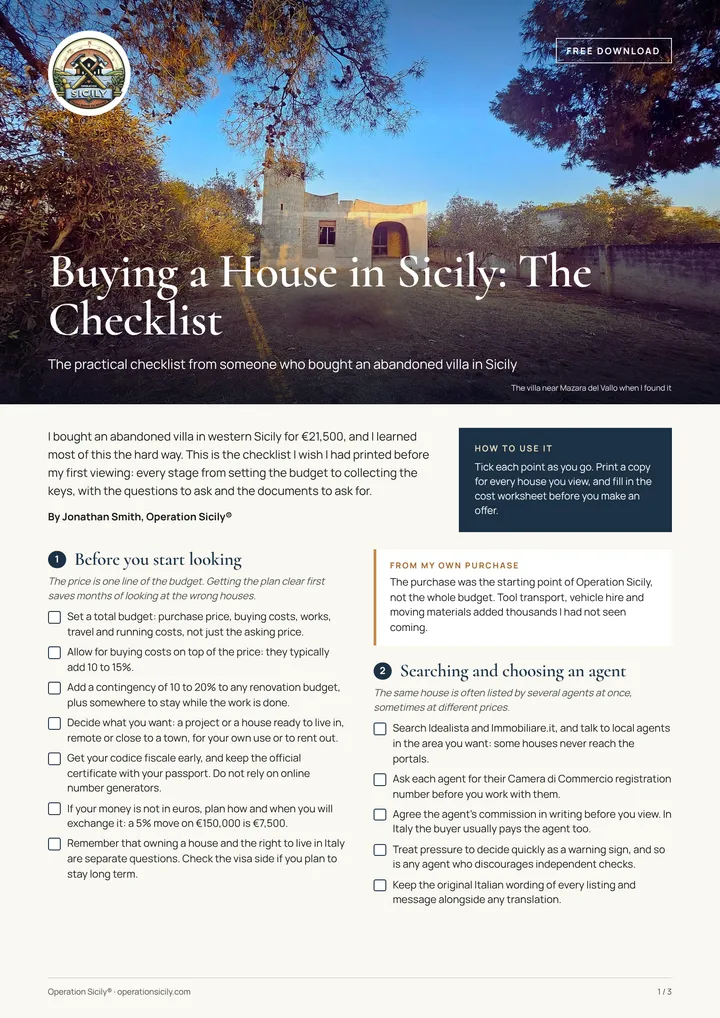
Free download
Buying a house in Sicily? Take my checklist.
Every step from budget to keys, the questions to ask at a viewing and the documents to ask for, as a PDF you can print.
Here is your checklist. Download the checklist (PDF)
Weather and climate in Forza d'Agrò
30.3°Caverage July high
5.6°Caverage January low
931 mmrain a year, on about 121 days
25days a year above 30°C
| Month | Average temperature | Rain |
|---|---|---|
| January | 10°C | 111 mm |
| February | 10°C | 102 mm |
| March | 11°C | 86 mm |
| April | 14°C | 61 mm |
| May | 17°C | 33 mm |
| June | 22°C | 28 mm |
| July | 25°C | 17 mm |
| August | 26°C | 24 mm |
| September | 23°C | 89 mm |
| October | 19°C | 114 mm |
| November | 15°C | 132 mm |
| December | 11°C | 132 mm |
Averages for 2015 to 2024. Winters are cool and damp, and you will want heating for three or four months. Summers are hot and dry.
See what each month brings in Sicily month by month, or size a solar system with the off-grid solar calculator.
Who lives there
- Population
- 930
- Change since 2019
- +7.1%
- Median age
- 46
- Foreign residents
- 117 (12.6%)
- People from Forza d'Agrò are called
- forzesi
Registered residents from abroad include 6 American, 8 German, 1 French, 1 Australian, 1 Swiss, 2 Polish, 63 Romanian and 4 Ukrainian citizens. Most of the rest come from countries outside Europe and the Americas. Others own holiday homes here without registering as residents.
Forza d'Agrò is a holiday town, with about 6 tourist beds for every 10 residents. It is busy from June to September and much quieter from November to March, when some hotels, restaurants and beach bars close. Visit in both seasons before you decide.
Beaches near Forza d'Agrò
- Letojanni Beach Letojanni, 4 km, sand and pebbles, water excellent
- Santa Teresa di Riva Beach Santa Teresa di Riva, 5 km, pebbles, water excellent
- Mazzeo Beach Taormina, 6 km, sand and pebbles, water excellent
- Spisone Beach Taormina, 7 km, sand and pebbles, water excellent
Things to see and do in and around Forza d'Agrò
Walk up to the castle on the summit for the panorama, then explore the Trinità, the convent cloister and crypt, the churches of San Francesco and Sant'Antonio Abate, and the ruined Byzantine church of San Michele at Casale. Film fans will recognise the square and the archway from The Godfather, and Savoca, the other Godfather village, is across the valley.
Below, Capo Sant'Alessio and its castle mark the start of the beaches that run south towards Letojanni and Taormina; Casalvecchio Siculo's Norman church of Santi Pietro e Paolo d'Agrò is a short drive up the valley.
- Castle in Forza d'Agrò
- Chiesa della Santissima Annunziata
- Castello di Forza d'Agrò
Beaches within the comune include Spiaggia di Forza d'Agrò, Spiaggia naturista di Forza d'Agrò.
The quickest beach to reach by car, Spiaggia naturista di Forza d'Agrò, is about 7 minutes away.
Earthquake, landslide and flood risk
Forza d'Agrò is in seismic zone 2, the second highest of Italy’s four seismic zones. The zone sets the anti-seismic standard for any new building, extension or structural renovation, which affects both the design and the cost. A structural survey is worth paying for before you buy any older building, stone house or flat.
12.4% of the comune's land is mapped by ISPRA as high or very high landslide hazard, where 11.3% of residents live, and 3.9% of the land could flood in a medium-probability flood (0.2% of residents). Ask for the hazard maps (PAI) for any house you are considering; the comune's technical office or your geometra can check them.
Check what you can build or change with the building permit checker, and keep a margin with the renovation contingency calculator.
The comune: useful details
- Official name
- Comune di Forza d'Agrò
- Province
- Messina (Città metropolitana di Messina)
- Postcode (CAP)
- 98030
- Dialling code
- 0942
- Area
- 12 km²
- Height above sea level
- 420 m
- ISTAT code
- 083024
- Cadastral code
- D733 (used in the codice fiscale of people born here)
- Official website
- comune.forzadagro.me.it
Registering as a resident, paying local taxes and building permits all go through the comune. If you were born abroad, get your Italian tax code first with the codice fiscale calculator.
Nearby towns
Forza d'Agrò borders 6 other comuni:
- Casalvecchio Siculo €510/m²
- Gallodoro €510/m²
- Letojanni €1,117/m²
- Limina €510/m²
- Mongiuffi Melia
- Sant'Alessio Siculo €1,425/m²
Towns like Forza d'Agrò elsewhere in Sicily
- Comitini (Agrigento province)
- Sant'Angelo Muxaro (Agrigento province)
- Joppolo Giancaxio (Agrigento province)
- Santa Elisabetta (Agrigento province)
- Aci Bonaccorsi (Catania province)
- Montedoro (Caltanissetta province)
See every town in Messina province (108 comuni), or let Find your town suggest places that match what you want.
Frequently asked questions
Where is Forza d'Agrò in Sicily?
Forza d'Agrò is in the province of Messina, about 35 km south-west of Messina. The centre sits about 420 metres above sea level and its land runs down to the coast.
What is Forza d'Agrò known for?
Forza d'Agrò and Savoca stood in for Corleone in The Godfather, and Forza also appears in Parts II and III. Under the abbots of Agrò, each household owed the monastery two hens and a goat at Christmas and Easter. In 1654 the village reached its peak population of 1,947, about twice today's.
Is Forza d'Agrò a good place to live?
It depends what you want. Lovers of history and views who want a lively but small village close to Taormina and the beaches of the Ionian coast. The nearest emergency department is about 23 minutes away, and homes average about €1,028 per m².
How much do houses cost in Forza d'Agrò?
Official figures from the Agenzia delle Entrate put homes in Forza d'Agrò at about €1,028 per square metre on average, so a 100 m² home in normal condition would be roughly €103,000. That is above the typical town in the province (€644) and above the typical Sicilian town (€593). Houses needing work sell for less, and the best homes for more.
What is the nearest airport to Forza d'Agrò?
Catania Fontanarossa airport is the nearest, about 1 hour 4 minutes away by car (71 km). Comiso is about 2 hours 23 minutes away. Times are for a clear road and will be longer in summer traffic.
What is the weather like in Forza d'Agrò?
Summers are hot and dry: July afternoons average about 30.3°C, with around 25 days a year above 30°C. Winter nights in January average about 5.6°C. Rain totals about 931 mm a year, falling mostly between October and March.
How many people live in Forza d'Agrò?
930 people live in the comune of Forza d'Agrò, according to ISTAT. The population grew by 7.1% between 2019 and 2025. Half the residents are older than 46.
Is there a hospital near Forza d'Agrò?
The nearest hospital with an emergency department (pronto soccorso) is Ospedale San Vincenzo, about 23 minutes away by car. In an emergency anywhere in Italy, call 112.
Is Forza d'Agrò in an earthquake zone?
Forza d'Agrò is in seismic zone 2, the second highest of Italy’s four seismic zones. New building and structural work anywhere in Italy must follow anti-seismic rules, and the zone sets how strict they are, so ask your geometra or engineer to check any house you plan to buy or renovate.
Does Forza d'Agrò count for the 7% flat tax for pensioners?
On population, yes: Forza d'Agrò is a Sicilian town under the 30,000 resident limit for Italy's 7% flat tax for foreign pensioners. The other conditions are about you, not the town. Check the details with our 7% flat tax town checker and a qualified adviser.
Does Forza d'Agrò have fast internet?
Yes, for most homes: about 67.3% of addresses in Forza d'Agrò can get full fibre (FTTH), according to the communications regulator AGCOM. Check the exact address before you buy.
Which scenes of The Godfather were filmed in Forza d'Agrò?
With Savoca, the village provided the Corleone scenes of the first film in 1972, and it appears again in The Godfather Part II and Part III.
Credits
Photo: trolvag, CC BY-SA 3.0, via Wikimedia Commons.
Figures: ISTAT, Agenzia delle Entrate (OMI), Copernicus ERA5-Land, AGCOM, Dipartimento della Protezione Civile, ISPRA, Ministero della Salute, Ministero dell'Istruzione e del Merito, IndicePA, Open-Meteo, NASA POWER, Wikidata and © OpenStreetMap contributors, with several series gathered by the expatliving-data open data collection. Map boundaries ISTAT via openpolis (CC BY 4.0). Sicily as a whole: 4,787,390 people in 391 comuni.
 The weekly YouTube series