
What is the elective residence visa?
It is Italy's visa for people who want to settle in Italy and live on their own resources rather than a job. The Italian decree that sets out the visa types describes it as being for a foreigner who wants to establish themselves in Italy and can support themselves without working, with ample, stable and regular income of their own. The income can come from pensions, annuities, property, stable economic activities or other sources that are not employment.
People often call it the Italian retirement visa, and the San Francisco consulate says it is aimed at wealthy people, especially those who are retired or of Italian origin. But you do not have to be retired. What matters is where the money comes from: it must not be from work.
- You cannot work in Italy on it. New York says the visa does not allow any work activities in Italy and that your income cannot come from any form of employment, so a salary from a US employer will not support an application. If you plan to keep working remotely, look at the routes that allow work in my guide to Italian visas.
- It is meant for a real move, not a long vacation. The consulates in Los Angeles and San Francisco both say it is not for extended tourism.
- A spouse, minor children and dependent adult children can apply with you as family members.
Which Italian consulate do Americans apply to?
The one that covers the state where you live, and you go in person. Italy has nine consulates in the US, and the embassy in Washington handles DC and a few nearby counties. This is the split published by the embassy.
| Consulate | States |
|---|---|
| Boston | Maine, Massachusetts, New Hampshire, Rhode Island, Vermont |
| Chicago | Colorado, Illinois, Iowa, Kansas, Minnesota, Missouri, Nebraska, North Dakota, South Dakota, Wisconsin, Wyoming |
| Detroit | Indiana, Kentucky, Michigan, Ohio, Tennessee |
| Houston | Arkansas, Louisiana, Oklahoma, Texas |
| Los Angeles | Arizona, Nevada, New Mexico and ten California counties (Imperial, Kern, Los Angeles, Orange, Riverside, San Bernardino, San Diego, San Luis Obispo, Santa Barbara, Ventura) |
| Miami | Alabama, Florida, Georgia, Mississippi, South Carolina, Puerto Rico, US Virgin Islands |
| New York | New York, Connecticut, northern New Jersey, Bermuda |
| Philadelphia | Pennsylvania, Delaware, North Carolina, West Virginia, southern New Jersey, and Maryland and Virginia outside the embassy’s counties |
| San Francisco | The rest of California, Alaska, Hawaii, Idaho, Montana, Oregon, Utah, Washington and the Pacific territories |
| Embassy, Washington | DC; Montgomery and Prince George’s counties in Maryland; Arlington and Fairfax counties and the cities of Alexandria, Falls Church and Fairfax in Virginia |
Each consulate publishes its own checklist and they are not identical, so read yours line by line before you book. The Italian foreign ministry's visa site, Visto per l'Italia, also lets you check which visa fits your situation.
Elective residence visa income requirements
The decree sets the minimum by a formula: at least three times a yearly amount fixed by the Interior Ministry. In practice, the consulates quote a round figure. The New York consulate says that for family applications each applicant must show sufficient resources, typically around €31,000 per person. At about $1.10 to the euro, that is about $34,000 per person.
What the consulates look for:
- Income that is stable and keeps coming: Social Security, pensions, annuities, rental income from property, or income from investments or a business you own but do not work in.
- Money in your own name. New York says the funds must be in the applicant's name and must not come from employment.
- Paper to prove it: letters from banks and financial institutions, Social Security statements, three months of bank statements (San Francisco) and your last two years of federal tax returns.
The decree and the consulates talk about income that is stable and regular, so if your money is mostly savings, ask your consulate how it treats them before you apply. And the figure is a minimum, not a target: the consulates judge whether your resources are ample, and a cushion helps.
Elective residence visa documents checklist
Taken together, the US consulates ask for these. Not every consulate asks for all of them, so use your own consulate's list as the final word.
- The national visa application form, signed, and a passport photo.
- Your passport, with blank pages and enough validity. New York asks for three months beyond the stay; San Francisco asks for 15 months from the application.
- A US driver's licence or state ID showing you live in the consulate's area.
- A letter explaining why you want to live in Italy, for how long, where, and who is coming with you.
- Proof of income, as above, with two years of tax returns.
- A home in Italy: a lease or a purchase deed in your name, registered with the Italian tax agency (Agenzia delle Entrate). Los Angeles says hotels and hospitality do not count; Chicago accepts one dwelling only; San Francisco wants a lease of at least 365 days.
- Health insurance that covers you in Italy. Chicago asks for overseas cover of 100% of medical expenses.
- An FBI Identity History Summary, issued within six months, which San Francisco requires. Other consulates may not list it; ask yours.
- A flight reservation. Los Angeles asks for a one-way reservation and Chicago for a confirmed flight, but San Francisco warns against buying tickets before the visa is issued, so book a refundable fare if you can.
- The visa fee, which Los Angeles and Chicago take by money order or cashier's check. It is set in euros and San Francisco adjusts it every quarter for the exchange rate, so check the current amount on your consulate's fee page.
Since 11 January 2025, applicants for national (long-stay) visas also have their fingerprints taken, according to the Los Angeles consulate. Former Italian citizens have extra steps at Chicago.
How long does the elective residence visa take?
Up to 90 days from your appointment, according to the Los Angeles and San Francisco consulates, though San Francisco says it aims for 30. Los Angeles recommends applying about 90 days before you plan to leave and says there is no rush service.
Because you usually need a lease or deed in Italy before you apply, the order matters. One way round this is to rent for the first year and buy once you are living there; my guide to buying property in Italy as an American covers the purchase side. San Francisco issues the visa for exactly 365 days.
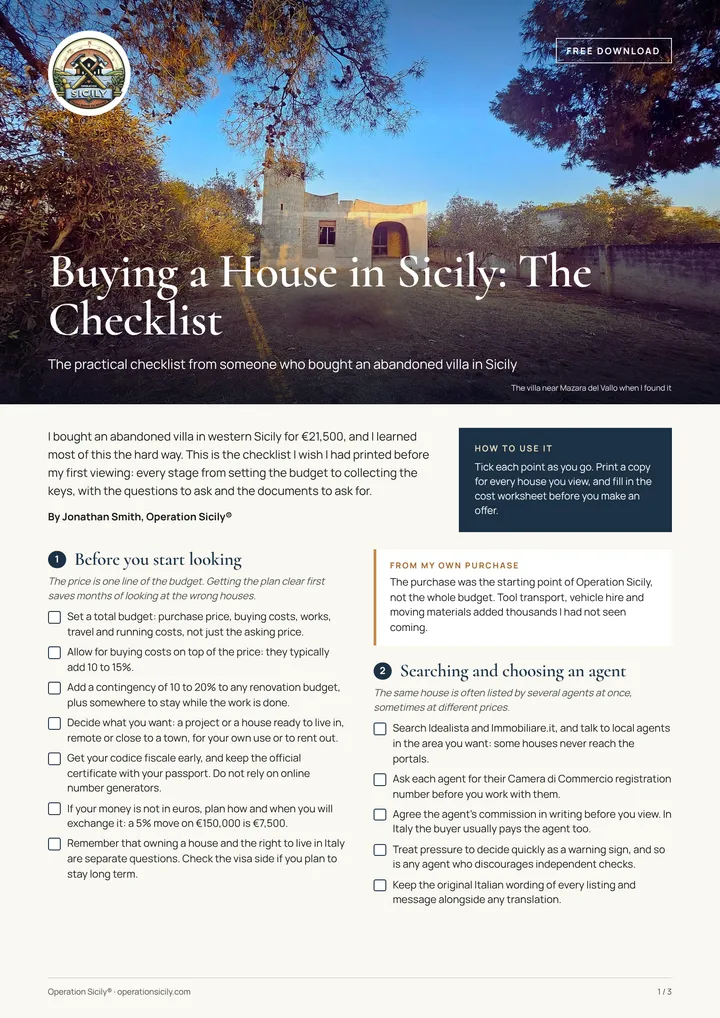
Free download
Buying a house in Sicily? Take my checklist.
Every step from budget to keys, the questions to ask at a viewing and the documents to ask for, as a PDF you can print.
Here is your checklist. Download the checklist (PDF)
After you arrive: the residence permit and registering
The visa gets you in; the permit lets you stay. Within 8 working days of arriving you apply for a permesso di soggiorno, the residence permit, through the yellow postal kit (kit postale) handed in at a post office, and the police headquarters (Questura) deals with it from there. My guide to the permesso di soggiorno in Sicily covers the kit, the fees, the receipt and renewal. San Francisco notes that the Questura checks each year that you still qualify when the permit is renewed.
With the permit, or the receipt for your application, you register as a resident with your town hall, which opens the door to an Italian ID card and, on this visa, voluntary enrolment in the national health service for a yearly fee with a minimum of €2,000. My guide to registering residency in Sicily walks through the town hall side, and my cost of living in Sicily vs the US page puts the health service fee and other bills in dollars.
Taxes and the 7% scheme: ask a professional
Moving your residence to Italy changes your tax position. You will also read about an Italian scheme with a 7% rate for pensioners moving from abroad to small towns in the south, including Sicily. Whether any of it applies to you depends on your own income and history, and I do not give tax advice. Speak to a professional who works with both US and Italian tax before you move, not after.
My guide to retiring to Sicily covers the rest of the move: healthcare, costs and what daily life is like.
Frequently asked questions
How much income do you need for an elective residence visa in Italy?
There is no single published figure. For family applications, the New York consulate says each applicant typically needs around €31,000, about $34,000 at $1.10 to the euro. The income must be stable, in your own name, and not from work: Social Security, pensions, annuities, rental or investment income. Each consulate decides, so check yours.
Does Social Security count for the elective residence visa?
It can. The New York consulate asks for substantial, steady income from private sources such as a pension or annuity, property or a stable business, and lists letters from US Social Security among the papers to provide. The money must be in your own name and cannot come from any form of employment. Each consulate decides what is enough, so check yours.
Can Americans retire in Italy?
Yes. Most Americans who retire to Italy without Italian citizenship use the elective residence visa, applied for in person at the Italian consulate covering their state. You need stable passive income, a home in Italy, health insurance and the documents on your consulate’s list.
Can I work remotely on an elective residence visa?
Do not plan on it. New York says the visa allows no work activities in Italy and that the income must not come from any form of employment. Italy has a separate digital nomad visa for remote workers.
Do I need to buy a house before applying for the elective residence visa?
You need a home in Italy, but it can be rented. Consulates ask for a lease or purchase deed in your name registered with the Italian tax agency, and San Francisco wants a lease of at least 365 days. Hotels and short vacation rentals do not count.
How long does the Italian elective residence visa take to process?
Up to 90 days from your appointment, according to the Los Angeles and San Francisco consulates. Los Angeles suggests applying about 90 days before you leave and offers no rush service.
Do I need an FBI background check for the Italian elective residence visa?
The San Francisco consulate requires an FBI Identity History Summary issued within the last six months. Other US consulates may not list one, so read your own consulate’s checklist.
How long is the elective residence visa valid?
San Francisco issues it for 365 days. In Italy you live on the residence permit, which you apply for within 8 working days of arriving and renew while you still meet the conditions.
Can my spouse and children come with me?
Yes. A spouse, minor children and dependent adult children can be included as family members. The New York consulate says each applicant must show sufficient resources, typically around €31,000 per person.
Sources and small print
- Consulate General of Italy in New York: elective residency
- Consulate General of Italy in Los Angeles: elective residency visa
- Consulate General of Italy in Chicago: elective residence visa
- Consulate General of Italy in San Francisco: elective residency checklist (PDF)
- Embassy of Italy in Washington: the consular network
- Interministerial decree 850 of 11 May 2011, annex A (the legal definition of the visa)
- Italian Ministry of Foreign Affairs: Visto per l'Italia
- Integrazione Migranti: voluntary health service enrolment from 2024
Consulates change their checklists and fees. Treat this page as a guide to what to expect, and your own consulate's current list as the rule.
Credits
Photo: Alexandra Smielova, Unsplash Licence, via Unsplash.
 The weekly YouTube series