
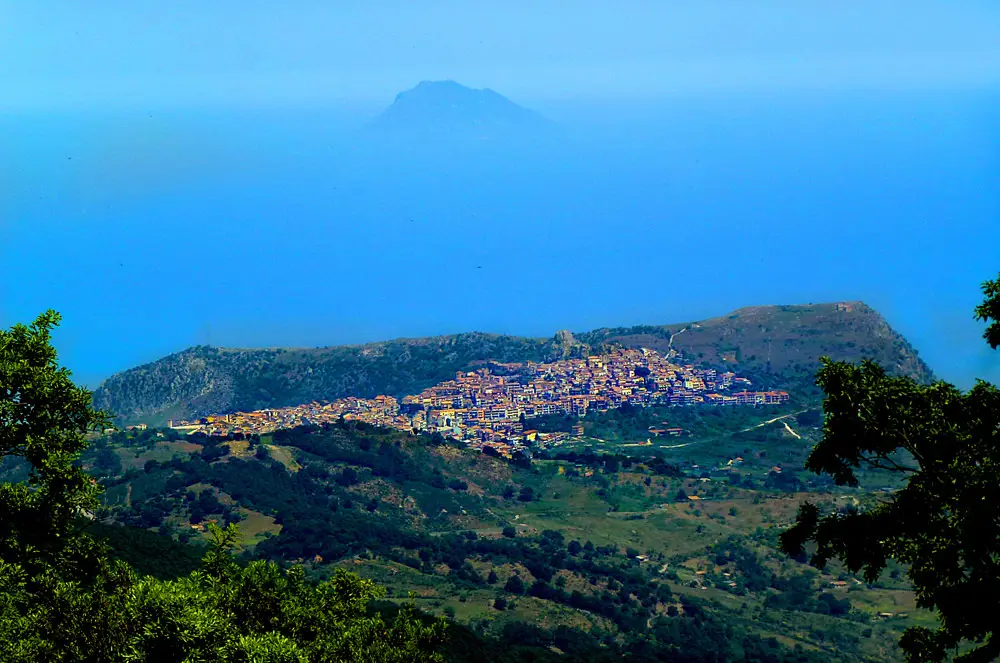
About San Fratello
The comune runs from about 300 metres almost to the summit of Monte Soro, through olive groves, small vineyards and the great woods of the Nebrodi Park, home to foxes, wildcats, porcupines and martens. On the open pastures graze cattle, sheep and the San Fratello horses, a sturdy breed that lives semi-wild; some say the Normans brought them as warhorses, others that they are native to Sicily.
The town lost its oldest quarters to landslides and much of its population moved to Acquedolci on the coast. What remains is a tight town of churches, among them the Madonna delle Grazie and San Benedetto il Moro, the fifteenth-century Palazzo Mammana and the ruins of the twelfth-century castle of San Filadelfio.
Living in San Fratello
With almost no tourist beds, San Fratello is a resident town, and its population has been falling for a century, from over ten thousand in 1921. The 2010 landslide forced many families out, often to Acquedolci, which now has the station and the supermarkets; Sant'Agata di Militello is the main service town nearby.
The upsides are strong community life, mountain air and woods all around. The downsides are serious: a significant share of the town lies in landslide-risk areas, winters are cold and wet, and work is scarce. Anyone buying here should commission a proper survey.
A short history
On Monte San Fratello, at 710 metres, some scholars place the acropolis of the Greek town of Apollonia. The Roman and medieval town was destroyed in the Arab invasion, and the present town was founded or refounded under the Normans by settlers from Piedmont, Liguria and Lombardy who came with Count Roger and his wife Adelasia del Vasto. Their dialect, San Frareau, is still spoken; linguists trace it to an area between the provinces of Cuneo, Asti and Savona.
The name comes from San Filadelfo, one of three martyr brothers, Alfio, Filadelfo and Cirino, honoured at the twelfth-century sanctuary of the Tre Santi; Filadelfo means one who loves his brother, and it became San Fratello. Saint Benedict the Moor grew up here and joined a Franciscan hermitage.
A landslide in 1745 damaged part of the town; a much worse one on the night of 7 to 8 January 1922 destroyed most of the old centre, and many people were moved to the coast at Acquedolci. On 14 February 2010 another great landslide struck the north-eastern side, forcing much of the population from their homes.
Food, festivals and traditions
San Fratello cooking is Nebrodi food: cheeses, black pig pork, mushrooms and wild fruits, with olive oil from the lower slopes. The town is also known for its traditional knives.
The Festa dei Giudei, from Wednesday to Good Friday of Holy Week, fills the streets with masked figures in elaborate nineteenth-century costumes blowing trumpets and bursting into the solemn processions. Its name comes from an old tradition that cast the Jews as the villains of the Passion; today it is a riotous folk festival that draws plenty of visitors. The Tre Santi are celebrated on 10 May, and Saint Benedict the Moor is the patron.
Interesting facts about San Fratello
- San Fratello's Gallo-Italic dialect traces back to Norman-era settlers from Piedmont and Liguria.
- The town had over ten thousand inhabitants in 1921, before the great landslide of 1922.
- The San Fratello horse is a hardy breed that lives semi-wild in the Nebrodi woods.
- The name San Fratello is a corruption of San Filadelfo, a saint whose name means one who loves his brother.
- Saint Benedict the Moor grew up in San Fratello.
House prices in San Fratello
€593average price per m² to buy
€1.65average rent per m² a month
€59,000a 100 m² home at that price
These are the official averages from the Agenzia delle Entrate's property market observatory (OMI) for homes in normal condition across the town's price zone. Prices in San Fratello are close to the typical town in Messina province (€644 per m²) and close to the typical Sicilian town (€593 per m²).
Why these figures can look low: they come from the values on real sales, which sit below advertised asking prices, and the typical Sicilian town is the middle of all 391 comuni, most of them small inland towns. Island-wide averages quoted on property portals, around €1,100 to €1,300 per m², lean towards the cities and the coast, where most homes are listed. Rents work the same way: listings usually ask well above the official rent figure, often double or more.
Houses that need work, which is most of the cheap ones you see advertised, sell well below these figures. The renovation comes on top, so budget for both.
Work out the return on a let with the rental yield calculator, or see the steps from offer to keys in the buying timeline planner.
Getting there and getting around
| From the centre to | By car | Distance |
|---|---|---|
| Catania Fontanarossa airport (CTA) | 1 hour 55 minutes | 105 km |
| Palermo Falcone Borsellino airport (PMO) | 2 hours 16 minutes | 166 km |
| Trapani Birgi airport (TPS) | 3 hours 14 minutes | 245 km |
| Comiso airport (CIY) | 3 hours 14 minutes | 186 km |
| Palermo city centre | 1 hour 47 minutes | 135 km |
| Catania city centre | 1 hour 47 minutes | 99 km |
| Messina, for ferries to the mainland | 1 hour 32 minutes | 113 km |
| Nearest railway station (Acquedolci -San Fratello) | 16 minutes | 9 km |
Times are by road on a clear day, worked out from OpenStreetMap. Allow longer in summer and on market days. Most people living in San Fratello rely on a car; buses link the bigger towns but are infrequent on Sundays and in August.
Planning flights and trips? See the Schengen 90/180 calculator if you are from outside the EU.
Everyday life: shops, health and schools
- Hospital with A&E
- Ospedale di Sant'Agata di Militello, about 17 minutes by car
- Pharmacies in the comune
- 2
- Supermarkets
- Not fully mapped yet
- Schools
- State: 2 nursery schools, 1 primary school, 1 middle school
- Banks and cash machines
- Not fully mapped yet
- Cafés and bars
- 4
- Restaurants
- 3
- Full fibre broadband
- 92.3% of addresses
Pharmacies and schools come from the official Ministry of Health and Ministry of Education lists. The other counts are of places mapped in OpenStreetMap inside the comune's boundary, so a small shop or a doctor's surgery can be missing. “Not fully mapped yet” means the volunteer map clearly has gaps here, not that the town has none. For a family doctor (medico di base, what the British call a GP), you register with the local health authority (ASP Messina) once you are resident.
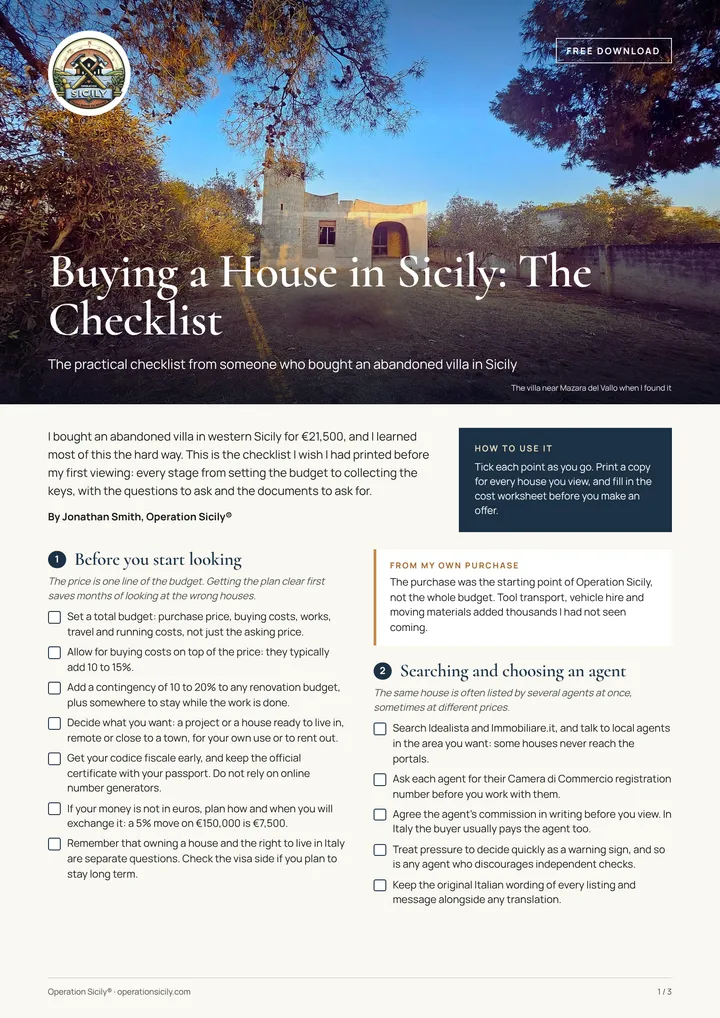
Free download
Buying a house in Sicily? Take my checklist.
Every step from budget to keys, the questions to ask at a viewing and the documents to ask for, as a PDF you can print.
Here is your checklist. Download the checklist (PDF)
Weather and climate in San Fratello
28.2°Caverage July high
3.7°Caverage January low
758 mmrain a year, on about 113 days
12days a year above 30°C
| Month | Average temperature | Rain |
|---|---|---|
| January | 7°C | 98 mm |
| February | 7°C | 85 mm |
| March | 9°C | 78 mm |
| April | 12°C | 56 mm |
| May | 16°C | 26 mm |
| June | 20°C | 23 mm |
| July | 23°C | 11 mm |
| August | 24°C | 17 mm |
| September | 20°C | 68 mm |
| October | 17°C | 95 mm |
| November | 13°C | 101 mm |
| December | 9°C | 101 mm |
Averages for 2015 to 2024. At 675 metres, San Fratello is cooler than the coast. Winter nights are cold, with frost and some snow on the higher ground, so plan on heating from November to March. Summers are warm rather than scorching, which is why Sicilians head for the hills in August.
See what each month brings in Sicily month by month, or size a solar system with the off-grid solar calculator.
Who lives there
- Population
- 3,199
- Change since 2019
- -8.9%
- Median age
- 48
- Foreign residents
- 21 (0.7%)
Registered residents from abroad include 1 British, 1 American, 1 German and 13 Romanian citizens.
San Fratello lives mainly for its own residents rather than for visitors, with only about 6 tourist beds, so everyday life changes little between summer and winter.
Beaches near San Fratello
- Sant'Agata di Militello Beach Sant'Agata di Militello, 8 km, sand and pebbles, water good
- Capo d'Orlando Beach Capo d'Orlando, 20 km, sand and pebbles, water good
- San Gregorio Beach Capo d'Orlando, 22 km, sand and pebbles, water excellent
- Testa di Monaco Beach Capo d'Orlando, 23 km, sand and pebbles, water excellent
Things to see and do in and around San Fratello
Visit the sanctuary of the Tre Santi above the town and the ruins of the Norman castle, then head into the Nebrodi woods along the SS289, where you are likely to meet the San Fratello horses. Monte Soro, at 1,847 metres, is the highest point of the Nebrodi, and the woods are rich in mushrooms in autumn.
The coast at Acquedolci and Sant'Agata di Militello is below, and the Nebrodi villages of Alcara li Fusi and Cesarò are within reach.
- Monte Soro
- Apollonia
- Monte San Fratello
- Santuario dei Tre Santi
The quickest beach to reach by car, Chiappe, is about 24 minutes away.
Famous people born in San Fratello include Benedict the Moor (Italian-born African Franciscan friar in Sicily).
Earthquake, landslide and flood risk
San Fratello is in seismic zone 2, the second highest of Italy’s four seismic zones. The zone sets the anti-seismic standard for any new building, extension or structural renovation, which affects both the design and the cost. A structural survey is worth paying for before you buy any older building, stone house or flat.
14.7% of the comune's land is mapped by ISPRA as high or very high landslide hazard, where 16.8% of residents live, and no medium-probability flood areas are mapped. Ask for the hazard maps (PAI) for any house you are considering; the comune's technical office or your geometra can check them.
Check what you can build or change with the building permit checker, and keep a margin with the renovation contingency calculator.
The comune: useful details
- Official name
- Comune di San Fratello
- Province
- Messina (Città metropolitana di Messina)
- Postcode (CAP)
- 98075
- Dialling code
- 0941
- Area
- 67 km²
- Height above sea level
- 675 m
- ISTAT code
- 083078
- Cadastral code
- H850 (used in the codice fiscale of people born here)
- Official website
- comune.sanfratello.me.it
Registering as a resident, paying local taxes and building permits all go through the comune. If you were born abroad, get your Italian tax code first with the codice fiscale calculator.
Nearby towns
San Fratello borders 5 other comuni:
- Acquedolci €893/m²
- Caronia €602/m²
- Cesarò €543/m²
- Militello Rosmarino €685/m²
- Sant'Agata di Militello €842/m²
Towns like San Fratello elsewhere in Sicily
- Calascibetta (Enna province)
- Monterosso Almo (Ragusa province)
- Nissoria (Enna province)
- Caltavuturo (Palermo province)
- Chiusa Sclafani (Palermo province)
- Valledolmo (Palermo province)
San Fratello on our lists
See every town in Messina province (108 comuni), or let Find your town suggest places that match what you want.
Frequently asked questions
Where is San Fratello in Sicily?
San Fratello is in the province of Messina, about 85 km west of Messina. The centre sits about 675 metres above sea level.
What is San Fratello known for?
San Fratello's Gallo-Italic dialect traces back to Norman-era settlers from Piedmont and Liguria. The town had over ten thousand inhabitants in 1921, before the great landslide of 1922. The San Fratello horse is a hardy breed that lives semi-wild in the Nebrodi woods.
Is San Fratello a good place to live?
It depends what you want. Best for lovers of mountains, horses and living traditions who want a real community with a character all its own, and who have checked their chosen house against the landslide maps. The nearest emergency department is about 17 minutes away, and homes average about €593 per m².
How much do houses cost in San Fratello?
Official figures from the Agenzia delle Entrate put homes in San Fratello at about €593 per square metre on average, so a 100 m² home in normal condition would be roughly €59,000. That is close to the typical town in the province (€644) and close to the typical Sicilian town (€593). Houses needing work sell for less, and the best homes for more.
What is the nearest airport to San Fratello?
Catania Fontanarossa airport is the nearest, about 1 hour 55 minutes away by car (105 km). Palermo Falcone Borsellino is about 2 hours 16 minutes away. Times are for a clear road and will be longer in summer traffic.
What is the weather like in San Fratello?
Summers are warm rather than scorching: July afternoons average about 28.2°C, with around 12 days a year above 30°C. Winter nights in January average about 3.7°C. Rain totals about 758 mm a year, falling mostly between October and March.
How many people live in San Fratello?
3,199 people live in the comune of San Fratello, according to ISTAT. The population fell by 8.9% between 2019 and 2025. Half the residents are older than 48.
Is there a hospital near San Fratello?
The nearest hospital with an emergency department (pronto soccorso) is Ospedale di Sant'Agata di Militello, about 17 minutes away by car. In an emergency anywhere in Italy, call 112.
Is San Fratello in an earthquake zone?
San Fratello is in seismic zone 2, the second highest of Italy’s four seismic zones. New building and structural work anywhere in Italy must follow anti-seismic rules, and the zone sets how strict they are, so ask your geometra or engineer to check any house you plan to buy or renovate.
Does San Fratello count for the 7% flat tax for pensioners?
On population, yes: San Fratello is a Sicilian town under the 30,000 resident limit for Italy's 7% flat tax for foreign pensioners. The other conditions are about you, not the town. Check the details with our 7% flat tax town checker and a qualified adviser.
Does San Fratello have fast internet?
Yes, for most homes: about 92.3% of addresses in San Fratello can get full fibre (FTTH), according to the communications regulator AGCOM. Check the exact address before you buy.
Credits
Photo: Armando Domenico Ferrari (thank's for 1.000.000) from Brescia, Italia, CC BY 2.0, via Wikimedia Commons.
Figures: ISTAT, Agenzia delle Entrate (OMI), Copernicus ERA5-Land, AGCOM, Dipartimento della Protezione Civile, ISPRA, Ministero della Salute, Ministero dell'Istruzione e del Merito, IndicePA, Open-Meteo, NASA POWER, Wikidata and © OpenStreetMap contributors, with several series gathered by the expatliving-data open data collection. Map boundaries ISTAT via openpolis (CC BY 4.0). Sicily as a whole: 4,787,390 people in 391 comuni.
 The weekly YouTube series